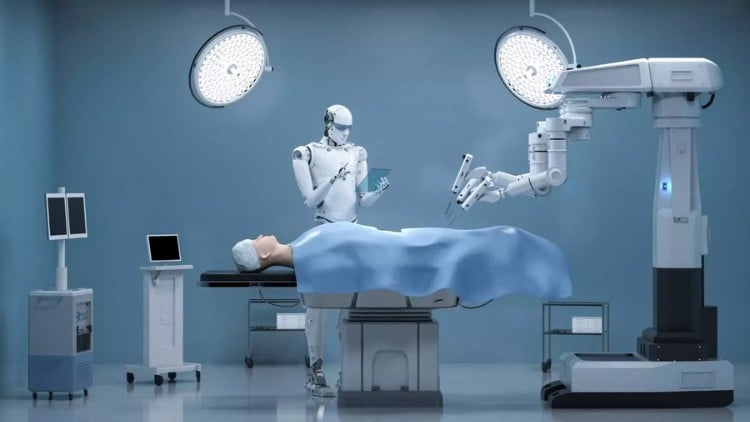
Unlock the Future of Healthcare with Advanced Skills and Expertise
⏱️ Length: 4.8 total hours
⭐ 4.23/5 rating
👥 10,652 students
🔄 September 2023 update
Add-On Information:
Note➛ Make sure your 𝐔𝐝𝐞𝐦𝐲 cart has only this course you're going to enroll it now, Remove all other courses from the 𝐔𝐝𝐞𝐦𝐲 cart before Enrolling!
- Course Title: Medical Robotics Course
- Course Caption: Unlock the Future of Healthcare with Advanced Skills and Expertise
- Course Length: 4.8 total hours
- Rating: 4.23/5 from 10,652 students (September 2023 update)
-
Course Overview
- This intensive, concise course provides a foundational yet impactful exploration into the dynamic field of medical robotics, emphasizing its interdisciplinary nature and profound influence on modern healthcare practices.
- Delve into the core principles of robotic systems as applied within medical contexts, ranging from surgical assistance to rehabilitation and diagnostics.
- Understand the convergence of engineering, computer science, and medicine, equipping you with a holistic perspective on automated solutions in clinical settings.
- Explore the ethical considerations, regulatory landscape, and safety standards paramount to the successful deployment and operation of robotic technologies in patient-facing environments.
- Gain insight into the current state-of-the-art and future trajectories of medical robotics, positioning yourself at the forefront of this rapidly evolving sector.
-
Requirements / Prerequisites
- A foundational understanding of engineering principles, computer science concepts, or biomedical sciences is highly recommended to maximize learning outcomes.
- Familiarity with basic programming logic or mathematical concepts related to kinematics (vectors, matrices) will be beneficial, though not strictly required.
- Curiosity for technological innovation and a strong interest in its application within healthcare are essential for engaging with the course material.
- No prior specialized experience in robotics or advanced medical training is necessary, making it accessible for motivated individuals from various technical backgrounds.
-
Skills Covered / Tools Used
- Robotics Fundamentals: Learn about robotic architectures, classifications (e.g., serial vs. parallel manipulators), and the distinct characteristics of medical-grade robots.
- Kinematics & Dynamics (Conceptual): Grasp the conceptual basics of how robots move, position, and interact within a workspace, crucial for understanding control.
- Control System Principles: Understand the fundamental feedback mechanisms and control loops that enable precise and safe robotic movements in medical applications.
- Sensing & Perception: Explore various sensor technologies (e.g., force sensors, vision systems, haptic feedback) vital for real-time data acquisition and decision-making in medical robots.
- Human-Robot Interaction (HRI): Investigate the design principles and safety considerations for effective and intuitive collaboration between medical professionals and robotic systems.
- Imaging Integration: Understand how medical imaging modalities (e.g., MRI, CT, ultrasound) are integrated with robotic systems for navigation, guidance, and augmented reality in procedures.
- Safety & Regulatory Compliance: Learn about the critical safety standards (e.g., ISO 13482, IEC 60601) and regulatory pathways (e.g., FDA, CE marking) for medical devices, ensuring responsible development and deployment.
- Software Environments (Conceptual): Exposure to the types of software platforms and programming paradigms (e.g., C++, Python, ROS – Robotics Operating System) commonly used for medical robot development and simulation.
- Hardware Components: Familiarization with key robotic hardware elements, including actuators, transmissions, end-effectors, and their specific requirements for medical precision and sterility.
-
Benefits / Outcomes
- Enhanced Career Prospects: Position yourself for diverse roles in a rapidly expanding sector, including R&D, product development, technical support, and clinical application specializations in medical robotics companies or research institutions.
- Foundation for Advanced Learning: Establish a robust conceptual framework that serves as an excellent springboard for pursuing further specialized education or advanced certifications in medical robotics and related fields.
- Informed Decision-Making: Develop the ability to critically evaluate, select, and integrate appropriate robotic solutions for specific medical challenges, understanding their limitations and potential.
- Interdisciplinary Competence: Bridge the gap between engineering and clinical practice, fostering effective communication and collaboration with both technical teams and healthcare professionals.
- Contribution to Innovation: Acquire insights into emerging trends and challenges, empowering you to contribute to the next generation of healthcare technologies and patient care improvements.
- Professional Portfolio Enhancement: Add a valuable, in-demand skill set to your professional profile, demonstrating a commitment to cutting-edge technology in healthcare.
-
PROS
- Time-Efficient Learning: The concise 4.8-hour duration makes it ideal for busy professionals or students seeking a quick yet comprehensive introduction to a complex field.
- High Student Engagement: Over 10,000 students signify the course’s popularity and relevance, potentially indicating a vibrant learning community and well-vetted content.
- Strong User Satisfaction: A 4.23/5 rating reflects positive feedback and suggests high quality in instruction and material.
- Up-to-Date Content: The September 2023 update ensures that the course material is current with the latest advancements and industry practices in medical robotics.
- Niche Specialization: Provides focused expertise in a highly specialized, in-demand area within both technology and healthcare.
-
CONS
- Limited Depth for Advanced Topics: Given its short duration, the course may provide conceptual overviews rather than in-depth practical application or exhaustive technical detail on highly complex sub-topics.
Learning Tracks: English,Teaching & Academics,Other Teaching & Academics