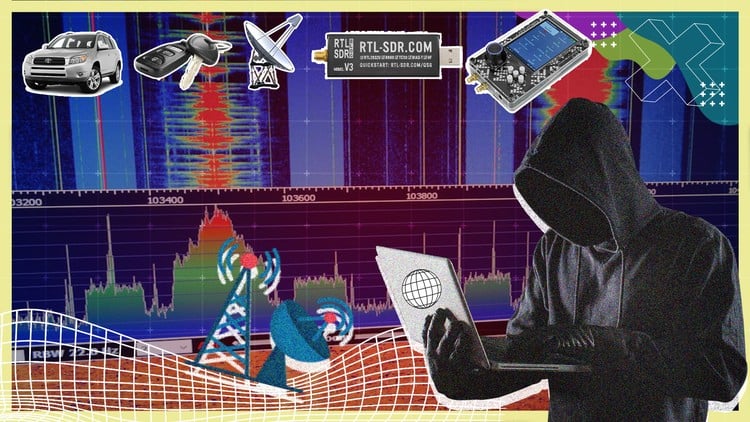
Learn Software Defined Radio (SDR) basics, GNU Radio, AM receivers, filters, and real SDR hardware, HackRF, RTL-SDR-2025
⏱️ Length: 8.1 total hours
⭐ 4.55/5 rating
👥 14,457 students
🔄 August 2025 update
Add-On Information:
Note➛ Make sure your 𝐔𝐝𝐞𝐦𝐲 cart has only this course you're going to enroll it now, Remove all other courses from the 𝐔𝐝𝐞𝐦𝐲 cart before Enrolling!
-
Course Overview
- Discover the profound paradigm shift that Software Defined Radio (SDR) brings to the world of telecommunications, transforming fixed hardware into flexible, programmable software.
- Explore the revolutionary potential of decoupling radio functionalities from dedicated circuits, allowing for unprecedented versatility and rapid innovation in wireless communication.
- Gain a comprehensive understanding of how modern computing power and specialized software like GNU Radio empower you to design, analyze, and manipulate radio signals on your desktop.
- Unravel the architectural advantages of SDR, enabling engineers, hobbyists, and researchers to experiment with complex signal processing chains without the need for expensive, specialized hardware setups.
- Embark on a hands-on journey to bridge the gap between abstract electromagnetic theory and tangible, real-time radio operations, witnessing signals come alive through visualizers and practical applications.
- Understand the open-source ethos driving much of the SDR ecosystem, fostering a community of developers and enthusiasts constantly pushing the boundaries of what’s possible in RF.
- Grasp the synergy between powerful processing software and versatile, cost-effective hardware platforms such as the RTL-SDR and HackRF.
- Learn to visualize and interpret the invisible world of radio frequencies, gaining insights into signal propagation, interference, and the intricate dance of wireless data.
- Position yourself at the forefront of wireless technology, equipped with the knowledge to explore everything from amateur radio to advanced signal intelligence concepts.
-
Requirements / Prerequisites
- Operating System Familiarity: Basic comfort level with navigating and installing software on a Windows, macOS, or Linux operating system.
- Curiosity for Wireless Technology: A keen interest in understanding how radio communication works and a desire to experiment with electromagnetic waves.
- Fundamental Computer Skills: Ability to manage files, download applications, and perform basic command-line operations (especially beneficial for Linux users).
- Optional Hardware for Full Experience: While not strictly mandatory for initial concepts, owning an RTL-SDR dongle is highly recommended for hands-on signal reception and analysis.
- Optional Advanced Hardware: For exploring signal transmission and more complex full-duplex experiments, a HackRF One or similar transceiver can significantly enhance your learning, though it’s not required to start.
- Stable Internet Access: Essential for downloading large software packages (like GNU Radio) and accessing course materials.
- Sufficient Disk Space: Approximately 20-30 GB of free hard drive space is advisable for installing the various SDR software suites and storing recorded signal data.
- Basic Math Aptitude: A foundational understanding of algebra will be helpful when conceptualizing signal transformations, though key mathematical principles will be explained.
-
Skills Covered / Tools Used
- Advanced Signal Visualization: Master the use of sophisticated spectrum analyzers, waterfall displays, and time-domain oscilloscopes within SDR software to expertly interpret complex RF environments.
- Custom Flowgraph Design in GNU Radio: Develop proficiency in using GNU Radio Companion to architect and debug custom signal processing chains for diverse applications, from basic receivers to advanced analyzers.
- Practical Digital Signal Processing (DSP) Application: Apply core DSP concepts like filtering, sampling, and decimation in real-world scenarios to enhance signal quality and extract information.
- Real-time Spectrum Analysis with SDR++: Leverage the intuitive interface of SDR++ to scan, monitor, and log radio frequencies in real-time, gaining insights into live RF traffic and interference.
- Hardware Interfacing and Driver Management: Learn to confidently connect, configure, and troubleshoot various SDR devices (RTL-SDR, HackRF) with your computer, ensuring seamless operation across platforms.
- Design and Implementation of Digital Filters: Gain practical experience in conceptualizing and building various digital filters (e.g., low-pass, high-pass, band-pass) to isolate desired frequencies and mitigate noise.
- Understanding and Applying Frequency Translation: Explore techniques such as heterodyning and direct conversion, critical for shifting signals to baseband for efficient digital processing.
- Decoding Diverse Signal Types: Beyond AM, build foundational skills for identifying and preparing signals for demodulation, including basic FM, SSB, and an introduction to digital modes.
- Exploration of Radio Frequency Interference (RFI): Develop an understanding of how to identify, characterize, and potentially pinpoint sources of electromagnetic interference using your SDR setup.
- Introduction to RF Protocol Analysis: Lay the groundwork for analyzing unknown wireless signals by observing their unique characteristics in the frequency and time domains, a stepping stone to reverse engineering.
- Building Custom Signal Generators: Learn to configure and utilize SDR hardware like HackRF to generate arbitrary waveforms and test signals for experimentation and calibration.
-
Benefits / Outcomes
- Become an Empowered Radio Experimenter: Acquire the technical confidence and practical skills to conduct independent radio experiments, from basic listening to advanced signal analysis and generation.
- Build a Foundation for Advanced Wireless Careers: Establish a strong conceptual and practical base highly valued in fields such as telecommunications engineering, RF security, aerospace, IoT development, and broadcasting.
- Develop Advanced Problem-Solving Abilities: Cultivate a systematic approach to diagnosing and troubleshooting issues within complex wireless systems, using SDR as a powerful diagnostic and analytical tool.
- Contribute to the Open-Source SDR Community: Gain the necessary skills to understand, utilize, and potentially contribute to the vibrant and growing open-source SDR ecosystem, fostering collaborative innovation.
- Design Custom Radio Applications: Possess the capability to design and implement bespoke radio receivers, transmitters, or signal analyzers for niche applications, limited only by your imagination.
- Enhance RF Security Awareness: Develop an intuitive grasp of how wireless signals are transmitted, intercepted, and analyzed, providing a foundational understanding for cybersecurity and privacy in the RF domain.
- Bridge Theory with Practical Application: Successfully connect abstract concepts of digital signal processing and electromagnetic theory with tangible, real-time radio operations and visualizations.
- Future-Proof Your Technical Skills: Invest in learning a highly relevant and rapidly evolving technology that continues to redefine wireless communication, ensuring your expertise remains cutting-edge and in-demand.
- Unlock New Hobbyist Horizons: Expand your passions into areas like amateur radio, satellite tracking, weather balloon telemetry, or drone communication, leveraging your new SDR proficiency.
-
PROS
- Exceptional Student Satisfaction: Boasts a superb 4.55/5 rating from over 14,000 students, highlighting the course’s effectiveness and high educational value.
- Timely and Relevant Content: Recently updated in August 2025, ensuring that the material covers the latest tools, techniques, and best practices in the dynamic field of SDR.
- Strong Practical Emphasis: Focuses heavily on hands-on application, enabling learners to move beyond theoretical knowledge to real-world implementation with actual SDR hardware.
- Comprehensive Tool Coverage: Integrates both GNU Radio for powerful custom signal processing design and SDR++ for intuitive, real-time spectrum monitoring, offering a holistic learning experience.
- Accessible Entry Point: Designed to introduce complex SDR topics clearly and progressively, making the subject approachable for newcomers while providing depth for those seeking more advanced understanding.
- Manageable Length: At 8.1 total hours, the course offers a focused yet comprehensive learning path that balances depth with a reasonable time commitment.
-
CONS
- To fully engage with the practical, hardware-dependent aspects of the course, learners may incur additional costs for purchasing SDR devices like an RTL-SDR or HackRF, which are not included.
Learning Tracks: English,IT & Software,Network & Security