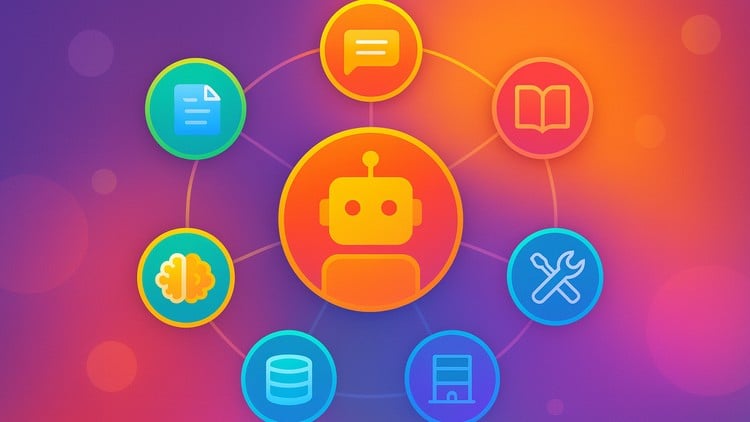
Learn how to design smarter, effective AI agents using the 6 essential context types: Instructions, Memory, Tools & more
⏱️ Length: 2.5 total hours
⭐ 4.14/5 rating
👥 16,345 students
🔄 August 2025 update
Add-On Information:
Note➛ Make sure your 𝐔𝐝𝐞𝐦𝐲 cart has only this course you're going to enroll it now, Remove all other courses from the 𝐔𝐝𝐞𝐦𝐲 cart before Enrolling!
-
Course Overview
- This course offers an advanced exploration into context design, the pivotal skill for architecting truly intelligent AI agents, transforming LLMs into proactive, goal-oriented entities.
- Move beyond basic prompt engineering to an architectural perspective, learning how structured informational environments endow AI agents with purpose and nuanced interpretation.
- Learn to orchestrate a rich tapestry of contextual elements, guiding agent behavior to align with objectives and minimize undesirable outputs like hallucinations.
- Discover the practical blueprint for constructing AI agents that are not just functional but genuinely intelligent and adaptive, fostering autonomy in complex workflows.
-
Requirements / Prerequisites
- A foundational understanding of Large Language Models (LLMs) and their basic operation, capabilities, and limitations. Familiarity with prompt engineering is beneficial.
- Basic programming proficiency, ideally in Python, as practical applications involve scripting and API interactions. Understanding code snippets enhances learning.
- An inquisitive mindset and genuine interest in pushing AI agent capabilities, particularly in developing autonomous, context-aware AI entities for complex tasks.
-
Skills Covered / Tools Used
- Strategic Context Orchestration: Develop expertise to synergistically combine diverse context types, moving beyond isolated prompts to architect holistic operational environments.
- Advanced Agent Behavior Modeling: Gain the ability to precisely define and elicit specific behavioral patterns from AI agents through nuanced contextual cues and ethical guidelines.
- Systematic Knowledge Integration: Master techniques for embedding authoritative knowledge bases directly into an agent’s context, ensuring factually grounded and domain-aware responses.
- Robust Memory System Architecture: Acquire skills to design and implement sophisticated short-term and long-term memory solutions for coherent conversations and adaptive behavior.
- External System Interoperability: Learn to equip AI agents to interact seamlessly with external APIs and tools, interpreting results for informed decision-making and complex workflows.
- Debugging and Contextual Refinement: Develop systematic approaches to analyze agent outputs and iteratively refine context design for enhanced accuracy, relevance, and reliability.
- Designing for Explainability and Control: Understand how well-structured context improves agent reasoning transparency and provides clearer control mechanisms for auditable operations.
- Optimizing Resource Utilization: Discover strategies for efficiently managing token consumption through precise and concise context design, ensuring economical yet intelligent agent operation.
-
Benefits / Outcomes
- Develop Highly Intelligent and Adaptable AI Agents: Engineer AI agents exhibiting advanced intelligence, learning, and adaptability in response to dynamic inputs and environments.
- Mastery of Complex Problem-Solving via AI: Gain expertise to break down intricate, multi-step problems into manageable, context-driven components for innovative AI solution development.
- Proficiency in Creating Self-Improving AI Systems: Architect agents that leverage memory and feedback loops for continuous learning and improved performance over time.
- Accelerated AI Solution Deployment: Equip yourself with a structured methodology for designing robust AI agents, significantly reducing development cycles and expediting market readiness.
- Enhanced Factual Accuracy and Reduced Hallucinations: Implement context strategies that ground AI agent responses in verifiable information, dramatically improving factual reliability.
- Career Advancement in Cutting-Edge AI Roles: Position yourself at the forefront of AI engineering, qualifying for specialized roles in agentic AI development and intelligent system architecture.
- Confidence in Architecting Production-Ready AI: Build the practical know-how to design and deploy scalable, robust AI agent solutions ready for real-world production environments.
-
PROS
- Highly Practical and Immediately Applicable: Provides actionable strategies directly transferable to real-world AI agent development projects, ensuring immediate value.
- Addresses a Critical Skill Gap: Focuses on context design, a sophisticated and often overlooked aspect, offering a distinct competitive edge in the rapidly evolving AI field.
- Structured and Comprehensive Approach: Offers a systematic framework for understanding and implementing various context types, making complex agent design principles accessible.
- Empowers Differentiated AI Solutions: Equips learners to build unique, high-performing AI agents that stand out in terms of intelligence, reliability, and advanced capability.
- Concise yet Impactful Learning: The course’s compact 2.5-hour duration allows for rapid skill acquisition without sacrificing depth, making it exceptionally time-efficient.
-
CONS
- Assumes Prior Foundational AI Knowledge: Best suited for individuals with a basic understanding of LLMs and prompt engineering, potentially posing a steeper learning curve for absolute beginners.
Learning Tracks: English,Development,Data Science