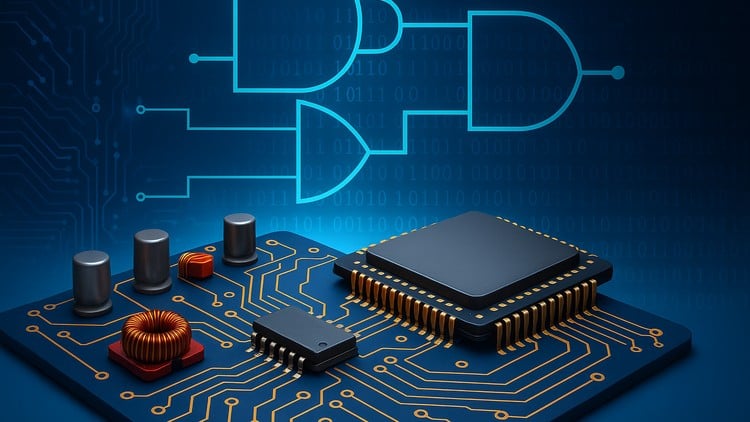
Master core computer science with electronics, C++, logic circuits & data structures—taught by real university professor
⏱️ Length: 14.4 total hours
⭐ 4.21/5 rating
👥 10,734 students
🔄 May 2025 update
Add-On Information:
Note➛ Make sure your 𝐔𝐝𝐞𝐦𝐲 cart has only this course you're going to enroll it now, Remove all other courses from the 𝐔𝐝𝐞𝐦𝐲 cart before Enrolling!
-
Course Overview
- Unravel the Digital Foundation: This course meticulously dissects the core mechanics of modern computing, revealing the intricate partnership between physical electronics and abstract software layers.
- Bridge the Hardware-Software Divide: Gain a profound understanding of how high-level programming commands translate into the fundamental electrical signals that govern processor operations.
- Holistic System Comprehension: Move beyond superficial programming to grasp the full lifecycle of data, from its binary representation to complex execution within a CPU’s architecture.
- Designed for Future Innovators: Crafted for computer science and engineering students aiming for deep system-level insights and a foundational mastery of digital technology.
- Expert Academic Guidance: Benefit from the structured curriculum and pedagogical approach of a seasoned university professor, ensuring a rigorous and comprehensive learning experience.
- Cutting-Edge Relevance: Updated for 2025+, the course incorporates contemporary insights into computer architecture and design principles, keeping your knowledge current.
- Demystify the Black Box: Transform your perception of computers from a mysterious device to a transparent, logical system, empowering you to truly innovate.
-
Requirements / Prerequisites
- Basic Programming Acumen: A conceptual familiarity with any high-level programming language (e.g., Python, Java) will provide a useful context for programming paradigms.
- Foundational Mathematical Logic: Comfort with elementary algebraic principles and problem-solving is advantageous, forming a basis for understanding Boolean operations.
- Eagerness to Explore: The most crucial prerequisite is a genuine curiosity about how computing devices operate at their most fundamental levels.
- Dedicated Learning Environment: Reliable access to a computer and stable internet connection is necessary for engaging with course materials and practical exercises.
- No Prior C++ Experience Assumed: This course builds C++ proficiency from the ground up, making advanced knowledge unnecessary.
- Zero Electronics Background Needed: Core electronics concepts are introduced comprehensively within the curriculum, requiring no prior specialized knowledge.
-
Skills Covered / Tools Used
- System Architectural Analysis: Develop the ability to critically analyze and understand the fundamental components and their interactions within a computer system.
- Low-Level Performance Optimization: Acquire techniques for identifying bottlenecks and optimizing code for maximum efficiency at the processor and memory level.
- Digital Circuit Design Principles: Practical application of logic design, moving from theoretical gates to functional digital components.
- C++ Development Workflow: Proficiency in utilizing modern C++ compilers and Integrated Development Environments (IDEs) for robust systems programming.
- Hardware-Software Interface Debugging: Gain expertise in diagnosing and resolving issues that arise at the boundary where software interacts with physical hardware.
- Memory Model Comprehension: Master the nuances of how memory is structured, accessed, and managed by both the hardware and the operating system.
- Abstract Data Type Implementation: Apply C++ features to effectively implement and manage complex data structures tailored for performance.
- Simulation and Emulation Familiarity: Basic interaction with tools that allow for the conceptual testing and visualization of logic circuits and low-level code execution.
- Problem-Solving with Resource Constraints: Learn to design solutions that effectively manage limited computational resources, a critical skill in embedded systems.
-
Benefits / Outcomes
- Robust Academic Foundation: Establish an unshakeable bedrock for advanced computer science topics, including Operating Systems, Compilers, Network Protocols, and specialized Computer Architecture.
- Enhanced C++ Engineering Prowess: Elevate your C++ skills beyond application-level programming to truly understand and manipulate system resources directly, opening doors to advanced software engineering.
- Informed Technical Decision-Making: Develop the insight to evaluate hardware and software trade-offs, leading to superior design choices in any computing project.
- Competitive Career Advantage: Stand out in the job market for roles requiring deep system comprehension, such as embedded systems development, high-performance computing, or firmware engineering.
- Confidence in Complex Systems: Gain the intellectual confidence to tackle daunting technical challenges, understanding the underlying mechanisms of complex software and hardware interactions.
- Integrative Computing Perspective: Cultivate a holistic view of computer systems, appreciating the synergy between electrical engineering principles and computer science abstractions.
- Practical Innovation Capability: Transition from merely using tools to understanding how to build and optimize them, fostering a mindset for true technological innovation.
- Prepared for Industry Standards: Equipped with fundamental knowledge that underpins many industry best practices for efficiency, reliability, and security in software and hardware.
-
PROS
- Expert University Instruction: Taught by an actual university professor, guaranteeing a curriculum that is both academically rigorous and highly practical.
- Proven Student Satisfaction: A high rating from over ten thousand students attests to the course’s quality, effectiveness, and positive learning experience.
- Timely & Relevant Content: The May 2025 update ensures the course material is current, reflecting the latest advancements and practices in computing.
- Comprehensive Skill Integration: Uniquely blends electronics fundamentals with C++, logic circuits, and data structures for a truly holistic understanding.
- Efficient Learning Curve: At 14.4 total hours, it’s designed to deliver maximum impact and core knowledge without excessive time commitment.
- Solid Foundation for Advancement: Provides critical groundwork essential for pursuing higher-level computer science and engineering specializations.
- Industry-Applicable Skills: The knowledge gained is directly applicable to real-world engineering challenges, enhancing employability and project success.
-
CONS
- Requires Dedicated Effort: The depth and interconnectedness of low-level computing concepts demand consistent engagement and self-study to fully master.
Learning Tracks: English,IT & Software,Other IT & Software