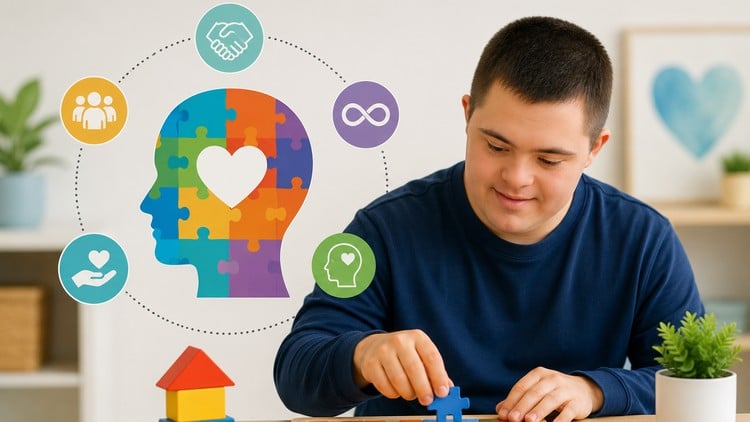
Master person-centred care for people with autism and learning disabilities.
What You Will Learn:
- Understand learning disability across the full spectrum — from mild to profound and multiple learning disabilities (PMLD)
- Recognise autism as a different way of experiencing the world — and support each person’s identity with dignity
- Communicate effectively with people who are non-speaking, semi-speaking, or use alternative methods
- Identify and respond to sensory needs and environmental stressors before they become crises
- Apply the social model of disability in everyday caregiving decisions
- Make and document reasonable adjustments under the Equality Act 2010
- Show more
Overview: Why This Course Hits Different
As someone who spends most of my day looking at logic gates and system architectures, you’d think a course on caregiving wouldn’t be on my radar. But here’s the reality: whether you’re debugging code or supporting a human being, the quality of your output depends entirely on how well you understand the operating system you’re working with. This course, Learning Disability and Autism Awareness in Caregiving, is essentially a deep-dive manual for the most complex “hardware” on the planet.
Most entry-level training in this space feels like a checkbox exercise—boring, clinical, and frankly, a bit patronizing. This one is different. It ditches the “medical model” (which treats disability like a bug that needs fixing) and pivots hard toward the social model of disability. It reframes the environment as the problem, not the person. For me, that’s a massive paradigm shift. It’s about building job-ready skills that actually matter when you’re in a room with someone who communicates through behavior rather than words. It’s not just about “awareness”; it’s about tactical, person-centered care that respects neurodivergence as a fundamental part of a person’s identity. If you’re looking for a professional certification that actually carries weight in a real-world setting, this is where the bar is set.
Prerequisites: What You Need in the Toolkit
One of the best things about this program is that it’s designed to take you from beginner to advanced without requiring a PhD in psychology. You don’t need prior medical training or a background in social work. However, you do need a high level of emotional intelligence and a willingness to unlearn some old-school biases.
In terms of “technical” requirements, if you can navigate a standard LMS and understand basic industry-standard tools for documentation, you’re good to go. This is a “boots on the ground” type of course. While it serves as excellent certification prep for higher-level health and social care NVQs, the only real prerequisite is a genuine desire to advocate for those who are often sidelined by the system. It’s perfect for upskilling if you’re already in a support role, or as a foundational block if you’re pivoting your career into healthcare.
Skills & Tools: Mastering the Craft
This isn’t just theory; it’s a toolkit for career growth. You’ll walk away with a solid grasp of Alternative and Augmentative Communication (AAC) methods. In the tech world, we talk about UI/UX; in caregiving, your “interface” is how you bridge the communication gap with non-speaking individuals. The course treats this like a real-world project, teaching you how to facilitate interaction without forcing a neurotypical standard on the client.
You’ll also master the Equality Act 2010 from a practical standpoint. Most people know the name of the act, but few know how to actually implement reasonable adjustments that hold up under legal and ethical scrutiny. You’ll learn how to identify sensory triggers—the “environmental stressors”—before they escalate into a crisis. This is basically high-level system monitoring for human environments. You’re learning to “patch” the environment to prevent a “system crash” (meltdown), which is an essential skill for any specialist support worker.
Career Benefits & Job Roles: The ROI of Empathy
Let’s talk about the career benefits. The demand for caregivers who actually *get* autism and PMLD (Profound and Multiple Learning Disabilities) is skyrocketing. We aren’t just talking about basic home care anymore. We’re talking about high-impact job roles like Specialist Support Advocate, Residential Care Manager, or SEN (Special Educational Needs) Consultant.
By completing this course, you’re putting yourself on a fast track for professional development. It serves as a fantastic bridge toward more advanced certification prep for RBT (Registered Behavior Technician) roles or specialized nursing. In a competitive job market, having “Autism and PMLD Awareness” on your resume isn’t just a “nice to have”—it’s a signal to employers that you possess job-ready skills that go beyond the basics. You become the person who can handle the complex cases that others shy away from. That’s where the real career growth happens.
The Pros
- Spectrum-Wide Depth: It doesn’t just focus on “high-functioning” autism. It goes deep into PMLD and profound disabilities, which is often ignored in cheaper, shorter courses.
- Social Model Focused: It empowers the caregiver to change the world around the individual, rather than trying to “fix” the individual. This is the industry-standard approach in modern advocacy.
- Communication Mastery: The sections on non-speaking communication are a masterclass in empathy and patience, providing hands-on labs-style scenarios for real-life application.
- Legal Clarity: It provides a no-nonsense breakdown of the Equality Act 2010, making sure you know your rights and the rights of those you care for.
The One Catch (The Cons)
If I’m being honest, the one area where this course could level up is in its hands-on labs for digital assistive technology. While it covers the concepts of alternative communication brilliantly, I would have loved to see more interactive tutorials on specific industry-standard tools like Proloquo2Go or other high-tech AAC apps. It’s a minor gripe, but for a tech-heavy professional, more “screen-time” with the actual tools of the trade would have been the icing on the cake.