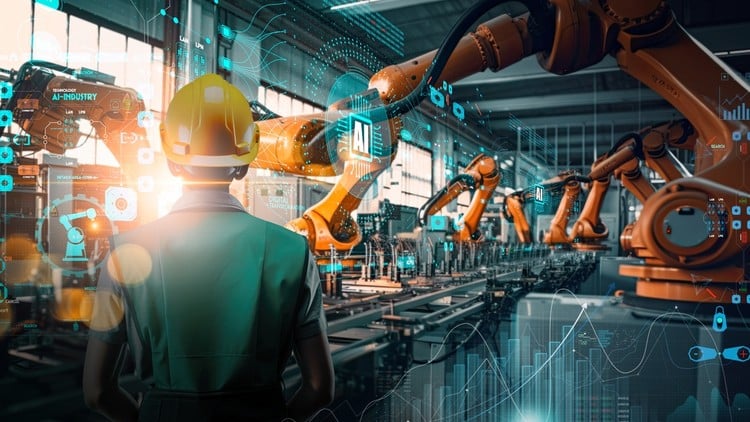
Industry 4.0 II Cutting-Edge Innovations for the Smart Factory
⏱️ Length: 3.5 total hours
⭐ 4.69/5 rating
👥 1,856 students
🔄 May 2025 update
Add-On Information:
Note➛ Make sure your 𝐔𝐝𝐞𝐦𝐲 cart has only this course you're going to enroll it now, Remove all other courses from the 𝐔𝐝𝐞𝐦𝐲 cart before Enrolling!
-
Course Overview
- Delve into the strategic imperatives and operational realities of the advanced manufacturing landscape, moving beyond foundational Industry 4.0 concepts to master their sophisticated integration. This course is designed to equip professionals with the foresight and skills necessary to navigate the complexities of modern industrial transformation.
- Explore the profound shift towards fully connected, data-driven production environments where every component communicates, enabling unprecedented levels of efficiency, responsiveness, and customization. Understand the architectural backbone supporting these smart factories and the revolutionary impact on traditional manufacturing paradigms.
- Understand how the convergence of diverse cutting-edge technologies creates resilient, adaptable, and highly intelligent manufacturing systems capable of responding dynamically to market demands and unforeseen disruptions. Position yourself at the forefront of this industrial evolution, understanding both the technical and business implications.
- This advanced module serves as a critical bridge, empowering learners to translate theoretical Industry 4.0 knowledge into tangible, impactful solutions for real-world manufacturing challenges. It focuses on the practical application and strategic deployment of advanced technologies to drive competitive advantage.
-
Requirements / Prerequisites
- A foundational understanding of core manufacturing principles, including common production processes, quality control methodologies, and basic supply chain dynamics, is highly recommended to maximize course engagement.
- Learners should possess a general familiarity with the overarching concepts of Industry 4.0, such as the Internet of Things (IoT), big data analytics, and cyber-physical systems, as this course builds upon these fundamental ideas.
- An analytical mindset and a keen interest in technological innovation are beneficial, enabling participants to critically assess new advancements and envision their practical applications within industrial settings.
- While no specific programming expertise or prior software certifications are strictly required, a basic grasp of logical thinking and system interactions will aid in comprehending the integration aspects of advanced technologies.
-
Skills Covered / Tools Used
- Digital Twin Development & Utilization: Gain proficiency in creating and leveraging virtual representations of physical assets, processes, and entire production lines for real-time monitoring, predictive modeling, and scenario planning. Learn to integrate various data sources to build accurate and actionable digital replicas.
- Industrial IoT (IIoT) Ecosystem Management: Develop expertise in designing, deploying, and managing interconnected sensor networks, edge computing devices, and cloud platforms specific to industrial environments. Understand data acquisition protocols and ensure seamless communication across diverse operational technologies.
- Predictive Analytics for Operational Excellence: Master the application of data science and machine learning techniques to manufacturing data. This includes identifying patterns to forecast equipment failures, optimize maintenance schedules, enhance product quality, and significantly reduce unplanned downtime.
- Cyber-Physical System (CPS) Orchestration: Learn how to integrate physical machinery with advanced computational capabilities and network connectivity to create intelligent, autonomous systems that can self-monitor, self-adapt, and collaborate effectively within a factory framework.
- Manufacturing Execution Systems (MES) Integration & Optimization: Understand how to strategically implement and refine MES solutions to achieve real-time visibility into production, manage work orders, track materials, control quality, and optimize resource allocation across the entire manufacturing floor.
- Advanced Simulation & Virtual Commissioning: Explore the use of sophisticated simulation software to virtually test and validate new factory layouts, process changes, or robot programming before physical implementation, significantly reducing risks and commissioning times.
- Supply Chain Digitization & Resilience: Examine how Industry 4.0 technologies facilitate end-to-end supply chain transparency, traceability, and agility. Learn to mitigate disruptions, optimize logistics, and enhance collaborative planning with suppliers and customers through digital platforms.
- Sustainable Manufacturing Principles: Investigate how advanced technologies, such as optimized resource allocation and intelligent energy management systems, contribute to more environmentally friendly and sustainable production processes, reducing waste and carbon footprint.
- Human-Machine Interface (HMI) & User Experience (UX) Design: Acquire knowledge in designing intuitive and effective HMI solutions that empower human operators to efficiently monitor, control, and interact with complex automated systems, ensuring safety and operational efficiency.
-
Benefits / Outcomes
- Accelerated Career Growth: Position yourself as a vital asset in any forward-thinking organization, equipped with the specialized knowledge and practical skills demanded by the rapidly evolving industrial sector.
- Enhanced Problem-Solving Capabilities: Develop a robust toolkit for analyzing complex manufacturing challenges and implementing innovative, data-driven solutions that significantly improve efficiency, quality, and cost-effectiveness.
- Drive Digital Transformation: Gain the confidence and expertise to lead initiatives in adopting cutting-edge technologies, fostering a culture of innovation and continuous improvement within your organization.
- Strategic Industry Insight: Acquire a holistic understanding of how advanced manufacturing technologies impact global business strategy, enabling you to make informed decisions regarding future investments, operational improvements, and market positioning.
- Future-Proof Skillset: Cultivate a highly relevant and adaptable skillset that remains valuable in an increasingly automated, interconnected, and competitive global manufacturing landscape, ensuring long-term professional relevance.
-
PROS
- Highly Relevant & Current: The course content is specifically updated for May 2025, ensuring learners receive the most up-to-date information and insights into rapidly evolving advanced manufacturing technologies.
- Exceptional Learner Satisfaction: Boasting a 4.69/5 rating from over 1,800 students, the course demonstrates high quality, effective instruction, and significant value to its participants.
- Concise & Impactful Learning: Designed for efficient knowledge transfer, the 3.5-hour duration allows busy professionals to quickly absorb critical advanced concepts without extensive time commitment.
- Practical Application Focus: Emphasizes real-world implementation strategies for advanced Industry 4.0 technologies, equipping students with actionable insights for immediate professional impact.
-
CONS
- Due to the comprehensive scope of “Advanced Manufacturing Technologies” within a 3.5-hour timeframe, some topics may be introduced at a high level, requiring participants to undertake additional self-study for deeper mastery.
Learning Tracks: English,Teaching & Academics,Engineering