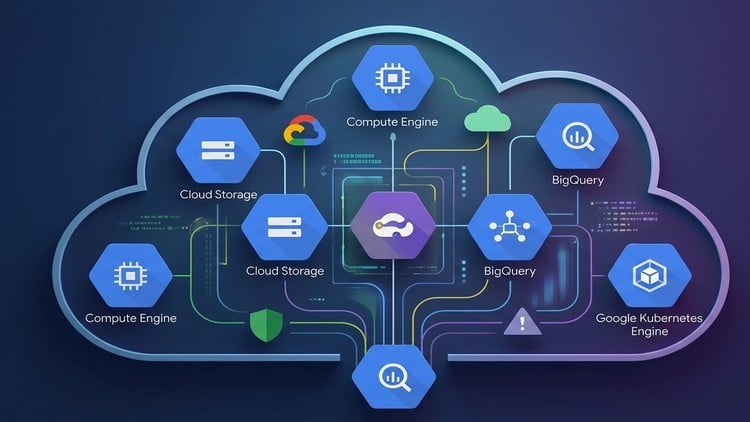
Realistic exam-level practice tests with detailed explanations for Google Cloud PCA 2026 prep.
What You Will Learn:
- Confidently answer PCA-style questions on GCP org design, IAM, networking, storage, and compute—aligned to the official exam domains.
- Choose the right GCP services for real-world scenarios, balancing cost, reliability, security, performance, and operations.
- Design secure, scalable architectures using VPCs, hybrid connectivity, IAM, KMS, and logging/monitoring best practices.
- Practice with timed mock tests and detailed explanations to identify weak areas and improve exam-taking strategy.
An Honest Look at Mastering the Google Cloud Architect Exam
Let’s be real for a second: the Google Cloud Professional Cloud Architect (PCA) exam has a reputation for being one of the most challenging certifications in the industry. It’s not just about knowing which button to click in the console; it’s about thinking like a CTO. I recently went through the Google Cloud Architect Practice Tests 2026, and honestly, it’s a breath of fresh air compared to the generic, outdated dumps you often find online. This isn’t just a certification prep tool; it’s a mental workout for anyone looking to build job-ready skills in a multi-cloud world.
What struck me most about this specific set of practice tests is how they handle the “gray areas.” In the real world, there’s rarely one “correct” answer—there’s the most cost-effective answer, the most secure answer, and the one that won’t break your performance goals. These tests force you to weigh those trade-offs. The 2026 version feels particularly relevant because it acknowledges the shift toward serverless architectures, AI-integrated infrastructure, and complex hybrid connectivity scenarios that are becoming industry-standard tools for modern enterprises.
Prerequisites for Success
Don’t jump into these tests if you’ve never touched the Google Cloud Platform (GCP). You need a solid foundation first. I’d recommend having at least six months of hands-on labs experience or having completed a beginner to advanced cloud engineer course. You should be comfortable with the command line (gcloud CLI) and understand basic networking concepts like CIDR blocks and firewall rules. If you’re coming from AWS or Azure, you’ll pick it up fast, but if you’re a total novice, these tests might feel like hitting a brick wall. This is a finishing school for architects, not an intro to the cloud.
Skills Developed and Tools Mastered
By grinding through these simulations, you’re effectively training your brain to navigate the GCP ecosystem with surgical precision. You’ll get deep into the weeds with:
- Resource Hierarchy: Designing GCP org designs that don’t become a nightmare to manage as the company grows.
- Security & Compliance: Implementing IAM roles with the principle of least privilege and managing encryption via KMS.
- Data Strategy: Choosing between BigQuery, Cloud Spanner, and Bigtable based on real-world scenarios of scale and latency.
- Operational Excellence: Using logging and monitoring suites to ensure your real-world projects don’t go dark during a traffic spike.
- Infrastructure as Code (IaC): While not a coding course, the logic here heavily aligns with how you’d structure Terraform or Deployment Manager scripts.
Career Benefits and Potential Job Roles
The ROI on a Professional Cloud Architect certification is massive. We’re talking about a credential that consistently sits at the top of salary surveys. By using these practice tests to ensure a pass, you’re positioning yourself for high-level career growth. Common roles for those who master this material include Solutions Architect, Cloud Security Engineer, and Site Reliability Engineer (SRE). Companies are desperate for people who can lead a cloud migration or design a secure, scalable architecture from scratch. Having this on your resume proves you aren’t just a technician—you’re a strategist.
The Pros: Why This Works
- Depth of Explanations: The “why” is more important than the “what.” Every question comes with a breakdown of why the correct answer wins and why the distractors are wrong. This is where the actual learning happens.
- Scenario-Based Logic: The questions mirror the actual PCA format, focusing on the official case studies. It forces you to synthesize information about VPCs, storage, and compute under pressure.
- Strategy Refinement: The timed mock tests are a reality check. They help you manage your pace so you don’t spend 20 minutes debating a single networking question and run out of time for the rest.
The Cons: One Honest Gripe
If I have one complaint, it’s that the difficulty curve is uncompromising. Some of the questions feel even harder than the actual exam. While that’s great for certification prep, it can be a bit of a localized ego-crusher if you’re scoring in the 60% range initially. Don’t let the intensity discourage you; it’s designed to expose your weak areas before the $200 exam fee is on the line.
In summary, if you’re serious about your career growth and want to move beyond basic administration into high-level design, these 2026 practice tests are an essential investment. They bridge the gap between “knowing the docs” and “knowing the job.”