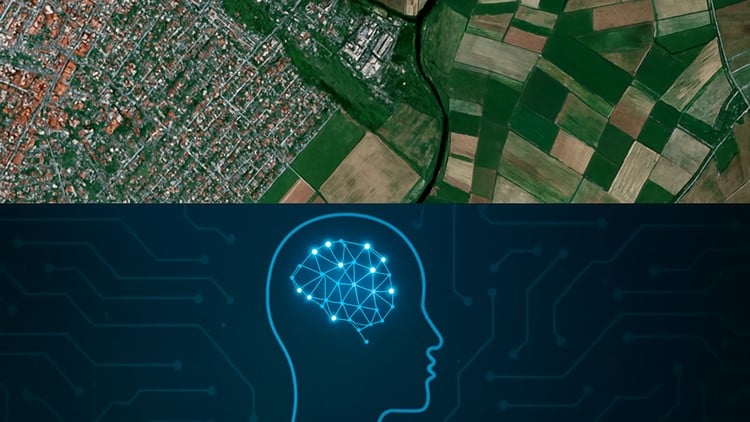
Build AI Models for Geospatial Data and Satellite Imagery
⏱️ Length: 4.6 total hours
⭐ 4.71/5 rating
👥 4,833 students
🔄 November 2025 update
Add-On Information:
Note➛ Make sure your 𝐔𝐝𝐞𝐦𝐲 cart has only this course you're going to enroll it now, Remove all other courses from the 𝐔𝐝𝐞𝐦𝐲 cart before Enrolling!
-
Course Overview:
- Embark on a dynamic journey into Geospatial AI, exploring the powerful convergence of Artificial Intelligence and Earth Observation. This course illuminates how deep learning, particularly through Convolutional Neural Networks (CNNs), is revolutionizing the analysis of vast satellite imagery datasets.
- Gain practical expertise in deciphering intricate patterns and extracting valuable intelligence from high-resolution satellite data. Understand how AI systems can enhance our understanding of terrestrial phenomena, from environmental monitoring to agricultural optimization.
- Dive into the full lifecycle of a Geospatial AI project, moving from foundational concepts to hands-on application. The curriculum emphasizes a project-based approach, building your confidence in applying sophisticated deep learning architectures to real-world geospatial challenges.
- Discover methodologies for transforming raw satellite observations into AI-ready structured datasets, paving the way for advanced predictive and classificatory models. This course highlights the unique suitability of deep learning for spatial and temporal data analysis.
- Position yourself at the forefront of innovation, understanding the profound impact of Geospatial AI across sectors like urban planning, disaster response, climate science, and sustainable resource management, driving data-driven decision-making.
-
Requirements / Prerequisites:
- A foundational understanding of Python programming (basic syntax, data structures, control flow) is essential for an optimal learning experience.
- Familiarity with fundamental machine learning concepts (e.g., supervised learning, features, model training/testing) will be beneficial. No prior deep learning experience is assumed.
- An eagerness to explore geospatial data and remote sensing principles is highly recommended to fully engage with the content.
- Reliable access to a computer with an active internet connection for utilizing cloud-based platforms and running Python environments.
- No prior experience with Google Earth Engine (GEE) or specific Deep Learning frameworks (like TensorFlow/Keras) is required, as these will be introduced.
-
Skills Covered / Tools Used:
- Cloud-Scale Geospatial Data Management: Master Google Earth Engine (GEE) for efficient access, manipulation, and analysis of massive satellite imagery archives.
- Advanced Pythonic Workflows: Enhance Python proficiency using libraries like NumPy for numerical operations, Pandas for data structuring, and Matplotlib/Seaborn for geospatial data visualization.
- Deep Learning Frameworks: Gain hands-on experience with popular deep learning libraries (e.g., TensorFlow/Keras) to construct and configure neural network architectures.
- Spatial Feature Engineering: Learn to design effective strategies for extracting relevant spatial, spectral, and temporal features from satellite imagery for AI models.
- Neural Network Architecture Design: Develop the ability to conceptualize and architect specialized Convolutional Neural Network (CNN) models optimized for interpreting patterns within satellite images.
- Model Interpretability & Validation: Explore techniques to understand model predictions and rigorously validate AI solutions for critical geospatial applications.
- Real-World Environmental Applications: Apply learned skills to practical scenarios such as land cover mapping, deforestation detection, and urban expansion analysis using AI.
-
Benefits / Outcomes:
- Build a Robust Geospatial AI Portfolio: Create practical projects demonstrating your deep learning skills with real-world satellite imagery, enhancing your professional profile.
- Gain In-Demand Interdisciplinary Expertise: Acquire a unique and highly sought-after skill set at the intersection of AI, remote sensing, and data science, opening diverse career pathways.
- Drive Data-Driven Decision Making: Contribute to solving global challenges by extracting actionable intelligence from satellite data, informing policies on climate, resource management, and sustainable development.
- Master End-to-End Deep Learning Workflows: Become proficient in the entire pipeline from raw satellite data acquisition and preprocessing to model development, training, evaluation, and deployment for geospatial applications.
- Innovate Custom Earth Observation Solutions: Develop the confidence to design and implement bespoke AI models for specific Earth observation problems, tailoring solutions to unique industry and research challenges.
- Unlock Career Advancement Opportunities: Position yourself for roles like Geospatial Data Scientist, AI Engineer (Geospatial), Remote Sensing Analyst, or GIS Developer.
- Critical Thinking in Spatial AI: Enhance problem-solving abilities by critically assessing geospatial datasets and interpreting model outputs within a spatial context.
-
PROS:
- Highly Relevant and In-Demand Skills: Combines AI and geospatial analysis, offering significant career prospects.
- Practical, Hands-On Learning: Strong emphasis on applying concepts through real-world examples and tools.
- Concise and Efficient Skill Acquisition: 4.6 hours for substantial knowledge, ideal for busy professionals.
- Excellent Student Satisfaction: 4.71/5 rating from 4,833 students signifies high quality and effectiveness.
- Up-to-Date Content: November 2025 update ensures current materials, tools, and best practices.
-
CONS:
- Limited Depth for Mastery: While comprehensive for its length, additional independent study and practice are needed for true mastery of complex challenges.
Learning Tracks: English,Development,Programming Languages