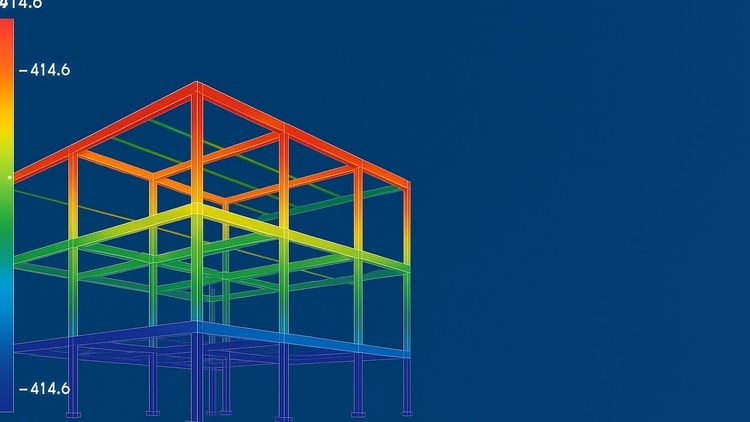
A Comprehensive Guide to Structural Analysis and Design
⏱️ Length: 2.6 total hours
⭐ 4.00/5 rating
👥 1,915 students
🔄 May 2025 update
Add-On Information:
Note➛ Make sure your 𝐔𝐝𝐞𝐦𝐲 cart has only this course you're going to enroll it now, Remove all other courses from the 𝐔𝐝𝐞𝐦𝐲 cart before Enrolling!
- Course Overview
- Offers an intensive introduction to Bentley STAAD.Pro CONNECT Edition, a premier software for comprehensive structural analysis and design.
- Master the advanced capabilities of this industry-leading tool to tackle complex structural challenges confidently.
- Gain proficiency in modeling diverse structural typologies, including industrial buildings, bridges, and specialized structures.
- Explore foundational principles behind structural engineering simulations and their practical software applications.
- Familiarize yourself with the CONNECT Edition’s collaborative features, crucial for modern project workflows.
- Understand material properties and section databases within STAAD.Pro, configuring them accurately for robust analysis.
- Learn about various analysis types: static, seismic, wind, and dynamic, and their effective application.
- Grasp design code implementation, ensuring compliance with international and local standards.
- Discover efficient methods for post-processing results, interpreting stresses, deflections, and internal forces.
- Prepare detailed engineering documentation, including design reports and quantity take-offs, essential for project execution.
- Requirements / Prerequisites
- Fundamental understanding of structural engineering principles: statics, strength of materials, and basic structural mechanics.
- Familiarity with structural elements like beams, columns, trusses, and slabs, and their behavior under load.
- Basic computer literacy and comfort navigating software interfaces.
- Access to Bentley STAAD.Pro CONNECT Edition software (student or commercial license) for hands-on practice.
- A strong desire to apply industry-standard structural analysis and design methodologies.
- Prior exposure to CAD or other engineering design tools is beneficial but not strictly required.
- A stable internet connection for accessing course materials.
- Skills Covered / Tools Used
- Mastering analytical model setup, including defining nodes, members, and plate elements with precision.
- Implementing advanced loading conditions such as moving loads, temperature, and response spectrum for seismic design.
- Utilizing integrated design modules for concrete, steel, timber, and aluminum, optimizing sections per design codes.
- Employing the physical modeling approach for intuitive, streamlined model creation and enhanced productivity.
- Leveraging STAAD.Pro’s robust meshing tools for plate and solid elements, crucial for detailed analysis of shear walls and slabs.
- Developing proficiency in advanced analysis techniques: P-Delta, buckling, and cable analysis.
- Generating comprehensive, customized output reports, including detailed design calculations and graphics.
- Interfacing with other Bentley or third-party software for data exchange and integrated project delivery.
- Applying best practices for model verification and validation, ensuring accuracy of simulation results.
- Utilizing the STAAD.Pro environment for collaborative design and efficient team communication.
- Benefits / Outcomes
- Confidently undertake complex structural engineering projects, from conceptual design to detailed analysis and reporting.
- Enhance career prospects by acquiring a highly sought-after skill in structural analysis and design, globally recognized.
- Optimize structural designs, leading to safer, more economical, and sustainable construction solutions.
- Develop a critical understanding of how loads and structural behaviors impact overall system performance.
- Accelerate design workflows, reducing manual errors and increasing efficiency in project delivery.
- Achieve deeper insight into various international building codes as applied within professional software.
- Become a proficient STAAD.Pro CONNECT Edition user, capable of troubleshooting modeling and analysis issues.
- Contribute effectively to multi-disciplinary engineering teams with clear structural insights.
- Position yourself as an expert in rigorous structural assessments and justified design recommendations.
- Unlock professional growth opportunities in civil construction, oil and gas, manufacturing, and infrastructure.
- PROS
- Provides a strong foundation in a leading, globally recognized industry software.
- Covers a wide range of analysis and design capabilities, versatile for diverse projects.
- Efficient course structure for learning, indicated by concise length and high rating.
- Offers practical skills immediately applicable to real-world structural engineering.
- ‘May 2025 update’ ensures up-to-date content and relevance to current software.
- Suitable for students and practicing engineers to expand software knowledge.
- CONS
- The relatively short duration (2.6 hours) might offer a high-level overview, requiring additional self-study for complete mastery of all advanced features.
Learning Tracks: English,Design,Other Design