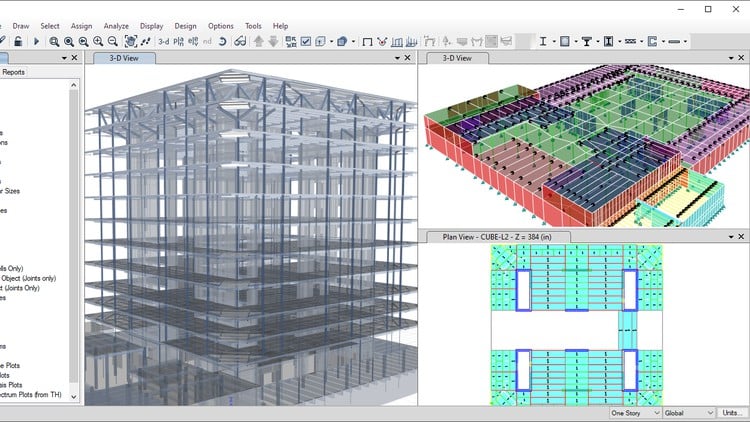
Structural Analysis and Structural Design of Residential Building in ETABS with Real World Project.
⏱️ Length: 5.4 total hours
⭐ 4.24/5 rating
👥 23,962 students
🔄 September 2024 update
Add-On Information:
Note➛ Make sure your 𝐔𝐝𝐞𝐦𝐲 cart has only this course you're going to enroll it now, Remove all other courses from the 𝐔𝐝𝐞𝐦𝐲 cart before Enrolling!
- Course Overview
- This comprehensive course is meticulously engineered to serve as your ultimate guide, transitioning learners from foundational understanding (“Zero”) to advanced proficiency (“Hero”) in structural analysis and design using ETABS, specifically tailored for residential building projects.
- Embark on a practical, project-centric learning adventure that demystifies the intricacies of structural behavior, focusing on real-world applications and industry best practices from the very first module.
- Gain profound insights into the conceptual framework behind structural modeling, understanding the synergistic relationship between architectural layouts, loading conditions, and the resultant structural response before initiating software interaction.
- Navigate the sophisticated environment of ETABS with confidence, mastering its extensive functionalities for creating robust structural models, applying various load types, and conducting rigorous analyses that inform safe and economical designs.
- Explore the nuanced integration of international design codes and standards within the ETABS workflow, ensuring that your structural solutions are compliant, resilient, and ready for professional implementation across diverse geographic locations.
- The unique bilingual delivery, offered in both Hindi and English, significantly broadens accessibility, allowing a wider demographic of aspiring and practicing engineers to fully grasp complex technical concepts without linguistic barriers.
- Understand the critical decision-making processes involved in material selection, section property definition, and the strategic placement of structural elements to achieve optimal performance and structural integrity.
- Requirements / Prerequisites
- A fundamental grasp of civil engineering principles, including basic mechanics, statics, and the behavior of materials under stress, will significantly enhance the learning experience and comprehension.
- Familiarity with interpreting architectural drawings and understanding typical building layouts will provide a valuable contextual background for the hands-on project work.
- Access to a personal computer capable of running the ETABS software (trial or licensed version) is indispensable, enabling interactive practice and direct application of course material.
- While not mandatory, a basic understanding of computer-aided design (CAD) concepts or spatial visualization skills can aid in efficient model creation and interpretation of results.
- An eagerness to engage with complex engineering challenges and a proactive approach to problem-solving are crucial, as the course encourages independent thought and critical evaluation.
- No prior hands-on experience with ETABS is required; the curriculum is expertly structured to guide absolute beginners through every step, progressively building skills and confidence.
- A stable internet connection for accessing course materials, updates, and potentially interacting with the learning community is recommended.
- Skills Covered / Tools Used
- Master advanced structural modeling techniques within ETABS, including the efficient generation of complex geometries, specialized diaphragms, and boundary conditions for a multitude of structural forms.
- Develop expertise in configuring advanced load patterns and combinations, including gravity loads, wind loads, and seismic loads, adhering to relevant design codes and producing reliable analysis inputs.
- Acquire proficiency in performing dynamic analyses, such as response spectrum analysis, to accurately assess a structure’s behavior under seismic forces and ensure its resilience.
- Cultivate the ability to critically interpret and validate ETABS analysis outputs, identifying critical forces, stress distributions, and potential failure mechanisms through graphical representations and tabular data.
- Gain practical skills in optimizing structural member sizes and material grades based on analysis results, striking a balance between safety, serviceability, and economic viability.
- Become adept at post-processing design data, learning how to export critical information from ETABS to platforms like Microsoft Excel for detailed verifications, custom calculations, or integration with other engineering software.
- Develop a systematic workflow for generating comprehensive structural design reports directly from ETABS, articulating design methodologies, assumptions, and final member detailing for stakeholders.
- Learn to effectively utilize ETABS’s various view options, selection tools, and display features to efficiently debug models, visualize structural behavior, and present design concepts.
- Primary software utilized throughout the course is ETABS (Extended 3D Analysis of Building Systems), serving as the central platform for all analysis and design activities.
- Microsoft Excel is employed as a supplementary tool for data manipulation, supplementary calculations, and comprehensive reporting to augment ETABS functionalities.
- Benefits / Outcomes
- You will emerge as a highly competent structural engineer, capable of independently undertaking and managing the complete analysis and design lifecycle of multi-story residential buildings.
- Significantly enhance your professional portfolio and marketability, positioning yourself as a sought-after expert in structural design with a strong command over industry-leading software.
- Gain the confidence and practical acumen to apply your ETABS skills to a wider array of civil engineering structures, extending beyond residential projects to commercial or institutional buildings.
- Develop a robust problem-solving framework for structural challenges, enabling you to diagnose structural issues and formulate efficient, code-compliant solutions using advanced analytical tools.
- Achieve a deep understanding of how theoretical structural mechanics translates into practical design decisions, bridging the gap between academic knowledge and real-world engineering demands.
- Receive a valuable certificate of completion, underscoring your proficiency and dedication to continuous professional development in structural engineering.
- Empower yourself to critically review and validate design outputs, ensuring high-quality, safe, and economical structural solutions in all your future projects.
- Become an invaluable asset to any design team, capable of contributing significantly to complex structural schemes and effectively collaborating with architects and other engineering disciplines.
- PROS
- Practical, Project-Based Learning: Provides immediate, hands-on experience through a real-world residential building project, ensuring direct applicability of learned concepts.
- Comprehensive Skill Development: Covers the entire spectrum from initial structural modeling to detailed reinforcement design, guaranteeing a holistic understanding of the design process.
- Bilingual Instruction: Offers unprecedented accessibility and clarity for a wider audience through expert explanations in both Hindi and English.
- Industry-Relevant: Focuses on highly sought-after skills and software proficiency, directly enhancing employability in the structural engineering job market.
- Beginner-Friendly with Advanced Progression: Expertly guides learners from foundational concepts to advanced design capabilities, fostering a confident journey from “Zero to Hero.”
- Efficient Learning Curve: Structured content ensures maximum learning impact and skill acquisition within a concise and manageable timeframe of 5.4 hours.
- High Student Satisfaction: Boasts a 4.24/5 rating from over 23,962 students, reflecting effective instruction and valuable content.
- CONS
- Time Constraint for Depth: While highly efficient, the 5.4-hour duration might feel constrained for truly delving into every nuanced aspect of highly complex structural behaviors, advanced seismic detailing, or exploring multiple alternative design methodologies in extensive detail.
Learning Tracks: English,Design,Other Design