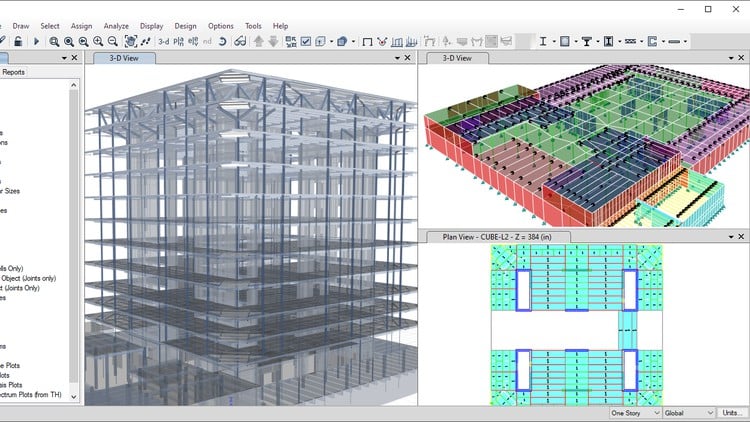
Structural Analysis and Structural Design of Residential Building in ETABS with Real World Project.
⏱️ Length: 5.4 total hours
⭐ 4.24/5 rating
👥 23,415 students
🔄 September 2024 update
Add-On Information:
Note➛ Make sure your 𝐔𝐝𝐞𝐦𝐲 cart has only this course you're going to enroll it now, Remove all other courses from the 𝐔𝐝𝐞𝐦𝐲 cart before Enrolling!
-
Course Overview:
- Dive into a comprehensive learning journey transforming absolute beginners into proficient ETABS users.
- Bridge the critical gap between theoretical structural concepts and their practical, real-world application in a dynamic software environment.
- Explore the nuances of accurately modeling diverse structural elements, including slabs, beams, columns, and walls, within the ETABS interface.
- Understand the profound importance of accurate input parameters and their direct impact on structural behavior, safety, and economy.
- Engage hands-on with a tangible real-world residential building project, serving as a central case study to solidify practical understanding and design workflow.
- Benefit from a unique bilingual approach, offering instruction in both Hindi and English, ensuring maximum accessibility and clarity for a wider audience of learners.
- Gain invaluable insights into industry best practices for achieving not only structurally sound but also economically efficient and sustainable design solutions.
- Unravel the intuitive yet powerful user interface of ETABS, making complex analytical tasks approachable and manageable even for newcomers.
- Appreciate the iterative nature of modern structural design and how ETABS facilitates rapid analysis, revisions, and optimization cycles.
- This course serves as a foundational stepping stone, equipping you with the core competencies required for more advanced structural engineering endeavors and specialized projects.
-
Requirements / Prerequisites:
- Basic understanding of structural engineering principles: Familiarity with fundamental concepts such as different types of loads (dead, live, wind, seismic), stresses, strains, and material properties (e.g., concrete and steel behavior) is highly recommended to fully grasp the course content effectively.
- Fundamental knowledge of civil engineering drawings: The ability to read and interpret architectural plans, structural layouts, and section details will significantly aid in the accurate modeling process within ETABS.
- Access to a computer: A functional personal computer or laptop with sufficient processing power and memory capable of running ETABS software (even a trial version) is absolutely essential for hands-on practice and assignments.
- No prior ETABS experience necessary: True to its “Zero to Hero” title, this course is meticulously structured to start from the very basics of the software interface, navigation, and core functionalities.
- Enthusiasm for learning: A keen interest and a proactive attitude towards mastering structural analysis and design software will profoundly enhance your overall learning experience and retention.
- Problem-solving mindset: The ability to think critically about structural challenges, analyze potential issues, and actively seek optimal and efficient solutions is a valuable asset throughout the course.
- Stable internet connection: Required for accessing all course materials, video lectures, updates, and potentially downloading the software itself.
- Basic computer literacy: General comfort with operating systems, file management, and software installation processes will ensure a smooth learning journey.
-
Skills Covered / Tools Used:
- Proficient structural modeling: Develop the advanced skill of creating accurate and comprehensive 3D models of multi-story buildings, including complex slab systems, shear walls, and foundation elements, directly within the ETABS environment.
- Advanced load application techniques: Master the art of skillfully applying various types of static and dynamic loads (e.g., gravity loads, lateral wind loads, seismic forces) precisely according to relevant national and international building codes.
- Interpretation of analysis results: Gain a deep and nuanced understanding of how to effectively read, interpret, and validate ETABS output, including member forces, moments, deflections, mode shapes, and stress distributions.
- Seismic design considerations: Learn to apply seismic provisions, understand response spectrum analysis, and implement dynamic analysis methods for creating earthquake-resistant structural systems.
- Wind load analysis: Comprehend the principles of wind load calculations and their accurate implementation and application on building structures as per design standards.
- Structural optimization principles: Develop a keen eye for efficient member sizing, material selection, and overall structural configuration to achieve cost-effective and resource-optimized designs.
- Report generation and documentation: Utilize powerful ETABS features to generate comprehensive and professional design reports, summaries, and graphical outputs suitable for project submissions and peer review.
- Code compliance interpretation: Navigate and confidently apply relevant building codes (e.g., IS codes for India, or international equivalents as applicable) to ensure all design checks within the software meet regulatory requirements.
- Troubleshooting structural models: Acquire the essential skills to identify, diagnose, and efficiently resolve common modeling errors, analysis warnings, or convergence issues that may arise in complex ETABS projects.
- Collaborative design workflow understanding: Understand where ETABS fits into the broader structural engineering design process, facilitating seamless interaction with other software and design disciplines.
- Primary Tool: ETABS (Extended 3D Analysis of Building Systems) – the industry-leading software for building analysis and design.
-
Benefits / Outcomes:
- Enhanced career prospects: Significantly elevate your resume and position yourself as a highly sought-after structural engineer or designer, proficient in the industry’s most recognized and demanded software.
- Confidence in real-world projects: Develop the critical confidence and practical skills to independently tackle complex structural challenges and design scenarios with a solid understanding of ETABS’ capabilities and limitations.
- Effective decision-making: Learn to make informed, validated structural design choices, backed by robust analysis results and engineering principles, leading to safer and more efficient structures.
- Time and cost efficiency: Master techniques to significantly expedite the structural design process and optimize material usage, directly contributing to substantial project time and cost savings.
- Deepened theoretical understanding: Witness complex structural theories and analytical concepts come alive through practical software application, profoundly solidifying your foundational engineering knowledge.
- Professional portfolio enhancement: Add a significant, tangible, and highly marketable skill to your professional portfolio, showcasing your readiness for the demands of the modern engineering industry.
- Problem-solving prowess: Cultivate a systematic and analytical approach to identifying structural problems, evaluating design options, and effectively validating proposed solutions.
- Preparedness for higher studies/certifications: Lay a strong and comprehensive groundwork that will be invaluable for pursuing advanced courses in structural dynamics, finite element analysis, or professional engineering licensure examinations.
- Self-reliance in design: Gain the invaluable ability to independently perform thorough structural analysis and design for various building types, from conception to final review.
- Networking opportunities: Join a vast community of learners and professionals, opening avenues for knowledge sharing, mentorship, and collaborative opportunities in the field of structural engineering.
-
PROS:
- Practical, Project-Based Learning: Direct application of concepts to a “Real World Project” ensures immediate relevance and enhances practical understanding and retention.
- Bilingual Instruction: Offering content in “Hindi / English” significantly broadens accessibility, making complex topics understandable to a diverse linguistic audience.
- High Student Satisfaction: A commendable 4.24/5 rating from over 23,000 students is a strong indicator of the course’s quality, effectiveness, and positive learner experience.
- Concise and Focused: At 5.4 total hours, the course is designed to be highly efficient, delivering comprehensive knowledge without unnecessary filler, ideal for busy professionals and students.
- Up-to-Date Content: The “September 2024 update” ensures that the course material reflects the latest software features, industry standards, and methodologies.
- Comprehensive for Beginners: The “From Zero to Hero” approach caters exceptionally well to absolute beginners, gradually building skills while providing sufficient depth to elevate proficient users.
- Relevant Specialization: Focus on residential buildings provides a highly practical and frequently encountered design scenario, making the skills immediately applicable in the job market.
-
CONS:
- Limited Scope for Advanced Structures: While highly effective for residential buildings, the 5.4-hour duration might not extensively cover highly specialized or complex structural types (e.g., high-rise towers, long-span bridges, or industrial facilities) in granular detail.
Learning Tracks: English,Design,Other Design