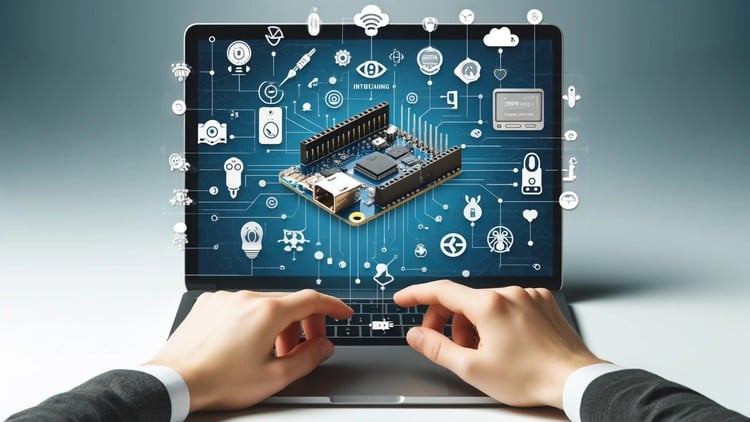
A Different IoT Power and Performance, Use ESP32 microcontroller to MAKE IoT projects to unleash your creativity
⏱️ Length: 2.6 total hours
⭐ 3.85/5 rating
👥 1,887 students
🔄 June 2025 update
Add-On Information:
Note➛ Make sure your 𝐔𝐝𝐞𝐦𝐲 cart has only this course you're going to enroll it now, Remove all other courses from the 𝐔𝐝𝐞𝐦𝐲 cart before Enrolling!
- Course Overview
- Dive into a specialized realm of IoT development, synergistically combining the distinct strengths of Arduino and ESP32 microcontrollers to achieve enhanced project capabilities and performance.
- Explore the architecture of creating sophisticated hybrid embedded systems that leverage Arduino’s extensive library support, shield compatibility, and robust real-time control, alongside ESP32’s advanced Wi-Fi and Bluetooth communication features.
- Understand the strategic advantages of offloading complex network tasks, data logging, and cloud integration responsibilities to an ESP32, while delegating precision sensor interfacing, rapid local processing, and actuator control to an Arduino board.
- Master practical, hands-on methodologies for establishing seamless, bidirectional data exchange and command execution between these two powerful yet disparate platforms, forming a cohesive and efficient cooperative processing unit.
- Embark on a guided, step-by-step journey to design, build, and implement robust, interconnected devices that transcend the inherent limitations and design compromises often faced when using a single microcontroller solution for comprehensive IoT projects.
- Discover the expansive potential to craft advanced IoT nodes capable of sophisticated data acquisition, intelligent local decision-making, secure cloud communication, and remote device management.
- This course empowers you to break through conventional project boundaries, fostering innovation in applications ranging from smart home automation and industrial monitoring to intricate environmental sensing and creative interactive installations.
- Requirements / Prerequisites
- A foundational understanding of basic electronics principles, including common components, circuit diagrams, voltage, current, and digital logic concepts.
- Prior practical experience with Arduino programming, including familiarity with the Arduino IDE, fundamental C/C++ syntax, variable types, control structures, and the process of uploading sketches to Arduino boards.
- Basic knowledge of microcontroller operations, including digital and analog I/O pins, pull-up/pull-down resistors, and interrupt handling.
- Access to an ESP32 development board (e.g., ESP32-DevKitC, NodeMCU-32S) and at least one Arduino board (e.g., Uno, Nano, Mega, ESP32-Arduino combination board).
- A personal computer (Windows, macOS, or Linux) with the Arduino IDE and the ESP32 board support packages properly installed, along with necessary USB drivers for both microcontrollers.
- A stable internet connection is essential for downloading software, libraries, firmware updates, and accessing supplementary online learning resources.
- Skills Covered / Tools Used
- Mastery of serial communication protocols, primarily UART (Universal Asynchronous Receiver-Transmitter), for robust and efficient data exchange between microcontrollers.
- Implementation of custom byte-based or packet-based communication protocols to ensure data integrity, error checking, and synchronized information flow across the interfaced boards.
- Developing event-driven programming paradigms where one microcontroller’s status changes or sensor readings can trigger specific actions or data transfers on the connected board.
- Utilizing the ESP-IDF framework or the Arduino core for ESP32 to program advanced Wi-Fi client/server functionalities, enabling the Arduino to become “web-enabled” through its ESP32 companion.
- Interfacing a wide array of digital and analog sensors (e.g., temperature, humidity, light, motion, pressure) with the Arduino, while leveraging the ESP32 for data aggregation, analysis, and cloud storage.
- Controlling various actuators (e.g., relays, servo motors, stepper motors, RGB LEDs, buzzers) via the Arduino, with commands originating from web dashboards, mobile applications, or other network services managed by the ESP32.
- Developing effective debugging strategies for complex, multi-microcontroller setups, enabling efficient identification and resolution of communication faults, timing issues, and logical errors.
- Applying best practices in wiring techniques, power distribution, and voltage level shifting (if required) to ensure stable and reliable operation of both microcontrollers in an integrated system.
- Gaining proficiency in selecting and configuring specific libraries and software tools designed to facilitate seamless interaction between ESP32 and Arduino environments.
- Exploring advanced programming concepts such as multitasking on ESP32 (using FreeRTOS indirectly via the Arduino core) to handle simultaneous communication and network operations.
- Hands-on experience with fundamental electronic components including breadboards, jumper wires, resistors, capacitors, LEDs, pushbuttons, and various power supply modules essential for project prototyping.
- Benefits / Outcomes
- Gain the foundational knowledge and practical confidence required to tackle sophisticated IoT projects that demand both precise local control and advanced wireless communication capabilities.
- Unlock unparalleled flexibility in hardware selection and project design, empowering you to combine the optimal features and ecosystems of different microcontroller platforms.
- Develop a deeper understanding of distributed system architecture, efficient task partitioning, and parallel processing in embedded applications, significantly enhancing your engineering toolkit.
- Create more resilient, scalable, and feature-rich IoT solutions by intelligently leveraging the specialized processing power and resources of each interfaced microcontroller.
- Be expertly equipped to build custom smart home devices, advanced environmental monitoring stations, responsive industrial automation systems, and innovative creative electronics projects.
- Sharpen your problem-solving abilities by designing and implementing robust communication channels and error-handling mechanisms between disparate hardware components.
- Future-proof your embedded systems and IoT project development by mastering a versatile, modular approach that maximizes the potential and longevity of available hardware resources.
- Enhance your professional portfolio with unique, demonstrably advanced projects that showcase a strong command of microcontroller interfacing and complex IoT integration skills.
- PROS of this Course
- Practical, Project-Oriented Learning: Emphasizes hands-on application and real-world project construction, enabling learners to immediately apply acquired skills to tangible outcomes.
- Optimized Resource Utilization: Teaches how to strategically combine microcontrollers, allowing for optimal performance, efficient task distribution, and overcoming the limitations inherent in single-MCU designs.
- Bridging Knowledge Gaps: Specifically designed for those already familiar with Arduino who aspire to integrate advanced connectivity and higher processing power without completely abandoning their existing development ecosystem.
- Enhanced Troubleshooting Skills: Develops a systematic and analytical approach to diagnosing and resolving issues within complex, multi-board embedded systems, a critical skill for advanced electronics developers.
- Future-Proof Skillset: Equips learners with a highly versatile and increasingly in-demand skill set crucial for navigating the evolving landscape of embedded systems, IoT, and connected device development.
- CONS of this Course
- The relatively concise course duration of 2.6 hours provides an excellent foundational introduction but might necessitate additional self-study and experimentation for achieving in-depth mastery of all potential interfacing scenarios and advanced, complex applications.
Learning Tracks: English,IT & Software,Hardware