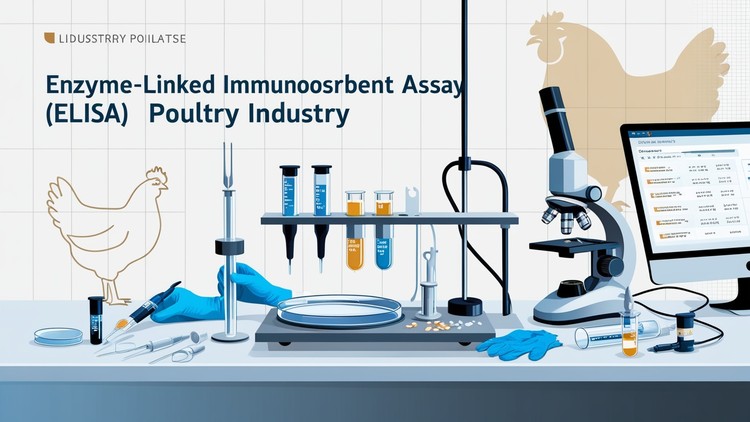
ELISA technique application in diagnosis poultry diseases
Why take this course?
Note➛ Make sure your 𝐔𝐝𝐞𝐦𝐲 cart has only this course you're going to enroll it now, Remove all other courses from the 𝐔𝐝𝐞𝐦𝐲 cart before Enrolling!
- Coated Plates: These are the plates that have been treated with antibodies or antigens specific to the pathogen you’re testing for. Each well in the plate is designed to capture and retain only those pathogens if they are present in the sample being tested.
- Positive and Negative Controls: These are samples that are known to contain or not contain the target pathogen, respectively. They serve as a reference to ensure the test is working correctly. A positive control should show a positive result, and a negative control should show a negative result.
- Sample Diluent: This reagent is used to prepare the samples from the specimen in a concentration that is compatible with the ELISA assay. It often contains buffers and substances to block non-specific binding sites.
- Conjugate: This is a complex molecule composed of an antibody specific for the pathogen’s antigen, linked to an enzyme or other label that can produce a detectable signal. The conjugate binds to the antigen if it is captured by the coated plate.
- Substrate (TMB): TMB (tetramethylbenzidine) is a chromogenic substrate used with peroxidase-labeled conjugates in ELISA assays. It reacts with the enzyme to produce a colored product, which can be quantified as an indication of antigen or antibody presence.
- Stop Solution: This solution stops the reaction between the substrate and the enzyme, halting the color development at the optimal time for reading the results.
- Wash Solution: This reagent is used to remove unbound materials from the wells of the plate after each step of the ELISA process. It ensures that only bound substances remain in the wells, which is crucial for obtaining accurate results.
Usage in Laboratory:
- Screening Tool: ELISA test kits are used as a first line of screening to quickly identify the presence of pathogens within a population.
- Confirmation: Positive results from ELISA tests should be confirmed using additional diagnostic techniques such as Hemagglutination (HI), Culture, Immunoprecipitation Assay (IPMA), Western Blot, Complement Fixation (CFC), Polymerase Chain Reaction (PCR), and Viant (VIV) tests.
- DIFFERENTIATING INFECTED FROM VACCINATED ANIMALS (DIVA) Test: ELISA test kits are not designed to differentiate between animals that have been infected by a pathogen and those that have been vaccinated against that pathogen. To achieve this, additional specific diagnostic tests would need to be performed.
Good Laboratory Practices: - Receiving Kits: Inspect for damage, record date received and when used, store properly per kit insert instructions, note kit expiration date.
- General Reagent Handling: Follow the kit insert (check often for revisions), warm up reagents (2–3 hours), mix reagents, avoid contamination (no “back pour”, use designated reagent reservoirs), and proper storage.
When performing ELISA test kits, it’s crucial to follow the manufacturer’s instructions meticulously, as these guidelines ensure the accuracy and reliability of your test results. Always refer to the insert for specific instructions tailored to the kit you are using. Proper handling, storage, and execution of each step in the ELISA process are key to obtaining accurate and reliable test results.
Add-On Information:
- Course Overview
- This specialized program delves into the sophisticated world of Enzyme-Linked Immunosorbent Assay (ELISA) technology specifically tailored for the global poultry industry.
- Participants will explore the integration of serological monitoring as a cornerstone of modern avian health management systems, moving beyond simple detection to holistic flock health.
- The curriculum focuses on the practical transition from laboratory theory to on-farm diagnostic implementation, ensuring rapid response to field challenges.
- We analyze the critical role of ELISA in distinguishing between maternal antibodies, vaccine-induced immunity, and active field pathogen exposure.
- Detailed modules cover the nuances of sample collection, serum separation, and the logistical maintenance of sample integrity from the poultry house to the diagnostic bench.
- The course examines various assay formats, including indirect, sandwich, and competitive ELISA, explaining when and why to use each for specific avian pathogens.
- Requirements / Prerequisites
- A foundational background in veterinary sciences, animal husbandry, or biological laboratory practices is highly recommended for all participants.
- General familiarity with common avian viral and bacterial diseases such as Newcastle Disease (NDV), Infectious Bursal Disease (IBD), and Avian Influenza (AI).
- Access to or a basic understanding of standard laboratory safety protocols and the handling of biological reagents.
- Skills Covered / Tools Used
- Proficiency in operating microplate readers and utilizing specialized diagnostic software for raw data extraction.
- Mastery of precision micropipetting techniques to minimize the coefficient of variation (CV%) and ensure test repeatability.
- Hands-on instruction on automated and manual plate washing protocols to maximize assay specificity and sensitivity.
- Advanced training in titer profile analysis and the expert interpretation of S/P (Sample to Positive) ratios for longitudinal flock profiling.
- Utilization of bio-statistical tools to visualize immunity trends across different production cycles and varied geographical locations.
- Benefits / Outcomes
- The ability to design customized vaccination programs based on real-time quantitative serological data rather than generic industry schedules.
- Enhanced capability for early detection of subclinical infections, which significantly reduces potential economic losses and mortality rates.
- Improved biosecurity auditing through the continuous monitoring of flock seroconversion patterns and sentinel bird responses.
- The professional confidence to provide data-driven consultancy for commercial poultry operations, hatcheries, and breeding facilities.
- Optimization of flock uniformity assessment, allowing for better-informed decisions regarding re-vaccination and intervention timing.
- PROS
- Provides high-precision training that successfully bridges the gap between molecular biology and commercial farm management.
- Crucial for maintaining international trade standards and mandatory health certifications required for poultry exports.
- Directly impacts animal welfare by reducing unnecessary vaccinations and identifying physiological stressors before they escalate.
- CONS
- The high initial investment in ELISA hardware and specialized reagents may be a barrier for smaller, independent laboratory setups or localized farms.
English
language