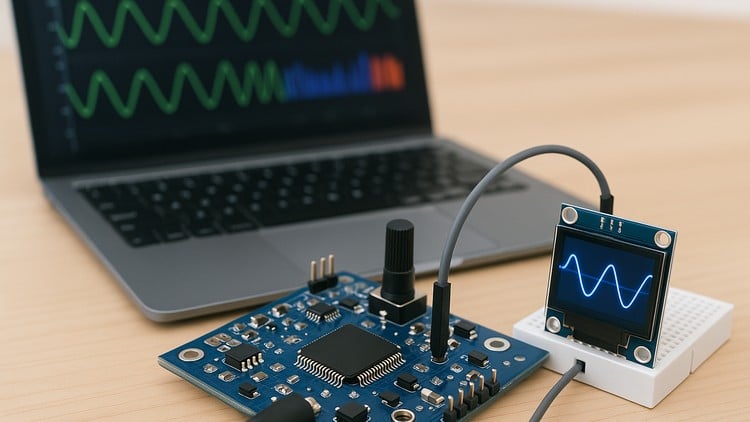
Build real-time DSP solutions for embedded systems with real-time filtering, FFT, optimization and hardware acceleration
What you will learn
Note➛ Make sure your 𝐔𝐝𝐞𝐦𝐲 cart has only this course you're going to enroll it now, Remove all other courses from the 𝐔𝐝𝐞𝐦𝐲 cart before Enrolling!
Understand the core principles of digital signal processing (DSP)
Apply sampling, quantization, and time-domain analysis techniques
Design and implement FIR and IIR filters for embedded systems
Use FFT, adaptive filtering, and hardware acceleration in real-time applications
Optimize DSP algorithms using fixed-point techniques
Add-On Information:
- Master the art of bridging the gap between theoretical signal processing concepts and their practical implementation on resource-constrained embedded hardware.
- Develop a keen intuition for translating continuous-time signals into their discrete digital representations, understanding the trade-offs inherent in the conversion process.
- Gain proficiency in the fundamental building blocks of digital signal manipulation, enabling you to sculpt and refine raw data streams.
- Craft sophisticated signal conditioning circuits on silicon, effectively removing unwanted noise and extracting meaningful features from sensor inputs.
- Unlock the power of spectral analysis to unveil the hidden frequency content within signals, crucial for applications ranging from audio processing to vibration monitoring.
- Implement dynamic filtering techniques that adapt to changing signal characteristics, providing robust performance in unpredictable environments.
- Explore advanced signal decomposition methods to break down complex waveforms into their constituent components for deeper analysis.
- Leverage specialized hardware capabilities to accelerate computationally intensive DSP tasks, ensuring real-time responsiveness in demanding applications.
- Optimize algorithms for efficiency on embedded processors, minimizing power consumption and memory footprint without sacrificing performance.
- Understand the intricacies of fixed-point arithmetic and its impact on signal integrity, enabling you to design for performance-critical embedded systems.
- Gain hands-on experience with industry-standard tools and techniques for debugging and validating DSP algorithms on target hardware.
- Cultivate problem-solving skills applicable to a wide array of embedded systems challenges involving signal processing.
- Develop a strategic approach to selecting appropriate DSP algorithms and hardware for specific application requirements.
- Prepare for a career at the forefront of embedded system design, where real-time signal intelligence is paramount.
- PROS: Highly practical and directly applicable to a vast range of modern embedded technologies.
- PROS: Develops a critical skillset in high demand across numerous industries.
- CONS: Requires a solid foundation in mathematics, particularly linear algebra and calculus, which might be a barrier for some.
English
language