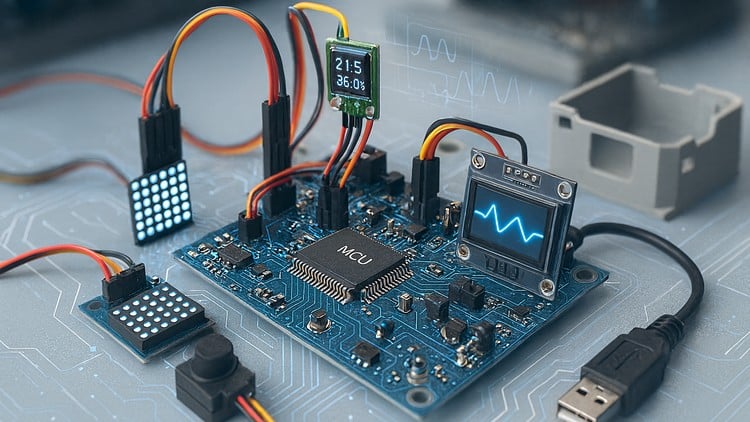
Master internal MCU design, from pipelines to peripherals, and build a strong foundation in embedded system hardware.
What you will learn
Note➛ Make sure your 𝐔𝐝𝐞𝐦𝐲 cart has only this course you're going to enroll it now, Remove all other courses from the 𝐔𝐝𝐞𝐦𝐲 cart before Enrolling!
Deconstruct and analyze the stages of the microcontroller instruction pipeline.
Understand memory hierarchy design and data access flow in microcontrollers.
Dissect bus protocols and arbitration techniques in embedded systems.
Evaluate peripheral subsystems and their integration within MCU architecture.
Apply low-power design strategies to improve energy efficiency.
Add-On Information:
- Master internal MCU design, from pipelines to peripherals, and build a strong foundation in embedded system hardware.
- Explore the fundamental principles of processor microarchitecture beyond simple instruction execution. Delve into techniques like pipelining optimization, speculative execution, and hazard mitigation, understanding how these design choices impact overall CPU performance and power consumption. Gain insights into the delicate balance between complexity and efficiency in core design.
- Analyze the intricate interplay between hardware and software at the lowest levels. Learn how compiler-generated code translates into specific microarchitectural operations and how hardware design decisions directly influence software development strategies, debugging efficiency, and system responsiveness in embedded applications.
- Grasp the nuances of cache memory design, including cache coherence protocols and their impact on multi-core microcontroller performance. Understand various caching policies, replacement algorithms, and the challenges of maintaining data consistency across multiple processing units or memory domains within a single chip.
- Investigate advanced interconnect technologies and network-on-chip (NoC) concepts. Go beyond basic bus structures to understand how high-speed data transfer, arbitration schemes, and message passing mechanisms are engineered to handle the growing complexity and data throughput demands of modern MCUs.
- Deconstruct the architecture of interrupt controllers and direct memory access (DMA) engines. Learn how these critical components offload the CPU, manage asynchronous events efficiently, and enable high-performance data transfers between peripherals and memory without constant processor intervention.
- Examine the design considerations for robust clocking and reset systems. Understand how global and peripheral clock trees are managed for synchronization, how dynamic frequency scaling is implemented, and the importance of a well-defined reset strategy for system stability and reliable operation.
- Develop an appreciation for security features integrated at the hardware level. Explore concepts like secure boot, memory protection units (MPUs), and cryptographic accelerators, understanding their role in protecting intellectual property and ensuring data integrity in embedded devices.
- Uncover the methodologies for hardware verification and validation in the context of MCU design. Gain an overview of simulation, emulation, and formal verification techniques used to ensure the correctness and robustness of complex digital circuits before silicon fabrication.
- Understand the trade-offs involved in selecting specific architectural paradigms for different application domains. Compare and contrast various instruction set architectures (ISAs) and their suitability for performance-critical, power-constrained, or cost-sensitive embedded systems.
- Acquire a foundational understanding of hardware description languages (HDLs) and their role in specifying digital logic. While not a dedicated Verilog/VHDL course, you will appreciate how these languages translate high-level design into implementable gates and circuits that form the MCU’s core.
- PROS:
- Gain unparalleled depth: Move beyond superficial use to true mastery of embedded system hardware, understanding the ‘why’ behind design decisions.
- Unlock advanced problem-solving: Develop the ability to diagnose complex hardware/software interaction issues and optimize systems at a fundamental level.
- Future-proof your career: Position yourself for roles in ASIC/FPGA design, custom SoC development, or advanced embedded systems engineering, where deep architectural knowledge is paramount.
- Inform intelligent hardware selection: Make more informed decisions when choosing microcontrollers for specific applications, understanding their true capabilities and limitations.
- CONS:
- Steep learning curve: This course demands significant dedication and a strong foundation in digital logic and computer architecture, making it challenging for beginners.
English
language