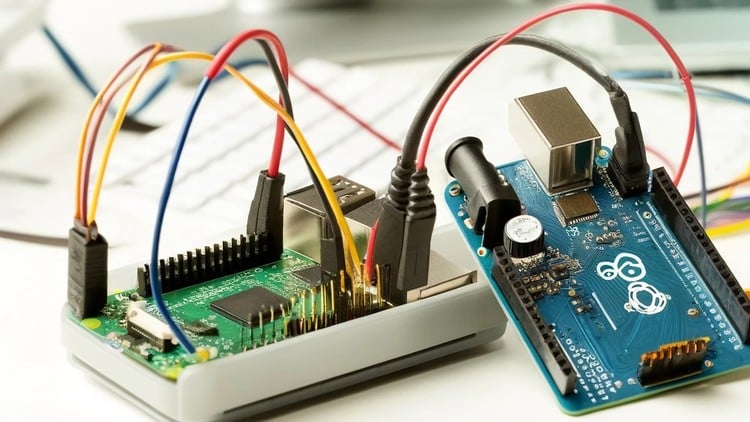
In this Course you will learn how to connect Raspberry Pi and Arduino the software and hardware part and why it’s useful
⏱️ Length: 1.2 total hours
⭐ 3.98/5 rating
👥 14,345 students
🔄 June 2025 update
Add-On Information:
Note➛ Make sure your 𝐔𝐝𝐞𝐦𝐲 cart has only this course you're going to enroll it now, Remove all other courses from the 𝐔𝐝𝐞𝐦𝐲 cart before Enrolling!
- Course Overview
- This concise course, ‘Connect and Interface Raspberry Pi with Arduino’, explores the powerful synergy of these two popular microcontrollers, teaching you to bridge their distinct capabilities. It unveils the critical software and hardware methods to enable seamless communication, showcasing why this integration is indispensable for advanced embedded projects.
- You will learn to leverage the Raspberry Pi’s high-level computing power, operating system, and extensive connectivity with the Arduino’s robust, real-time control and precise I/O. This blend empowers you to build smarter, more capable, and highly responsive electronic systems.
- Discover the fundamental principles behind combining a general-purpose computer (Raspberry Pi) with a microcontroller (Arduino) to address complex tasks that neither can efficiently manage alone, from advanced data processing to reliable hardware interaction.
- The course covers essential communication methods and practical setup configurations, ensuring a solid understanding of how these boards interact. It’s designed for efficiency, delivering maximum impact in just 1.2 total hours.
- Highly rated at 3.98/5 by 14,345 students, this course is a proven resource for makers and developers. The content benefits from a recent June 2025 update, ensuring relevance with current technologies and best practices.
- Requirements / Prerequisites
- A basic familiarity with fundamental electronics concepts is beneficial, including understanding components like resistors, LEDs, and the roles of voltage, current, and ground in simple circuits.
- Some prior exposure to programming, specifically basic Python syntax for Raspberry Pi and C/C++ for Arduino sketches, will aid in quicker comprehension and code adaptation during the course.
- Access to essential hardware components is recommended for hands-on practice, including at least one Raspberry Pi board, one Arduino board, connecting wires, and a breadboard.
- While a strong engineering background isn’t mandatory, a curious mind and an eagerness to experiment with embedded systems are the most important prerequisites for success.
- Skills Covered / Tools Used
- Mastering UART serial communication: Configure and implement this fundamental protocol on both Raspberry Pi and Arduino for reliable bidirectional data exchange.
- Exploring I2C and SPI protocols: Understand when and how to utilize these powerful interfaces for connecting multiple sensors, displays, and other peripherals efficiently.
- Python programming for Raspberry Pi: Develop scripts to manage communication, process incoming data, and orchestrate high-level system logic.
- Arduino C/C++ development: Craft robust sketches for precise sensor readings, accurate actuator control, and efficient data transmission to the Raspberry Pi.
- Adhering to hardware wiring best practices: Learn correct interconnection techniques, ensuring proper grounding, power management, and signal integrity between the boards.
- Implementing voltage level shifters: Understand and apply solutions for differing voltage levels between the 3.3V Raspberry Pi and 5V Arduino to prevent damage and ensure compatibility.
- Effective multi-platform debugging techniques: Acquire essential skills to systematically identify and resolve communication or functional issues in hybrid embedded systems.
- Proficiency with Arduino IDE and Python development environments: Navigate and utilize these key software tools for coding, compiling, and deploying your projects.
- Understanding system architecture design: Learn to modularize tasks, assigning appropriate roles to each board for optimal performance and fault tolerance.
- Benefits / Outcomes
- You will gain the capability to design and build sophisticated hybrid embedded systems, effectively merging the Raspberry Pi’s intelligence with the Arduino’s real-time control for complex tasks.
- Significantly expand your project capabilities, enabling the creation of advanced IoT devices, intelligent robotics, and robust automation solutions that leverage the strengths of both platforms.
- Develop robust systems that benefit from the Pi’s processing power for data analytics and networking, combined with Arduino’s reliable, deterministic control over physical hardware.
- Cultivate immense confidence in hardware-software integration, moving from theoretical understanding to practical application in real-world scenarios, crucial for any embedded systems enthusiast.
- Acquire valuable problem-solving skills in distributed computing, learning to manage communication challenges, data synchronization, and error handling between distinct processing units.
- Understand how to implement modular system design, improving scalability, maintainability, and overall reliability by distributing tasks between specialized microcontrollers.
- Learn to construct systems where the Arduino acts as a protective buffer, isolating the sensitive Raspberry Pi from potential electrical hazards and managing higher power loads.
- PROS
- Highly Practical & Hands-on: Focuses on direct application with clear hardware setups and code examples, ensuring immediate learning transfer.
- Addresses Critical Integration: Teaches a vital skill for modern embedded development, combining the best features of two leading platforms.
- Time-Efficient: At just 1.2 hours, it’s perfect for quickly acquiring foundational knowledge without a major time investment.
- Community Validated: A strong 3.98/5 rating from over 14,000 students confirms its quality and effectiveness.
- Up-to-Date Content: The June 2025 update ensures the material is current and aligned with contemporary practices.
- CONS
- Limited Depth: Due to its concise 1.2-hour duration, the course provides a foundational overview and may not delve into highly advanced topics or intricate protocol optimizations.
Learning Tracks: English,IT & Software,Hardware