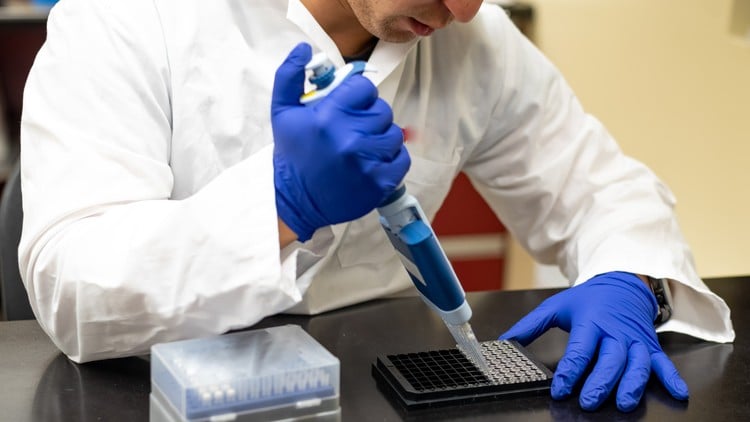
Master Immuno assays for diagnostics, protocols, quality controls, troubleshooting and statistical data interpretations
⏱️ Length: 1.1 total hours
👥 65 students
🔄 August 2025 update
Add-On Information:
Note➛ Make sure your 𝐔𝐝𝐞𝐦𝐲 cart has only this course you're going to enroll it now, Remove all other courses from the 𝐔𝐝𝐞𝐦𝐲 cart before Enrolling!
-
Course Overview
- Embark on a concise yet comprehensive exploration of Enzyme-Linked Immunosorbent Assays (ELISAs), a cornerstone immunoassay in diagnostics and research. This updated course provides a fundamental understanding of ELISA principles and their extensive applications across various scientific fields.
- Discover the critical immunological interactions that drive ELISA technology, learning how specific antigen-antibody binding enables sensitive and precise quantification. Gain insight into the core mechanisms that make ELISA an indispensable tool for molecular detection.
- Despite its compact 1.1-hour length, this guide delivers a robust framework for understanding the complete ELISA workflow, from initial assay selection to the final interpretation of results. It ensures a holistic perspective that integrates theory with practical considerations.
-
Requirements / Prerequisites
- A basic familiarity with general biological concepts, including proteins, antibodies, antigens, and enzymatic reactions, will enhance your learning experience. No prior hands-on ELISA expertise is necessary.
- An inquisitive mind and a keen interest in analytical laboratory techniques are beneficial. The course is designed for motivated individuals seeking to understand quantitative immunoassay methods without prior specialized training.
-
Skills Covered / Tools Used
- Strategic Reagent Optimization: Learn to select and prepare optimal concentrations of capture agents, detection antibodies, enzyme conjugates, and substrates, crucial for maximizing assay sensitivity and specificity.
- Microplate Assay Development: Understand the art of coating microtiter plates, optimizing incubation steps, and designing efficient washing protocols to ensure robust and reproducible assay performance.
- Systematic Assay Problem-Solving: Develop a structured approach to diagnosing and resolving common and uncommon issues encountered during ELISA execution, minimizing errors and improving reliability.
- Spectrophotometric Measurement Principles: Grasp the fundamentals of microplate reader operation, including wavelength selection and absorbance measurement, essential for accurate data acquisition.
- Quantitative Data Transformation: Acquire the ability to convert raw absorbance data into meaningful concentrations, including standard curve generation and application of appropriate curve-fitting models.
- Ethical & Quality Assurance Context: Gain awareness of the ethical considerations and basic quality control standards (e.g., GLP/GMP implications) relevant to employing ELISAs in professional settings.
-
Benefits / Outcomes
- Increased Assay Confidence: Emerge with a solid conceptual and practical foundation in ELISA, empowering you to confidently discuss, plan, and contribute to immunoassay projects.
- Effective Assay Design: Develop the capability to design targeted and efficient ELISA protocols tailored to specific diagnostic or research objectives, enhancing experimental productivity.
- Proficient Data Interpretation: Master the skill of critically evaluating ELISA results, recognizing potential anomalies, and ensuring the accuracy and validity of reported findings.
- Enhanced Lab Efficiency: Apply systematic troubleshooting techniques to swiftly identify and rectify assay issues, significantly reducing downtime and optimizing resource utilization in the laboratory.
- Career Readiness: Bolster your resume with highly sought-after immunoassay expertise, opening doors to advanced roles in biotechnology, pharmaceuticals, and clinical diagnostics.
- Foundational Knowledge Transfer: The core principles learned provide an excellent foundation for understanding and engaging with other complex immunoassay platforms and experimental designs.
-
PROS
- Highly Concentrated Learning: Delivers extensive knowledge on ELISA within an extremely efficient 1.1-hour format, perfect for rapid skill acquisition.
- Up-to-Date Content: Incorporates the latest best practices and information, reflecting an August 2025 update for contemporary relevance.
- Direct Practical Relevance: Focuses on applicable skills from assay setup to data interpretation, immediately beneficial for laboratory professionals.
- Versatile Skill Set: Offers expertise valuable across diverse scientific and industrial fields, enhancing career flexibility and opportunities.
- Cost-Effective Education: Provides comprehensive training in a critical technique without significant time or financial investment.
-
CONS
- Breadth-Depth Trade-off: Given its brief 1.1-hour duration, the course prioritizes core understanding over an exhaustive dive into highly specialized or advanced research applications of ELISA.
Learning Tracks: English,Teaching & Academics,Science