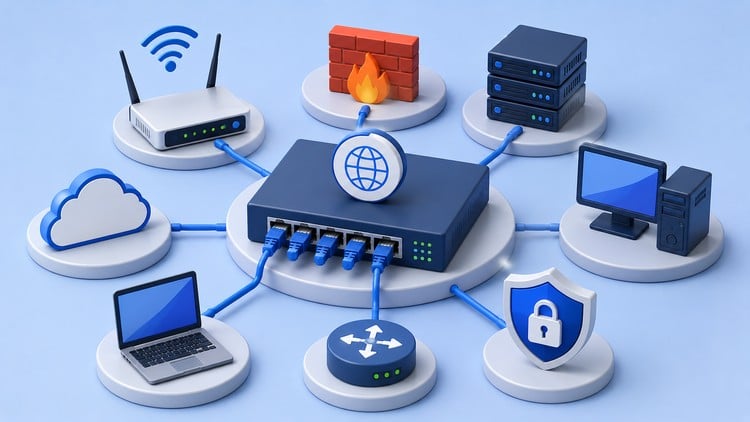
Test your skills in Subnetting, OSI Model, VLANs, STP, and OSPF routing to ace your CCNA and Network+ exams.
What You Will Learn:
- Evaluate your foundational knowledge of the OSI Model, differentiating between TCP/UDP, DNS, and ARP protocols.
- Test your mathematical proficiency in IPv4 Subnetting, calculating CIDR limits, host addresses, and IPv6 SLAAC.
- Assess your Layer 2 Switching knowledge, configuring 802.1Q VLAN trunking, Spanning Tree Protocol (STP), and EtherChannel.
- Validate your Layer 3 Routing skills, mastering OSPF link-state logic, Static Default Routes, NAT, and Access Control Lists (ACL).
The Reality Check Your CCNA Prep Needs
If you’ve been in the IT game for more than a minute, you know that the gap between “reading a book” and “surviving an exam” is a literal canyon. I’ve seen brilliant techs freeze up during the CCNA certification prep because they knew the theory but couldn’t handle the clock or the way Cisco words their trickier scenarios. That’s where ‘Cisco CCNA & IT Networking: Master Mock Exams’ steps in. This isn’t just another passive video series where you nod along; it’s a high-stakes simulation designed to break your bad habits before the actual proctor is watching you.
What I appreciate about this specific course is that it treats the 200-301 exam like a logic puzzle rather than a memorization test. In my experience, most beginner to advanced learners struggle not with the concepts, but with the application. These mock exams force you to think like a Network Engineer under pressure. Instead of just asking what a VLAN is, it throws you into a scenario where the trunk is failing and the spanning tree is looping, demanding you identify the root cause in seconds. It’s that “trial by fire” approach that actually builds job-ready skills.
Prerequisites
Before you dive into these simulations, don’t expect to be handheld through the very basics of “what is a computer.” You should have a baseline understanding of networking fundamentals. Specifically, I recommend:
- A foundational grasp of the OSI Model (you should know your Layer 2 from your Layer 3 without hesitation).
- Basic familiarity with the Cisco IOS command line—knowing how to ‘enable’ and ‘conf t’ is a must.
- Prior exposure to binary math; while the course tests your Subnetting speed, it helps if you’ve at least seen a CIDR table before.
- Access to Cisco Packet Tracer or GNS3 if you want to lab out the questions you get wrong.
The Toolkit: Skills & Industry-Standard Tools
While this is a mock exam course, it essentially trains you to use industry-standard tools through mental simulation and logic. You aren’t just clicking buttons; you are mastering the logic behind:
- Cisco IOS: Understanding the syntax for VLAN trunking, OSPF neighbor adjacency, and ACL application.
- Subnetting Calculators: Moving away from digital tools and developing the mental “speed-math” required for IPv4 Subnetting and IPv6 SLAAC.
- Wireshark Logic: Even though you aren’t staring at a packet sniffer, the questions on TCP/UDP and DNS protocols require you to understand packet headers as if you were looking at a real-world project capture.
- Terminal Emulators: Simulating the environment of PuTTY or SecureCRT when troubleshooting Static Default Routes and NAT translations.
Career Benefits & Job Roles
Let’s talk money and career growth. Passing the CCNA is often the “gatekeeper” certification for high-paying roles. By mastering these mock exams, you aren’t just prepping for a piece of paper; you’re prepping for the interview. When a hiring manager asks you how to prevent a broadcast storm, you won’t just recite a definition—you’ll explain STP (Spanning Tree Protocol) logic with confidence.
Completing this level of rigorous testing prepares you for roles such as:
- Junior Network Engineer: Managing EtherChannel and Layer 2 switching environments.
- Systems Administrator: Handling Access Control Lists (ACL) and basic routing security.
- Technical Support Engineer (L2/L3): Deep-dive troubleshooting of connectivity issues.
- Network Operations Center (NOC) Technician: Monitoring OSPF link-state logic and enterprise-wide connectivity.
Pros
- Deep-Dive Explanations: The “why” is more important than the “what.” This course provides thorough breakdowns of why an answer is correct and, more importantly, why the other three are wrong.
- High-Pressure Simulation: The questions mirror the complexity and wording of the actual Cisco CCNA, which is vital for overcoming exam anxiety.
- Granular Topic Coverage: It doesn’t ignore the “dry” stuff. It hits NAT, ARP, and DNS just as hard as the flashy routing protocols, ensuring no gaps in your knowledge.
- Bridge to Hands-on Labs: The scenarios are so detailed that they naturally encourage you to fire up your lab and verify the logic, cementing those hands-on labs skills.
Cons
- Strict Focus on Exams: If you are looking for a “follow-me” configuration tutorial, this isn’t it. This is a rigorous assessment tool, so if you haven’t done your initial certification prep reading, you might find the difficulty curve a bit punishing right out of the gate.