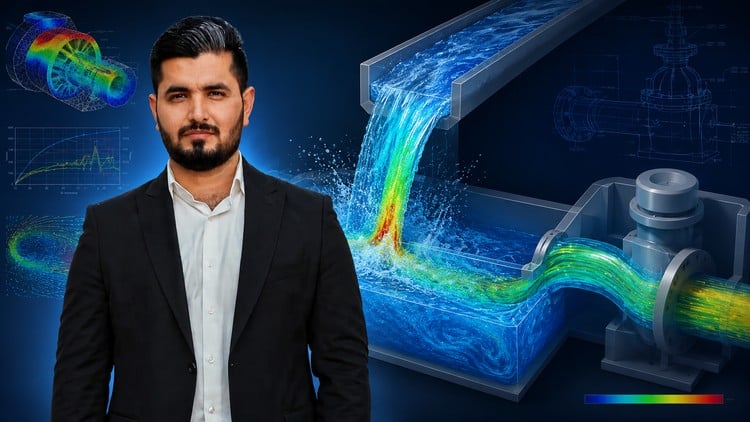
Mastering FLOW-3D: From Project Setup and Geometry Creation to Simulation, Result Export, and Animation.
What You Will Learn:
- Build complete CFD projects in FLOW-3D
- Simulate open-channel and hydraulic flows
- Analyze velocity, pressure and turbulence results
- Generate professional engineering reports
- Create animations and visualizations for presentations
- Apply FLOW-3D to real engineering problems
An Honest Deep Dive into Mastering FLOW-3D
Let’s be real for a second: the world of Computational Fluid Dynamics (CFD) can be an absolute minefield for the uninitiated. Most courses out there either bury you under a mountain of esoteric partial differential equations or treat the software like a “black box” where you click buttons and hope the colorful contours actually mean something. After spending years in the engineering trenches, I’ve realized that the real value lies in finding that sweet spot between theoretical accuracy and job-ready skills. This course on CFD simulation using FLOW-3D hits that mark surprisingly well, specifically for those of us focused on hydraulic and environmental engineering.
What sets this apart from your run-of-the-mill YouTube tutorial is the focus on the TruVOF method—the crown jewel of FLOW-3D. If you’ve ever struggled with free-surface tracking in other solvers, you know the pain of “numerical diffusion” ruining your day. This course doesn’t just show you how to set up a project; it teaches you how to think like a simulation engineer. It bridges the gap from beginner to advanced by focusing on how the software handles the interface between liquids and gases, which is non-negotiable for anyone working on spillways, bridge piers, or urban drainage systems. It’s an opinionated take on CFD that favors practical results over academic fluff.
Prerequisites for Success
You don’t need a PhD in mathematics to get started here, but don’t expect to walk in cold. To truly benefit from the hands-on labs, you should have a solid foundation in Fluid Mechanics—think Reynolds numbers, Froude numbers, and the basics of the Navier-Stokes equations.
From a technical standpoint, a basic understanding of 3D geometry is essential. If you’ve never touched a CAD program, you might find the geometry creation and STL manipulation a bit steep. Lastly, you’ll need access to the software itself. FLOW-3D is a premium, industry-standard tool, so ensuring you have a workstation that meets the hardware requirements (don’t try this on a basic netbook) is key before you dive into the heavier real-world projects.
Skills Acquired & Tools Mastered
The curriculum is built around a “project-first” philosophy. You aren’t just learning menus; you’re building complete CFD projects from the ground up. Here’s a breakdown of the toolkit you’ll develop:
- The FAVOR™ Method: You’ll learn how FLOW-3D defines geometry within a rectangular grid, which is a total game-changer for meshing complex hydraulic structures.
- Meshing Strategy: Mastering multi-block meshing to capture high-gradient areas without exploding your computation time.
- Physics Setup: Configuring gravity, turbulence models (like RNG or k-epsilon), and surface tension for open-channel and hydraulic flows.
- Post-Processing: Using FlowSight to extract velocity, pressure, and turbulence results that actually stand up to peer review.
- Visualization: Crafting high-quality animations and visualizations that make your presentations look like they came from a high-end VFX studio, but with the backing of rigorous engineering data.
Career Benefits & Job Roles
In today’s market, “I know how to use a computer” isn’t enough. Employers are looking for specialized certification prep and documented experience with real-world projects. Mastering FLOW-3D opens doors in sectors that generalist CFD solvers often miss.
If you are aiming for career growth in Civil Engineering, Coastal Engineering, or Municipal Water Management, this skill set is a massive differentiator. Common job roles for graduates of this path include Hydraulic Modeler, Water Resources Engineer, and CFD Specialist. These roles are high-demand and offer a significant salary bump because the ability to accurately predict flood impacts or spillway performance saves companies millions in potential failure costs. It’s about becoming a “job-ready” asset who can deliver professional engineering reports on day one.
The Pros
- Workflow-Oriented: The course mimics the actual lifecycle of a consultancy project, from CAD import to the final client report.
- Niche Mastery: It focuses on free-surface flow, which is FLOW-3D’s superpower, rather than trying to be a “jack of all trades” CFD guide.
- Visualization Focus: It places a heavy emphasis on animations for presentations, recognizing that half the battle in engineering is convincing stakeholders your data is correct.
- Practicality: The hands-on labs ensure you encounter (and solve) the common “solver crashed” errors that plague every CFD engineer.
The Cons
- Hardware Intensity: The course naturally requires a beefy PC to run the simulations provided in the labs. If you’re working on an underpowered machine, the “wait time” for results can disrupt the learning flow, making it feel a bit disjointed compared to lighter software training.