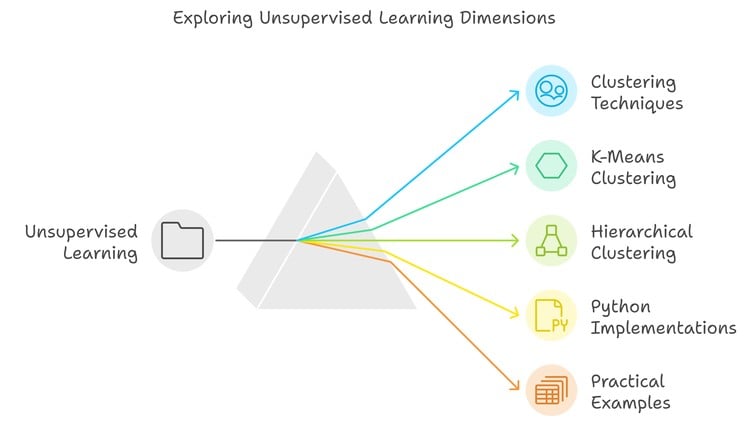
Unsupervised Learning & Clustering: K-Means, Hierarchical, DBSCAN, GMM, PCA for Data Science & ML Mastery.
⭐ 3.50/5 rating
👥 1,060 students
🔄 October 2025 update
Add-On Information:
Note➛ Make sure your 𝐔𝐝𝐞𝐦𝐲 cart has only this course you're going to enroll it now, Remove all other courses from the 𝐔𝐝𝐞𝐦𝐲 cart before Enrolling!
- Course Overview
- This comprehensive certification course offers an in-depth expedition into the critical domain of Unsupervised Learning and its pivotal application in Clustering, designed for aspiring and established data scientists and machine learning engineers. Unlike supervised methodologies, this paradigm empowers you to uncover inherent patterns, groupings, and structures within vast, unlabeled datasets without requiring prior knowledge of output labels, making it an indispensable skill for exploratory data analysis, anomaly detection, and feature engineering.
- You will embark on a structured journey through the theoretical foundations and practical implementations of leading clustering algorithms. The curriculum meticulously covers K-Means Clustering, teaching you its centroid-based approach for efficiently partitioning data into a predefined number of clusters, alongside advanced techniques for determining the optimal ‘K’ and robust initialization strategies to ensure reliable results.
- The course extensively explores Hierarchical Clustering (both Agglomerative and Divisive methods), guiding you through the process of building nested clusters and visualizing their intricate relationships using dendrograms. You’ll gain a profound understanding of various linkage criteria (ee.g., Ward’s method, Complete, Average) and their influence on cluster formation, providing a flexible framework adaptable to diverse data structures and analytical objectives.
- Delve into Density-Based Spatial Clustering of Applications with Noise (DBSCAN), a uniquely powerful algorithm renowned for its ability to discover arbitrarily shaped clusters and effectively identify outliers or noisy data points. You will learn to intuitively grasp and tune its core parameters (epsilon, minPts), appreciating its resilience in real-world datasets where cluster shapes are often irregular and challenging for other methods.
- Master Gaussian Mixture Models (GMMs), a probabilistic extension of K-Means that models clusters as a mixture of Gaussian distributions. This section teaches how GMMs provide soft assignments, offering probabilities of data points belonging to multiple clusters, which yields a more nuanced interpretation of data membership and a robust framework for handling overlapping clusters.
- Acquire expertise in Principal Component Analysis (PCA), a fundamental technique for dimensionality reduction. This crucial module equips you with the skills to transform high-dimensional data into a lower-dimensional representation while preserving the maximum possible variance, essential for mitigating the ‘curse of dimensionality,’ visualizing complex datasets, and significantly improving the efficiency and interpretability of subsequent machine learning models.
- Designed for practical mastery and aligned with the latest October 2025 updates, this course emphasizes a hands-on, project-driven approach, ensuring you not only comprehend the theoretical underpinnings but also gain substantial experience in implementing these sophisticated algorithms using industry-standard Python libraries. The ultimate goal is to certify your ability to independently apply and interpret unsupervised techniques to solve complex data challenges, transforming raw information into actionable business intelligence and scientific discovery.
- Requirements / Prerequisites
- A foundational understanding of Python programming is essential, including familiarity with core syntax, data types, control flow (loops, conditionals), and function definitions, as all practical assignments and demonstrations will be conducted in Python.
- Prior exposure to key Python data science libraries such as NumPy for efficient numerical operations and Pandas for robust data manipulation and analysis is highly recommended. These tools form the backbone of data preparation and processing steps critical for applying clustering algorithms effectively.
- A basic grasp of linear algebra concepts, particularly vector operations, matrix manipulations, and eigenvalue/eigenvector intuition, will significantly aid in understanding the mechanics behind algorithms like PCA. Similarly, an elementary comprehension of statistics and probability (e.g., mean, variance, distributions) will enhance your understanding of GMMs and other probabilistic models.
- While not strictly mandatory, preliminary exposure to general machine learning concepts, even from a supervised learning context, will provide helpful context and accelerate your learning curve. This includes an understanding of data splitting, model evaluation principles (even if specific metrics differ), and the overall ML workflow.
- Skills Covered / Tools Used
- Advanced Python Programming for Data Science: Solidify your Python skills by implementing complex data analysis and machine learning workflows, moving beyond basic syntax to apply it effectively in a scientific computing context.
- Scikit-learn Mastery: Gain hands-on expertise with Scikit-learn, the premier machine learning library in Python, for implementing and fine-tuning all covered unsupervised learning algorithms, including K-Means, Hierarchical Clustering, DBSCAN, GMM, and PCA, understanding their API and robust parameter tuning.
- Comprehensive Data Preprocessing: Learn to meticulously prepare raw data for unsupervised learning tasks, covering essential steps such as feature scaling (standardization, normalization), handling missing values, encoding categorical variables, and outlier detection – all critical for optimal algorithm performance.
- Insightful Data Visualization & Interpretation: Develop strong skills in data visualization using libraries like Matplotlib and Seaborn to visually explore datasets, interpret intricate clustering results (e.g., scatter plots, dendrograms, heatmaps), and present complex insights clearly and effectively.
- Advanced Clustering Evaluation Metrics: Master a diverse range of internal and external metrics to quantitatively assess the quality, stability, and robustness of different clustering models. This includes applying and interpreting the Silhouette Score, Davies-Bouldin Index, Calinski-Harabasz Index, and advanced techniques like the Elbow Method and gap statistic for K-Means.
- Practical Dimensionality Reduction with PCA: Acquire the ability to apply Principal Component Analysis (PCA) for effective dimensionality reduction, noise reduction, and feature extraction, significantly improving model performance, reducing computational load, and enhancing interpretability in high-dimensional spaces.
- Enhanced Exploratory Data Analysis (EDA): Significantly enhance your EDA capabilities by leveraging unsupervised techniques to uncover hidden patterns, identify subtle anomalies, and understand the inherent, latent structure of complex datasets, thereby informing more intelligent subsequent data modeling decisions.
- Jupyter Notebook Proficiency: Become adept at using Jupyter Notebooks for interactive data analysis, iterative code development, dynamic result visualization, and ensuring reproducible research, a fundamental and widely adopted tool in the data science industry.
- Benefits / Outcomes
- Earn a highly respected Certified Unsupervised Learning & Clustering credential, a valuable and tangible addition to your professional profile that unequivocally validates your expertise in a critically sought-after domain of machine learning.
- Confidently apply a diverse array of powerful unsupervised learning algorithms (K-Means, Hierarchical, DBSCAN, GMM, PCA) to real-world, often messy, unlabeled datasets, enabling you to extract profound meaningful insights and discover hidden patterns where explicit labels are absent.
- Develop advanced exploratory data analysis (EDA) capabilities, moving beyond basic statistical summaries to leverage sophisticated clustering and dimensionality reduction techniques for a deeper, nuanced understanding of data structure, feature relationships, and inherent variability.
- Gain the critical skill set to solve complex, real-world data science problems that intrinsically involve pattern recognition, customer segmentation, advanced anomaly detection, document clustering, image compression, and market basket analysis, all without requiring labor-intensive pre-labeled data.
- Significantly enhance your data science and machine learning portfolio with practical, impactful projects demonstrating your ability to implement, fine-tune, and expertly interpret sophisticated unsupervised models, making you a highly attractive and competitive candidate for challenging roles in data analysis, machine learning engineering, and research.
- Position yourself for accelerated career advancement and new opportunities in rapidly evolving fields that increasingly demand advanced analytical skills, as businesses and scientific endeavors worldwide heavily rely on unsupervised methods to derive intelligence from their ever-growing volumes of raw, unclassified information.
- Cultivate a robust and intuitive understanding of how to prepare data effectively and efficiently for unsupervised tasks, including critical preprocessing steps, thereby ensuring your models are robust, accurate, and consistently yield actionable, impactful results from diverse and challenging data sources.
- PROS
- Comprehensive Algorithmic Coverage: The course provides an exceptionally thorough and in-depth exploration of all the most critical unsupervised learning algorithms, ensuring a holistic understanding of various techniques and their suitable, practical applications across different data types.
- Strong Practical Emphasis: With a primary focus on hands-on implementation and project-based learning using Python and Scikit-learn, students gain invaluable practical skills directly transferable to real-world data science projects and professional work environments immediately upon completion.
- Industry-Relevant Skill Set: The meticulously designed curriculum is specifically crafted to equip learners with a highly demanded and cutting-edge skill set in the current job market, covering fundamental techniques for data exploration, pattern discovery, and dimensionality reduction essential for modern data professional roles.
- Certification of Mastery: Earning the ‘Certified Unsupervised Learning & Clustering’ title provides tangible, verifiable proof of your expertise and proficiency in this specialized field, significantly boosting your professional credibility and opening doors to advanced career opportunities in data science and machine learning.
- CONS
- While comprehensive and practical, the course assumes a foundational understanding of Python programming and basic statistical/linear algebra concepts, which might pose a significant initial challenge for absolute beginners without prior exposure to these fundamental areas, potentially requiring supplementary learning.
Learning Tracks: English,IT & Software,Other IT & Software