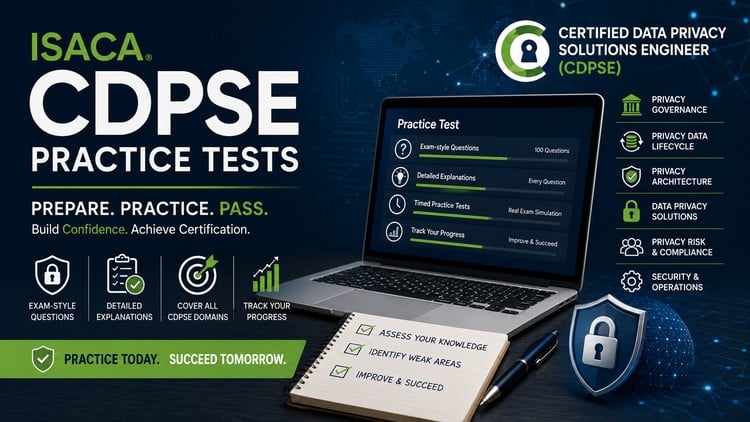
Prepare for the CDPSE exam with realistic practice questions covering data privacy, governance, architecture, lifecycle
What You Will Learn:
- Assess your readiness for the ISACA CDPSE certification exam.
- Strengthen your understanding of privacy governance, principles, policies, and frameworks.
- Practice data lifecycle management, from collection and use to retention, sharing, and disposal.
- Test your knowledge of privacy architecture and Privacy by Design concepts.
- Understand data privacy solutions, controls, and privacy-enhancing technologies.
- Practice privacy risk assessment, compliance, and regulatory requirements.
- Strengthen your knowledge of security controls that support data privacy and protection.
- Practice privacy incident management, monitoring, and response scenarios.
- Identify knowledge gaps through realistic practice questions and detailed explanations.
- Build the confidence, accuracy, and exam readiness needed for the CDPSE certification.
Overview: The Missing Bridge Between Tech and Compliance
If you’ve been in the IT or security space for a while, you know the drill: the legal team drops a 50-page compliance doc on your desk, and the engineers look at it like it’s written in ancient Greek. That’s where the CDPSE (Certified Data Privacy Solutions Engineer) comes in. I’ve gone through plenty of certification prep materials in my time, but this set of practice tests for the ISACA CDPSE is particularly focused on bridging that “translation gap.”
Let’s be honest, the ISACA exams are notoriously “thinky.” It’s never just about memorizing a definition; it’s about understanding the industry-standard tools and the situational logic of how data flows through a modern enterprise. These practice tests don’t just mimic the exam format—they force you to adopt the mindset of a privacy engineer. Instead of just asking what GDPR is, the questions push you into scenarios where you have to decide between different Technical Privacy Controls while maintaining system performance. It’s a beginner to advanced journey that assumes you know your way around a server but need to learn how to bake privacy into the code itself, rather than bolting it on as an afterthought.
Prerequisites: What You Need Before You Click Start
While the course lists itself as comprehensive, don’t expect to walk in with zero IT knowledge and come out a pro. To really get the most out of these practice sets, you should have:
- A foundational understanding of Information Security principles (think Security+ or CISM level).
- Basic familiarity with Data Governance concepts and global regulations like GDPR or CCPA.
- At least a couple of years of experience in an IT or auditing role. This isn’t a “my first tech cert” kind of deal; it’s for those looking for career growth into specialized roles.
- The patience to read long, technical explanations for why your “technically correct” answer was “strategically wrong” according to ISACA standards.
Skills & Tools: Developing a Privacy Engineering Mindset
This isn’t just a test bank; it’s a crash course in job-ready skills. By working through these questions, you’re essentially training your brain to look for privacy vulnerabilities in the Data Lifecycle. You’ll find yourself digging into:
- Privacy by Design (PbD): Learning how to integrate privacy at the architecture level, not just the policy level.
- Data Sovereignty & Localization: Navigating the nightmare of where data lives and who can see it.
- Anonymization & Pseudonymization: Understanding the industry-standard tools used to mask data without destroying its utility for the business.
- Privacy Impact Assessments (PIA): Learning the structured way to evaluate risk before a single line of code is written.
Career Benefits & Job Roles: The ROI of Privacy
Data privacy is one of the fastest-growing niches in tech right now. Companies are terrified of the fines associated with data breaches and non-compliance. Earning this certification (and using these tests to get there) puts you in the running for high-paying roles such as:
- Data Privacy Engineer: Designing systems that are compliant by default.
- Privacy Architect: Building the high-level infrastructure that protects user data across global regions.
- Data Protection Officer (DPO): Serving as the critical link between the board of directors and the IT department.
- IS Audit Manager: Specializing in privacy-specific audits that go deeper than standard security checks.
Pros: Why This Set Stands Out
- The “Why” Behind the Answer: The best part of these tests isn’t the questions; it’s the detailed explanations. They don’t just tell you that “B” is correct; they explain why “A,” “C,” and “D” are wrong, which is where the real certification prep happens.
- Realistic Difficulty: Many practice tests are too easy, giving you a false sense of security. These questions mimic the “tricky” wording of ISACA, preparing you for the actual pressure of exam day.
- Holistic Coverage: It hits all the major domains—from Privacy Governance to Technical Controls—ensuring you don’t have a blind spot that sinks your score.
Cons: The One Reality Check
If you’re looking for hands-on labs where you’re actively configuring a firewall or writing Python scripts for data masking, you won’t find them here. This is a text-based practice environment. While it builds the mental framework for real-world projects, you’ll still need to seek out practical, keyboard-time experience elsewhere to fully round out your technical toolkit.