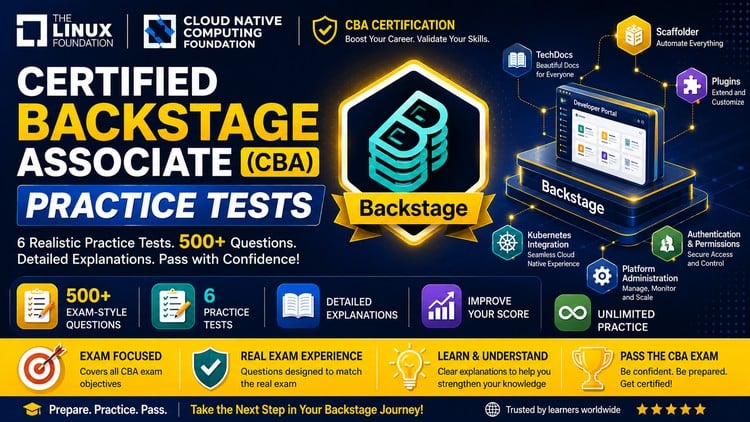
6 full-length practice tests | 500+ questions on Backstage catalog, plugins, templates & TechDocs | Golden Kubestronaut
What You Will Learn:
- Master the official Certified Backstage Associate (CBA) exam objectives with 500+ realistic practice questions.
- Assess your knowledge of Backstage architecture, Software Catalog, Scaffolder, TechDocs, Plugins, Kubernetes integration, authentication, permissions, and platf
- Build confidence by completing 6 full-length practice exams that closely simulate the real CBA exam.
- Understand the reasoning behind every answer through detailed explanations that reinforce key Backstage and Internal Developer Platform (IDP) concepts.
- Identify knowledge gaps and focus your study on the areas that need improvement.
- Be fully prepared to pass the Certified Backstage Associate (CBA) certification exam on your first attempt.
- Show more
The Reality of Taming the IDP Beast
Let’s be real for a second: Internal Developer Platforms (IDPs) have gone from a “nice-to-have” luxury at Spotify to an absolute requirement for any enterprise trying to scale without drowning in microservice chaos. Backstage is the undisputed heavyweight champion in this space. But here’s the kicker—knowing how to use Backstage as a developer and passing the Certified Backstage Associate (CBA) exam are two entirely different animals. I’ve seen seasoned platform engineers fail these certifications because they underestimated the nuance of the Software Catalog entity relations or the specific syntax of a Scaffolder template.
The ‘CBA – Certified Backstage Associate Practice Exams 2026’ isn’t just another brain dump; it’s a focused piece of certification prep that actually respects your time. While most resources out there are either too academic or just a regurgitation of the official documentation, this set of six exams feels like it was written by someone who has actually spent late nights debugging a broken TechDocs build. It moves you from a beginner to advanced understanding of how the components actually talk to each other under the hood.
What You Need Before Diving In
Don’t expect to walk into these practice tests cold. While the course is marketed as a comprehensive prep tool, you’ll get the most value if you already have a baseline in the Cloud Native ecosystem. You should be comfortable with YAML (the “language of the gods” in Backstage) and have a fundamental grasp of how Kubernetes manages workloads. If you’ve never touched a GitHub Action or don’t know what a Software Template is, you might find the 500+ questions a bit daunting. Think of this as the final bridge between your hands-on labs and the actual testing center.
Mastering the Ecosystem Tools
This course forces you to master the industry-standard tools that make up the Backstage core. You aren’t just memorizing definitions; you’re learning the logic behind:
- Backstage Architecture: Understanding the relationship between the frontend, backend, and the database.
- Software Catalog: Grasping how Component, API, Resource, and System entities create a unified graph.
- The Scaffolder: How to automate real-world projects by creating standardized templates for new services.
- TechDocs: The “docs-as-code” philosophy that keeps technical documentation alongside the source.
- Authentication & Permissions: Tackling the often-confusing world of identity providers and RBAC within the platform.
Career Growth and the IDP Job Market
If you’re looking for career growth, specialized certifications like the CBA are currently high-yield assets. We are moving into an era where “Platform Engineer” is one of the highest-paying titles in tech. Companies are desperate for people who can turn a cluttered mess of repos into a streamlined Internal Developer Platform.
By mastering these objectives, you aren’t just passing a test; you’re acquiring job-ready skills for roles like:
- Platform Engineer: Architecting the developer experience for large-scale engineering teams.
- DevOps Architect: Standardizing deployment pipelines and service discovery.
- Cloud Architect: Integrating Kubernetes and cloud-native services into a single pane of glass.
- Developer Experience (DevEx) Lead: Focusing purely on reducing cognitive load for developers.
Why This Course Hits the Mark (The Pros)
- Detailed Explanations: This is the standout feature. When you get a question wrong (and you will), the course doesn’t just give you the right answer; it explains the “why.” It deep-dives into the Backstage logic, which is crucial for certification prep.
- Exam Simulation: The pressure of a 60-question timed exam is hard to replicate. These tests do a great job of mimicking the actual CNCF exam environment, helping you manage your time effectively.
- High-Quality Question Bank: With 500+ questions, you aren’t seeing the same three patterns repeated. It covers everything from Kubernetes integration to the intricacies of the Permissions framework.
- Up-to-Date Content: Since it’s geared toward 2026, it accounts for the rapid evolution of the Backstage plugin ecosystem and the move toward more modular backend systems.
The Reality Check (The Cons)
The only real downside is that these are practice exams, not a hands-on lab environment. If you’re the type of learner who needs to type code into a terminal to understand it, you’ll need to supplement this with your own local Backstage instance. It’s a tool for validation and refinement, not a replacement for actually building something. If you rely 100% on these questions without ever looking at the app-config.yaml of a real project, you’ll be “exam smart” but “production dangerous.”
Final Verdict
If you’re serious about the CBA, this is a non-negotiable investment. It’s the difference between walking into the exam feeling anxious and walking in knowing exactly how the questions are structured. For anyone aiming to be a Golden Kubestronaut or just trying to solidify their standing in the Platform Engineering community, this is the gold standard.