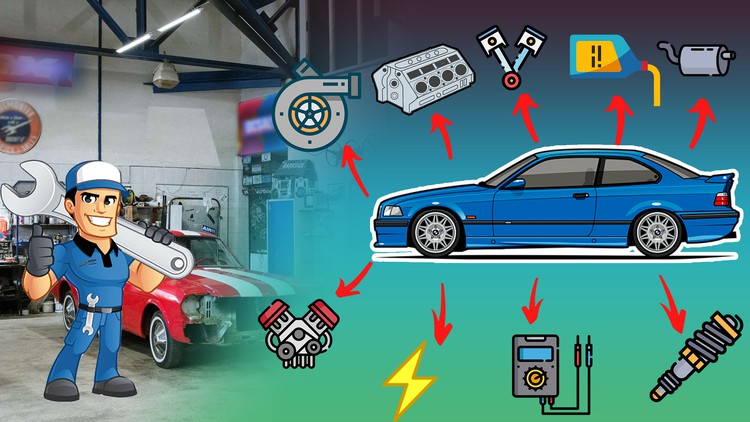
Learn the Car Repair from Beginner to Professional Level ! Car Mechanic, Car Tuning, Electrician, Automotive Engineering
What you will learn
Note➛ Make sure your 𝐔𝐝𝐞𝐦𝐲 cart has only this course you're going to enroll it now, Remove all other courses from the 𝐔𝐝𝐞𝐦𝐲 cart before Enrolling!
Car Repair for Everyone !
Engine Types and their working Principles (2 Stroke,4 Stroke and others)
Understanding Car Repair Principles
Working Principle of Automobile Sensors
Knowing how to perform a basic car tune-up.
Understanding the fundamentals of car suspension and steering systems.
The Advanced Introduction to Manual Transmission Working Principles
Semi-Clutch and DCT Transmission
Car Chassis Types
Understanding the importance of car safety and how to perform basic car safety checks.
Electronic Components of Car and Their Working Principle (Relays, Fuses, Switches and other components)
Automobile Engine and Body Train Sensors
Identifying the different parts of a car and their functions.
Electrical Engineering Training for Car Mechanics
Learning how to diagnose common car problems.
Understanding the basics of engine maintenance.
Learning about the different types of car batteries and their maintenance.
Car Suspension Types
Understanding the basics of car electrical systems.
Deep understanding of Car Repair and Car Electronic Components
Knowing how to diagnose and fix common electrical problems.
Learning about car brakes and how to diagnose and fix brake issues.
Electrical Side of Car Repair
Knowing how to diagnose and fix common suspension and steering problems.
Car Engine Control Unit (Electronic Control Unit) Working Principle
How to diagnose and fix common car heating problems.
Learning about car audio and entertainment systems.
Learning about car alarm and security systems.
Learning about hybrid and electric car systems.
and other awesome topics ! –>>
Add-On Information:
- Master the core principles of internal combustion engines, including the intricate workings of two-stroke and four-stroke cycles, and explore the nuances of various engine configurations.
- Gain proficiency in diagnostic methodologies for identifying and rectifying common automotive malfunctions, moving beyond superficial fixes to understand root causes.
- Develop a comprehensive understanding of automotive sensor technology, learning to interpret their signals and their critical role in modern vehicle performance and diagnostics.
- Become adept at conducting thorough basic car tune-ups, ensuring optimal engine performance, fuel efficiency, and emission control.
- Acquire practical knowledge of suspension and steering systems, enabling effective troubleshooting and repair of handling and alignment issues.
- Explore the sophisticated mechanics of manual and advanced automatic transmissions, including semi-clutch and Dual-Clutch Transmissions (DCTs).
- Understand the structural integrity and functional variations of different car chassis types, and their impact on vehicle dynamics.
- Prioritize and implement vehicle safety protocols, performing essential safety checks to ensure driver and passenger well-being.
- Demystify the complex electrical architecture of vehicles, learning to identify and understand the function of key components like relays, fuses, and switches.
- Gain hands-on experience with engine and body sensor integration, recognizing their interdependencies for overall vehicle operation.
- Develop the ability to accurately identify and describe the function of all major automotive components, building a strong foundation for effective repair.
- Integrate fundamental electrical engineering concepts specifically tailored for automotive applications, bridging the gap between mechanical and electrical systems.
- Cultivate problem-solving skills for diagnosing a wide range of common vehicle issues.
- Learn best practices for routine engine maintenance, extending vehicle lifespan and preventing costly repairs.
- Understand the diverse types of automotive batteries and master their maintenance for reliable starting and electrical system performance.
- Categorize and comprehend the various suspension system designs and their specific functions.
- Build a solid grasp of the entire automotive electrical system, from basic circuits to advanced control modules.
- Execute effective diagnostic and repair procedures for prevalent electrical system faults.
- Master the identification and repair of common issues within automotive braking systems.
- Focus on the crucial electrical aspects of car repair, understanding how electrical faults manifest and are resolved.
- Skillfully diagnose and rectify prevalent suspension and steering system problems.
- Unravel the complex workings of the Engine Control Unit (ECU), the brain of the modern vehicle.
- Efficiently diagnose and resolve common vehicle heating and cooling system malfunctions.
- Explore the intricacies of automotive audio and entertainment systems, including installation and troubleshooting.
- Understand the principles and installation of car alarm and security systems.
- Gain foundational knowledge in the specialized maintenance and repair of hybrid and electric vehicle systems.
- PROS:
- Comprehensive Curriculum: Covers a broad spectrum of automotive repair and electrical knowledge, from foundational principles to advanced systems.
- Practical Skill Development: Emphasizes hands-on learning and diagnostic techniques, preparing graduates for real-world automotive challenges.
- Industry-Relevant Certifications: Equips individuals with recognized credentials highly valued by employers in the automotive sector.
- Future-Proofing: Includes modules on hybrid and electric vehicles, addressing the evolving landscape of automotive technology.
- Versatile Career Paths: Opens doors to a wide range of employment opportunities in car dealerships, independent repair shops, and specialized automotive service centers.
- CONS:
- Time Commitment: The extensive curriculum may require a significant time investment for comprehensive mastery.
English
language