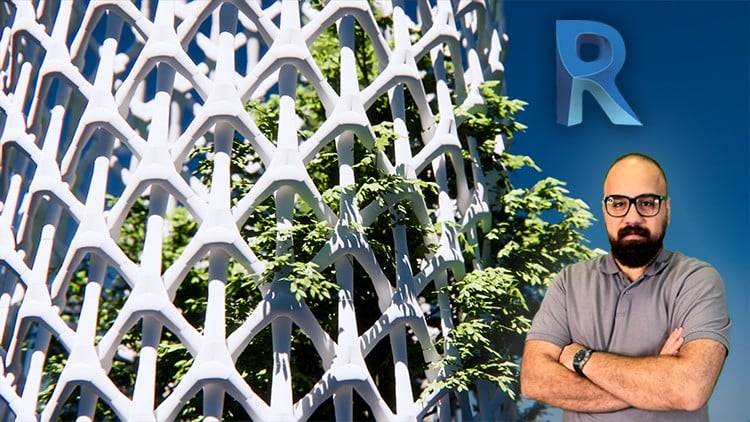
Model movable louver & Voronoi-based panel, advanced dynamic family creation using formula & adaptive Generic component.
⏱️ Length: 6.3 total hours
⭐ 4.69/5 rating
👥 3,954 students
🔄 September 2025 update
Add-On Information:
Note➛ Make sure your 𝐔𝐝𝐞𝐦𝐲 cart has only this course you're going to enroll it now, Remove all other courses from the 𝐔𝐝𝐞𝐦𝐲 cart before Enrolling!
-
Course Overview
- This course offers an intensive dive into parametric design within Revit, specifically tailored for crafting cutting-edge, pattern-based modular facades. Moving beyond conventional static representations, participants explore the profound capabilities of intelligent, data-driven design, enabling dynamic and responsive architectural skins. You’ll integrate advanced computational logic with practical BIM workflows, fostering an understanding of how complex aesthetic ambitions translate into buildable, performant structures. The curriculum focuses on developing facades that are not only visually striking but also functionally adaptable, paving the way for innovations in sustainable and responsive architecture. It empowers designers to author building envelopes that react to their environment, user input, or predefined formulas, pushing the boundaries of conventional Revit modeling. This expertise unlocks a new realm of design possibilities, fostering true architectural innovation through precise, formula-driven modeling.
-
Requirements / Prerequisites
- Basic Revit Proficiency: Foundational understanding of Revit’s user interface, navigation, and basic modeling tools is essential.
- Architectural Design Interest: Enthusiasm for innovative forms and facade design challenges will enhance engagement.
- Conceptual Understanding of Geometry: Familiarity with fundamental geometric principles and mathematical relationships as design drivers.
- Access to Autodesk Revit: Students need access to a licensed Revit version (preferably 2023+ for modern features).
- Problem-Solving Mindset: Aptitude for logical thinking and readiness to tackle complex design challenges via parametric approaches.
-
Skills Covered / Tools Used
- Computational Facade Development: Master designing intricate building envelopes where components are intelligently linked, enabling rapid iteration and refinement.
- Dynamic Design Authoring: Gain expertise in creating architectural elements with inherent movement capabilities (e.g., automated louvers) within BIM.
- Advanced Geometric Manipulation: Develop proficiency in generating sophisticated, non-linear geometries and intricate surface patterns responsive to specified inputs.
- Data-Driven Design Optimization: Learn to embed intelligence into models through parameters and formulas, optimizing facades for performance or aesthetic variation.
- Iterative Design Workflow: Adopt a methodological approach to design facilitating continuous refinement and exploration of multiple options via parametric controls.
- Intelligent System Creation: Understand building modular facade systems where individual components communicate and adapt to overall design changes.
- Digital Fabrication Preparation: Acquire modeling techniques ensuring parametric designs are precise and detailed enough for potential digital fabrication.
- Complex Form Generation within BIM: Develop the ability to model highly organic, free-form, mathematically derived shapes while maintaining BIM intelligence.
- Performance-Oriented Design Principles: Integrate design decisions with facade performance characteristics, utilizing parametric control for energy efficiency and user comfort.
-
Benefits / Outcomes
- Elevated Design Capabilities: Unlock the ability to conceive and execute highly innovative, responsive facade designs, transforming abstract ideas into tangible, intelligent models.
- Career Advancement & Specialization: Position yourself as a specialist in advanced BIM and parametric design, a highly sought-after skill in progressive architectural firms.
- Portfolio Enhancement: Create a compelling portfolio showcasing sophisticated parametric facade projects, demonstrating mastery of cutting-edge design and modeling.
- Increased Design Efficiency: Significantly reduce design and revision time by leveraging parametric intelligence, allowing faster exploration and optimization.
- Innovation in Building Envelopes: Contribute to the future of architecture by designing facades that are not only aesthetically pleasing but also performative, sustainable, and adaptive.
- Mastery of Complex Revit Workflows: Gain profound confidence in tackling challenging modeling scenarios within Revit, becoming an expert in intricate parametric solutions.
- Seamless Design-to-Documentation: Develop a robust process for taking complex parametric designs from conceptualization through to detailed documentation, ensuring accuracy and buildability.
- Empowerment Through Automation: Learn to harness design automation, allowing the system to handle repetitive tasks and complex calculations, freeing focus for creative problem-solving.
- Creative Problem Solving: Cultivate a systematic approach to design challenges, viewing constraints as opportunities for innovative parametric solutions.
-
PROS
- High Demand Skillset: Equips learners with highly sought-after expertise in advanced parametric facade design, boosting employability.
- Practical Application Focus: Concentrates on real-world architectural challenges, providing actionable skills immediately applicable.
- Innovation-Centric Curriculum: Encourages creative problem-solving and the development of unique, performance-driven architectural forms.
- Comprehensive Skill Development: Covers a wide array of advanced Revit tools and methodologies for complex parametric modeling.
- Positive Peer Validation: High rating and significant enrollment attest to the course’s quality and effectiveness.
- Up-to-Date Content: September 2025 update ensures material is current with latest Revit functionalities and best practices.
- Transformative Learning Experience: Shifts designers from static modeling to dynamic, intelligent building component creation.
- Concise and Focused: Despite advanced topics, manageable duration offers a direct path to specialized knowledge.
-
CONS
- Requires Dedicated Effort: The advanced nature of topics demands consistent practice and genuine commitment to mastering complex technical concepts.
Learning Tracks: English,Design,Architectural Design