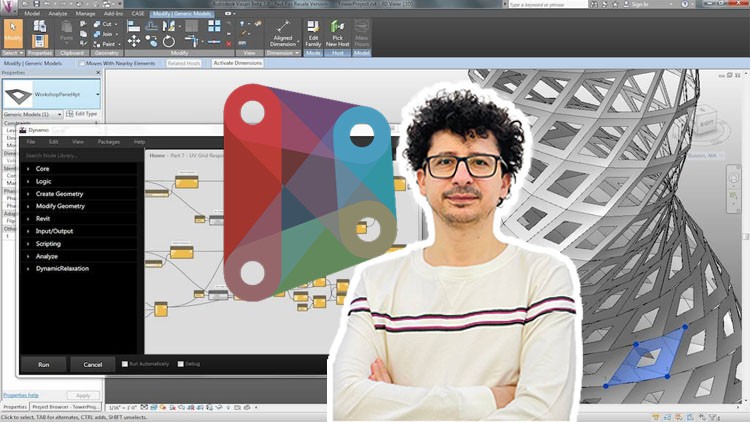
Dynamo Unleashed: Empowering Efficient Revit Workflows for Intelligent Parametric Modeling, Seamless Element Placement
What you will learn
Selection Nodes with Practical Examples
Element Nodes with Practical Examples
Placing Elements in Different Positions in Revit File Using Dynamo
Professional Parametric Modeling Project of a Room Using Dynamo
Using Mass Patterns in Dynamo and Assigning Them to Skins
Import XYZ Points from Excel into Dynamo and Convert Them into Shapes
Create Levels in Revit Intelligently with Dynamo in Seconds
Creating Sheets in Revit with Dynamo
Add Required Views to Sheets Automatically
Many Examples of Different Topics
Description
Note: The main difference in this course compared to others is that we have not confined ourselves to explaining simple techniques. Instead, we have conveyed the subject through challenging projects and specific tricks, which are the result of numerous experiences.
- Are you ready to unlock the power of Dynamo and transform your Revit workflow?
- Ready to take your Revit projects to the next level?
- Ever wondering how is sheet arrangement done with Dynamo?
Join our comprehensive Udemy course on Dynamo, where we delve into practical examples that will revolutionize your workflow. Learn to effortlessly select and manipulate nodes for efficient modeling, while gaining a solid grasp of element nodes through hands-on projects.
Discover the art of dynamically placing elements at various positions within your Revit files, all with the intelligence of Dynamo. Dynamo’s magic extends to sheet creation. Learn how to automate the process of generating sheets in Revit, complete with required views placed precisely where they belong. From start to finish, our course is packed with diverse examples and topics that will equip you with the skills you need to become a Dynamo pro.
Headlines:
- Selection Nodes with Practical Examples
- Element Nodes with Practical Examples
- Placing Elements in Different Positions in Revit File Using Dynamo
- Professional Parametric Modeling Project of a Room Using Dynamo
- Using Mass Patterns in Dynamo and Assigning Them to Skins
- Import XYZ Points from Excel into Dynamo and Convert Them into Shapes
- Create Levels in Revit Intelligently with Dynamo in Seconds
- Creating Sheets in Revit with Dynamo
- Add Required Views to Sheets Automatically
- Many Examples of Different Topics
If you are currently a BIM modeler or planning to become one, it is essential not to limit yourself to any form. You should be able to manage any architectural design in the BIM process And in the end, you will be the hero of this training. Please watch this course and feel free to ask me any questions you have while watching it.
Content
Introduction
Application and Use of Selection Library
Application and Use of Get & Set Nodes
Exercise (Sinusoidal Modeling of Columns)
Exercise (Wall Modeling by Dynamo)
Exercise (Beam Modeling with Dynamo)
Practice (Floor Modeling with Dynamo)
Practice (Ceiling Modeling with Dynamo)
Practice (Family Placement Based on Points)
Exercise (Coloring Elements Based on Parameters)
Exercise (Checking Project Furniture Based on Rooms)
Exercise (Multiplication of Elements Along the Path)
Practice (Modeling Based on the Pattern of the Mass Environment)
Practice (Using Adaptive Mass on Mass)
Exercise (Modeling Based on Excel Data)
Exercise (Placement of Families Based on AutoCAD and Excel Files)
Practice (Creating and Managing Levels with Dynamo)
Exercise (Creating and Managing Levels Based on Excel)
Exercise (Copying and Adding Views in the Sheet with Dynamo)
Exercise (Output of Revit View Information to Excel)
Practice (Modeling Shed with Dynamo)
Exercise (Creating Floor Based on Rooms)
Exercise (Showing Rooms in 3D View by Dynamo)
Exercise (Creating Room Based on Excel)
Exercise (Control and Adjustment of Texts in Revit by Dynamo)
Practice (Setting the Color of the Panels Randomly)
Exercise (Showing the Connection Elements Relative to Each Other)
Checking Element Type Nodes
Checking New Nodes in Revit
Checking Selection Nodes
Checking the Warning Nodes
Exercise (Creating Topography Based on the Image)
Exercise (Parametric Tower Modeling in Full)
Dynamo Unleashed: A Deep Dive into Intermediate Parametric Power
This “BIM-Dynamo Intermediate (Level 2)- Project Based” course promises a significant step up from the basics, and from my perspective, it largely delivers. Having spent years navigating the complexities of Revit and exploring automation tools, I approached this with a keen eye for practical application and genuine skill development. The “Project Based” aspect is key here; it’s not just about learning nodes, it’s about understanding how to string them together to solve real-world BIM challenges. If you’ve dabbled with Dynamo but feel stuck on rudimentary tasks, this course aims to push you into more sophisticated territory, bridging the gap between beginner curiosity and job-ready skills.
Prerequisites
My recommendation is that you’ve got a solid grasp of the Dynamo Fundamentals. Think knowing your way around the interface, understanding basic list manipulation (flatten, unwrap, etc.), and having a general comfort level with Revit’s core functionality. This isn’t a “learn Dynamo from scratch” course. You should also be comfortable with the idea of parametric modeling in Revit, even if you haven’t automated it with Dynamo yet. A basic understanding of Excel is also beneficial, given the mention of importing XYZ points.
Skills & Tools Gained
This course is designed to equip you with a robust set of job-ready skills. You’ll move beyond simple element selection and delve into intelligent placement, understanding how to control position, orientation, and parameters with precision. The ability to create complex geometry, like mass patterns and assigning them to skins, opens up significant design possibilities. Crucially, the course tackles common Revit administrative tasks that can be incredibly time-consuming – think automating level creation and sheet generation with associated views. This isn’t just about theoretical knowledge; the emphasis on hands-on labs and real-world projects ensures you’re building practical muscle memory. The tools you’ll be manipulating are, of course, Dynamo and Revit, but the real takeaway is the ability to leverage these industry-standard tools more effectively.
Career Benefits & Job Roles
For anyone looking for career growth in the BIM space, this kind of intermediate Dynamo training is invaluable. It positions you as a more efficient and valuable asset to any project team. Roles like BIM Coordinator, BIM Specialist, or even a more advanced Revit Modeler will benefit immensely. The ability to automate tasks not only saves time but also reduces errors, a highly sought-after trait. This course can also serve as excellent certification prep for more advanced BIM qualifications, demonstrating a commitment to mastering these essential technologies.
Pros
- Bridging the Gap to Advanced Automation: This course excels at taking users from basic Dynamo functionality to tackling complex, multi-step automations that directly address common Revit workflows. The project-based approach is fantastic for seeing how different nodes and concepts tie together in a meaningful way.
- Tangible Output and Time Savings: The emphasis on creating levels, sheets, and placing elements intelligently translates directly into significant time savings on actual projects. You’ll feel a real sense of accomplishment seeing how much manual work you can eliminate.
- Practical Geometry and Data Handling: The inclusion of topics like importing XYZ points and working with mass patterns provides practical experience in handling external data and generating more complex parametric geometry within Revit, which is a game-changer for design exploration.
- Reinforced Learning Through Examples: The sheer volume of different examples provided for various topics is a major strength. This allows for repeated exposure to concepts and demonstrates multiple ways to achieve similar outcomes, fostering a deeper understanding.
Cons
- Can Be Overwhelming Without Solid Fundamentals: While the course targets intermediate users, if your foundational Dynamo understanding is shaky, some of the more complex scripts and workflows might feel like a leap too far. A bit more introductory context or review within the course for certain advanced concepts could have been beneficial for those who haven’t used Dynamo consistently since their initial learning.