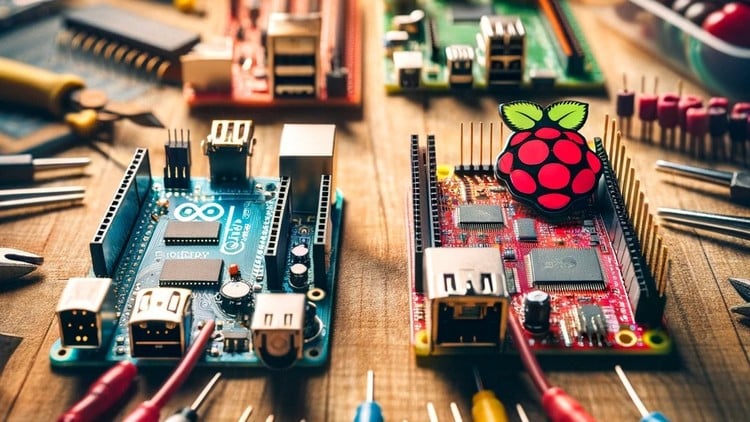
You will no longer wonder what board should you start with, or what board should you learn or use.
⏱️ Length: 1.4 total hours
⭐ 4.00/5 rating
👥 15,027 students
🔄 June 2025 update
Add-On Information:
Note➛ Make sure your 𝐔𝐝𝐞𝐦𝐲 cart has only this course you're going to enroll it now, Remove all other courses from the 𝐔𝐝𝐞𝐦𝐲 cart before Enrolling!
- Course Overview
- This essential course offers a clear, concise, and highly practical comparison of Arduino, Raspberry Pi, and PIC Microcontrollers. It demystifies these prevalent embedded platforms, clarifying their strengths, weaknesses, and ideal application scenarios.
- The initial choice of your development board significantly impacts a project’s success. This course directly addresses that critical decision, providing a side-by-side analysis that uncovers fundamental differences and shared attributes.
- You’ll gain a foundational understanding, systematically breaking down conceptual boundaries between Arduino (microcontroller board), Raspberry Pi (single-board computer), and PIC Microcontroller (traditional microcontroller family).
- Meticulously structured for efficiency, the curriculum provides a strategic overview without getting bogged down in intricate code examples. Despite its brevity (1.4 total hours), it delivers actionable insights for informed decision-making.
- Ultimately, this course empowers learners, from beginners to experienced individuals, to confidently navigate embedded hardware options. It offers a structured approach to evaluating platforms against specific project requirements, ensuring your next endeavor starts with the optimal technology.
- Requirements / Prerequisites
- No prior specific knowledge of Arduino, Raspberry Pi, or PIC Microcontrollers is necessary. This course is accessible to beginners in embedded systems, focusing purely on comparative understanding.
- A basic understanding of general computing principles and an eagerness to learn about hardware-software interaction are beneficial.
- An inherent curiosity about electronics, building projects, or exploring IoT foundations will enhance your learning experience.
- No specific software installation or hardware acquisition is needed. All comparisons are theoretical and observational.
- A stable internet connection and a device capable of playing video content are the only technical requirements.
- Skills Covered / Tools Used
- Analytical Comparison Skills: Develop the ability to critically evaluate and contrast technical specifications, architectural designs, and operational paradigms across diverse embedded computing platforms.
- Decision-Making Frameworks for Hardware Selection: Acquire a structured approach to selecting the most appropriate hardware based on comprehensive analysis of project constraints like budget, power, processing needs, memory, and real-time demands.
- Fundamental Embedded Concepts: Gain a clear conceptual understanding of the core differences between a microcontroller’s dedicated real-time control, a single-board computer’s OS-driven multitasking, and a traditional microcontroller’s low-level programming.
- Resource Optimization Awareness: Cultivate insight into how factors like on-board memory, processor speed, GPIO pins, ADC presence, and power efficiency directly influence project scope, complexity, and scalability.
- Development Ecosystem Comprehension: Understand the typical software toolchains, IDEs, programming languages (e.g., C/C++, Python), and community support associated with Arduino, Raspberry Pi, and PIC Microcontrollers.
- Project Scoping Acumen: Learn to effectively map specific project requirements and envisioned functionalities to the inherent strengths and limitations of each platform for realistic planning.
- Understanding of Trade-offs: Recognize the inherent compromises in hardware selection, such as balancing ease of use with performance, or cost with flexibility, fostering a mature engineering perspective.
- Strategic Technology Assessment: Develop the capacity to assess emerging technologies and new platform iterations against foundational comparative knowledge, enabling continuous adaptation in a rapidly evolving tech landscape.
- Benefits / Outcomes
- Accelerated Project Initiation: Drastically reduce time spent on initial project planning by making confident, well-informed hardware decisions from the start, allowing faster development.
- Cost-Effective Development Cycle: Prevent costly mistakes and wasted resources by selecting optimal hardware, avoiding over-engineering or under-specifying, leading to efficient budget allocation.
- Enhanced Project Reliability & Performance: Implement solutions built upon platforms inherently suited to your application’s demands, ensuring greater stability and predictable performance.
- Expanded Technical Fluency: Articulate the distinct advantages and disadvantages of each platform with precision, enriching technical discussions and making you a more knowledgeable contributor.
- Confident Platform Migration & Scalability: Gain foundational understanding to gracefully transition between platforms as project requirements evolve or scale, recognizing when a different board is more appropriate.
- Strategic Hardware Planning Capabilities: Develop a forward-thinking mindset for embedded system design, anticipating future needs, challenges, and integration possibilities.
- Empowered Innovation: Feel liberated to conceptualize and explore a wider array of project ideas, knowing you possess the analytical toolkit to select the most fitting technological foundation.
- Competitive Edge in the Job Market: Equip yourself with the highly valued skill of critically assessing and recommending appropriate embedded hardware, sought after in engineering, IoT, robotics, and automation roles.
- Reduced Learning Curve for New Platforms: By understanding the fundamental characteristics and philosophies of these core platforms, you’ll find it significantly easier to grasp new or niche embedded technologies.
- PROS of this Course
- Highly Focused and Targeted: Addresses a common point of confusion for beginners and intermediate users in embedded systems.
- Time-Efficient Learning: At only 1.4 hours, it delivers maximum insight in minimal time, ideal for busy schedules.
- Expert-Vetted Content: A 4.00/5 rating from a significant student base indicates high quality and effectiveness.
- Current and Relevant: Benefits from a June 2025 update, ensuring up-to-date information on technologies and trends.
- Practical Decision-Making: Provides actionable knowledge immediately applicable to real-world project planning.
- Broad Appeal: Suitable for hobbyists, students, and professionals solidifying their understanding of embedded platforms.
- Confidence Building: Empowers learners to overcome uncertainty in hardware selection, leading to more productive development.
- CONS of this Course
- While excellent for comparative understanding, the short duration means it focuses primarily on high-level conceptual differences and may not delve into deep-dive coding examples or hands-on practical implementation for each platform.
Learning Tracks: English,IT & Software,Other IT & Software