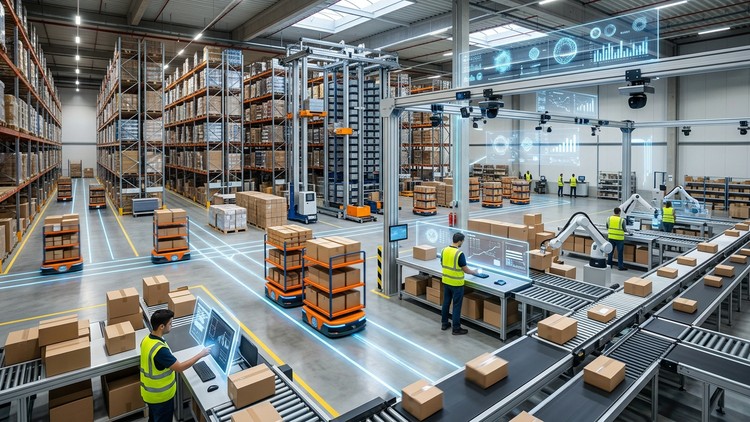
Master AI, Robotics, PLC & Edge Computing for modern warehouses. Real Indian projects, Python code, and job-ready skills
What You Will Learn:
- Apply AI and machine learning to real warehouse operations from receiving to dispatch
- Understand and evaluate AMRs, AGVs, ASRS, and Goods-to-Person automation systems
- Connect PLC signals to AI pipelines using OPC-UA, MQTT, and Edge AI on Jetson hardware
- Build demand forecasting, anomaly detection, and pick optimisation models in Python
- Design digital twins for warehouse equipment and predict failures before they happen
- Calculate ROI and build a board-level business case for warehouse AI investment
My Take: Why This Isn’t Your Typical “Hello World” AI Course
Let’s be real for a second. The internet is flooded with generic AI courses that teach you how to classify pictures of cats and dogs. But in the high-stakes world of 2026 logistics, that stuff won’t get you a seat at the table. I recently went through the AI in Warehouse Management — Receiving to Dispatch 2026 program, and it’s a different beast entirely. It’s gritty, technical, and refreshingly practical. Instead of staying in the clouds, this course drags AI down into the warehouse trenches where the real career growth is happening.
The standout feature for me was the focus on the “Physical-to-Digital” bridge. Most data scientists have no clue how a PLC (Programmable Logic Controller) works, and most warehouse managers don’t know their way around a Python script. This course forces those two worlds to shake hands. It’s about more than just software; it’s about understanding how a Jetson hardware module on the edge can make a split-second decision on a conveyor belt without waiting for a round-trip to a cloud server. If you’re tired of theoretical fluff and want job-ready skills that actually solve “broken pallet” or “bottleneck” problems, this is where you need to be.
Who Should Actually Sign Up? (Prerequisites)
This isn’t exactly a “zero-to-hero” course for someone who has never touched a keyboard. To get the most out of these hands-on labs, you should come prepared with:
- Foundational Python: You don’t need to be a software engineer, but you should know your way around loops, functions, and basic libraries like Pandas.
- Logic Basics: A basic understanding of how goods move from a loading dock to a rack will save you a lot of head-scratching.
- Hardware Curiosity: You need a genuine interest in the “moving parts”—robotics, sensors, and edge devices.
- System Access: While many simulations are provided, having a mid-range PC to run digital twin environments is a huge plus.
The Toolkit: Industry-Standard Tools You’ll Master
The curriculum doesn’t waste time on obscure academic tools. You’ll be working with the same stack used by global 3PL (Third-Party Logistics) giants. The real-world projects focus heavily on:
- Python & PyTorch: For building the actual “brains” behind demand forecasting and anomaly detection.
- OPC-UA & MQTT: These are the “languages” of the warehouse floor. Learning to pipe data from a Siemens PLC into an AI model via MQTT is a game-changer.
- NVIDIA Jetson & Edge AI: Mastering Edge Computing is the secret sauce here. You’ll learn how to deploy models locally for zero-latency computer vision.
- Digital Twin Software: You’ll use simulation tools to build a virtual replica of a warehouse to test your pick optimisation algorithms before deploying them to a real AMR.
Career Benefits & Job Roles
The logistics sector is currently undergoing a massive “intelligence” upgrade. Completing this course serves as excellent certification prep for those looking to pivot into high-paying, specialized roles. Because the course uses real Indian projects as case studies, it’s particularly valuable for the booming logistics hubs in Bengaluru, Pune, and Gurgaon.
After finishing, you’ll be qualified for roles such as Warehouse Automation Engineer, Supply Chain Data Scientist, or AI Solutions Architect. These aren’t just entry-level positions; these are roles where you’re expected to justify the ROI of multi-million dollar automation investments, a skill this course teaches better than any MBA program I’ve seen.
The Pros: Where This Course Shines
- The “Hardware-First” Approach: Most AI courses ignore the physical world. This one embraces it. Connecting PLC signals to AI pipelines is a rare and highly sought-after skill in 2026.
- Business Acumen: I loved the section on building a board-level business case. If you can’t prove the ROI, the board won’t fund your AI project. This course teaches you how to speak “C-Suite.”
- Hyper-Relevant Projects: Using real-world projects based on actual warehouse layouts (receiving to dispatch) ensures you aren’t just learning syntax, but solving actual operational headaches.
The Cons: An Honest Critique
If there’s one drawback, it’s the steep learning curve once you hit the Edge AI and Jetson hardware integration. For a student without a background in hardware or networking, the jump from writing Python code to configuring OPC-UA gateways can feel like hitting a brick wall. The course could benefit from a few more “bridge” lessons to help pure software types navigate the complexities of industrial hardware protocols without feeling overwhelmed.