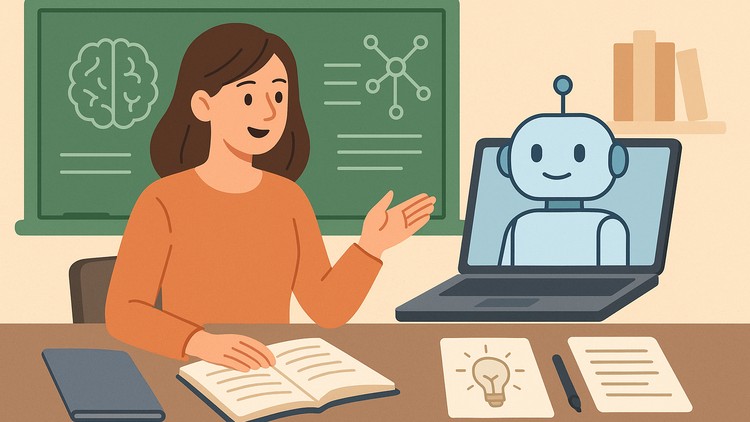
Innovating Instruction with Confidence and Responsibility
What you will learn
Note➛ Make sure your 𝐔𝐝𝐞𝐦𝐲 cart has only this course you're going to enroll it now, Remove all other courses from the 𝐔𝐝𝐞𝐦𝐲 cart before Enrolling!
Explain the basics of AI and its relevance to education.
Apply AI tools to enhance teaching, learning, and productivity.
Identify risks, ethical issues, and equity concerns tied to AI.
Teach students responsible and critical AI use.
Design instructional materials and classroom practices that integrate AI thoughtfully.
Add-On Information:
- Innovating Instruction with Confidence and Responsibility
-
- Cultivate an AI-fluent pedagogical approach: Move beyond simply using AI tools to strategically integrating them into your overall teaching philosophy and practice, understanding how AI can fundamentally reshape learning environments and instructional design.
- Master AI’s potential for differentiated instruction: Discover how to leverage AI to tailor learning experiences for diverse student needs, ensuring every learner receives personalized support and challenges that meet them where they are, fostering equitable access to advanced learning.
- Become a discerning curator and critical evaluator of AI educational technologies: Develop the sophisticated judgment to assess the pedagogical value, reliability, and appropriateness of various AI platforms and applications for your specific subject matter and student demographics.
- Navigate the evolving landscape of AI-driven assessment and feedback: Explore innovative ways AI can support formative and summative assessment, providing richer, more timely insights into student progress while upholding fairness, academic integrity, and reducing teacher workload.
- Foster a proactive culture of AI literacy within your institution: Learn robust strategies to champion and disseminate best practices for AI integration among colleagues and administrators, building a collective understanding of its profound benefits and inherent boundaries.
- Empower students to become conscientious digital citizens in an AI world: Gain practical, actionable methods to guide students in critically understanding AI’s pervasive societal impact, using it responsibly, and recognizing its limitations, inherent biases, and ethical implications.
- Design future-ready curricula that strategically embrace AI as a collaborative learning partner: Develop the foresight and skills to adapt existing course content and create innovative new modules that genuinely prepare students for a world where AI collaboration is not just common, but essential.
- Strategize for robust data privacy and security in AI-enhanced learning environments: Understand the critical implications of data collection, processing, and usage by AI tools in education, implementing stringent protocols to safeguard sensitive student information and ensure compliance.
- Harness AI to unlock unprecedented avenues for deep research and inquiry-based learning: Explore how AI can serve as a powerful assistant for both students and educators in conducting complex research, analyzing vast datasets, and generating innovative, creative solutions to real-world problems.
- Develop and influence institutional guidelines for responsible AI adoption: Acquire the knowledge to contribute meaningfully to shaping school, district, or university-level policies that ensure ethical, equitable, and demonstrably effective integration of AI technologies across all educational domains.
- Transform your role from a traditional content deliverer to an AI-facilitated learning orchestrator: Reimagine your teaching identity, intelligently leveraging AI to automate routine administrative tasks, thereby freeing up invaluable time to focus on higher-order thinking, personalized mentorship, and critical student engagement.
- Proactively address the digital equity gap in an AI-driven educational future: Learn to identify and strategically mitigate potential disparities in AI access and proficiency, ensuring all students, regardless of background, can fully benefit from technological advancements and opportunities.
- Spark continuous innovation in your classroom by confidently experimenting with emerging AI technologies: Gain the confidence and foundational understanding to explore cutting-edge AI tools and methodologies, staying dynamically ahead of the curve in the rapidly evolving landscape of educational technology.
- PROS:
- Future-Proof Your Teaching Skills: Gain an essential, forward-thinking toolkit for navigating the rapidly evolving educational landscape, ensuring your professional relevance and effectiveness for years to come.
- Elevate Student Engagement and Outcomes: Learn to profoundly personalize learning experiences, foster deeper understanding, and genuinely prepare students for an AI-integrated world, leading to more motivated, capable, and successful learners.
- Become an Ethical AI Leader: Develop the critical expertise to confidently guide your institution and students in responsible AI use, championing equity, critical thinking, and thoughtful technological adoption.
- Boost Your Professional Efficiency and Creativity: Leverage AI to intelligently automate routine administrative and instructional tasks, freeing up valuable time and inspiring innovative, transformative instructional strategies, enhancing both productivity and job satisfaction.
- CONS:
- Requires Ongoing Adaptability: The rapid, exponential pace of AI development means continuous learning, critical evaluation, and flexible adaptation will be necessary to stay current with the latest tools, ethical considerations, and best practices.
English
language