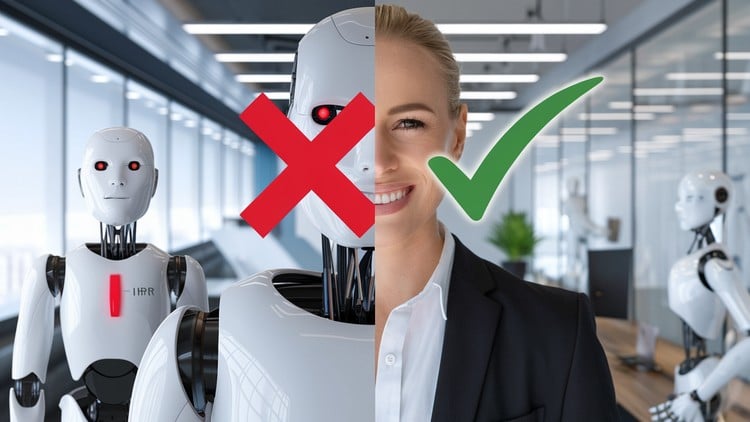
Become an AI-Ready HR Leader: From Compliance Expert to Innovation Champion
⏱️ Length: 7.2 total hours
⭐ 4.00/5 rating
👥 6,271 students
🔄 February 2025 update
Add-On Information:
Note➛ Make sure your 𝐔𝐝𝐞𝐦𝐲 cart has only this course you're going to enroll it now, Remove all other courses from the 𝐔𝐝𝐞𝐦𝐲 cart before Enrolling!
- Course Overview
- This timely and essential course positions HR professionals at the forefront of the artificial intelligence revolution, transforming them into vital architects of responsible AI deployment.
- Moving beyond superficial understanding, it dives deep into the intricate interplay between cutting-edge AI technologies and the ethical, legal, and operational landscapes of human resources.
- Participants will gain a holistic perspective on integrating AI ethically and effectively across talent acquisition, performance management, employee development, and workforce planning.
- It’s designed to equip HR leaders not just with compliance knowledge, but with the strategic foresight to champion AI innovation while meticulously safeguarding organizational values, employee rights, and regulatory adherence.
- Explore how to create a culture of transparency, fairness, and accountability around AI, ensuring technology serves humanity in the workplace.
- This program provides the critical frameworks for navigating the complex future of work, making HR a proactive force in shaping intelligent and equitable organizations.
- Requirements / Prerequisites
- Fundamental understanding of human resources principles: Familiarity with core HR functions such as recruitment, talent management, compensation, and employee relations is beneficial.
- Basic awareness of Artificial Intelligence concepts: While no prior technical expertise in AI programming is required, a general grasp of what AI is and its potential applications is helpful.
- An eagerness to engage with digital transformation: A proactive interest in technology’s impact on the workplace and a willingness to explore innovative solutions.
- A commitment to ethical leadership: A desire to uphold fairness, transparency, and accountability in all aspects of organizational development.
- Skills Covered / Tools Used
- Ethical AI Design & Implementation: Developing the capacity to identify, analyze, and mitigate biases in AI algorithms impacting hiring, promotions, and performance reviews.
- Data Stewardship & Privacy Advocacy: Mastering principles of secure data handling, anonymization techniques, and advocating for robust data privacy policies within AI-driven HR processes, aligned with global privacy standards (e.g., GDPR, CCPA implications).
- Stakeholder Communication & Influence: Cultivating the ability to articulate complex AI governance concepts to diverse audiences, including executive leadership, legal teams, IT departments, and employees, fostering cross-functional alignment.
- Policy Formulation & Adaptation: Crafting internal guidelines and organizational policies that proactively address the societal and legal implications of AI use in HR, ensuring agility in response to evolving regulations.
- Organizational Change Leadership for AI Adoption: Guiding teams and entire organizations through the cultural shifts necessary for successful, responsible AI integration, managing resistance, and promoting acceptance.
- AI Lifecycle Ethical Review: Implementing checkpoints for ethical review at every stage of an AI system’s lifecycle, from conception and procurement to deployment and decommissioning.
- Technology Assessment & Vendor Management: Evaluating AI vendor solutions not just for functionality but for their inherent ethical design, data security practices, and compliance commitments.
- Strategic Foresight in AI: Anticipating future trends in AI development and regulation, allowing HR to prepare proactively for emerging challenges and opportunities.
- Conceptual Tools: Engagement with ethical AI frameworks (e.g., principles derived from the EU AI Act, NIST AI Risk Management Framework), templates for impact assessments, communication strategies for AI literacy, and conceptual models for privacy-by-design in HR tech.
- Benefits / Outcomes
- Elevated Strategic Influence: Position yourself as an indispensable strategic partner, guiding your organization through the complexities of AI adoption with confidence and integrity.
- Career Resilience & Advancement: Future-proof your professional trajectory by becoming a sought-after expert in a rapidly evolving and critical domain, opening doors to leadership roles in AI strategy and ethical technology.
- Enhanced Organizational Trust: Cultivate a reputation for responsible innovation, bolstering employee trust, investor confidence, and brand integrity through transparent and ethical AI practices.
- Mitigated Legal & Reputational Risk: Proactively identify and neutralize potential legal pitfalls and public relations challenges associated with AI, safeguarding your organization from costly sanctions and reputational damage.
- Fostered Ethical Innovation Culture: Lead the charge in building a workplace where AI is a force for good, promoting fairness, equity, and human-centric design in all technological implementations.
- Global Compliance Acumen: Gain a nuanced understanding of diverse international AI regulatory landscapes, enabling your organization to operate with confidence across various jurisdictions.
- PROS
- Highly Relevant & Future-Oriented: Addresses an urgent and growing need for ethical AI leadership within the HR domain.
- Actionable & Practical Insights: Provides concrete strategies and frameworks that can be immediately applied in real-world scenarios.
- Empowers HR for Strategic Leadership: Transforms HR professionals from administrative roles to key drivers of organizational innovation and responsibility.
- Comprehensive Skill Development: Covers a broad spectrum of competencies, from policy formulation to ethical decision-making and change management.
- CONS
- Requires Continuous Learning: The rapid pace of AI development and regulatory changes necessitates ongoing self-education and adaptation beyond the course duration.
Learning Tracks: English,Business,Management