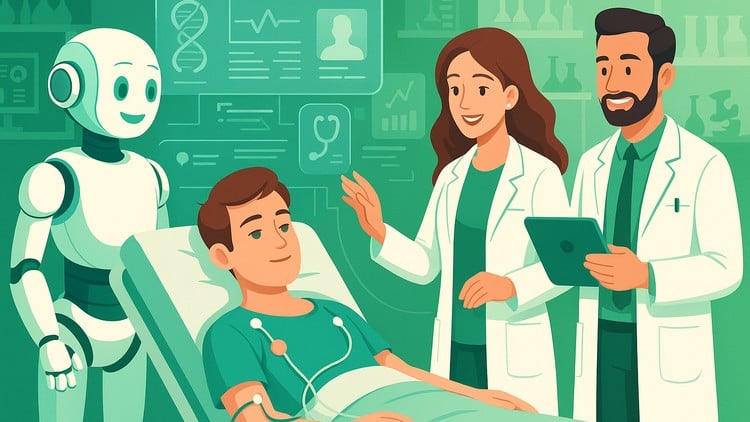
Understand AI in medicine, digital health, and wellbeing: clinical ML, multimodal AI & synthetic data to explainability
⏱️ Length: 2.3 total hours
👥 54 students
🔄 October 2025 update
Add-On Information:
Note➛ Make sure your 𝐔𝐝𝐞𝐦𝐲 cart has only this course you're going to enroll it now, Remove all other courses from the 𝐔𝐝𝐞𝐦𝐲 cart before Enrolling!
- Course Overview
- This course explores the transformative intersection of artificial intelligence, digital health, and individual wellbeing, offering a strategic perspective on their dynamic convergence. It illuminates how intelligent systems are redefining not only patient care and diagnostic processes but also preventative medicine and personalized health management strategies across diverse populations. Participants will gain a comprehensive understanding of the ethical considerations, cutting-edge technological advancements, and practical applications that are driving profound innovation in this critical and rapidly expanding domain. The curriculum emphasizes moving beyond theoretical AI concepts to addressing real-world scenarios where AI profoundly augments human capabilities for achieving superior health outcomes, promoting health equity, and fostering sustainable wellness practices for individuals and communities alike. Learners will acquire crucial insights into developing, evaluating, and responsibly deploying AI solutions that are both clinically effective and ethically integrated into diverse health ecosystems, from advanced clinical settings to ubiquitous everyday lifestyle support systems and broader public health initiatives.
- Requirements / Prerequisites
- A foundational understanding of data science principles, including basic statistics and data manipulation techniques, is highly recommended for optimal engagement with the course material. Participants should possess basic programming proficiency, ideally in Python, as practical examples and exercises will significantly leverage this language to illustrate key concepts. An eagerness to explore complex, data-driven problems within health contexts and a genuine interest in the societal implications and ethical considerations surrounding AI’s deployment in sensitive areas like personal health information are highly valued. This course is ideally suited for professionals, researchers, and students aiming to enter or advance their expertise within digital health, or current practitioners seeking to strategically integrate cutting-edge AI methodologies into their existing frameworks.
- Skills Covered / Tools Used
- Learners will cultivate the practical capacity to preprocess, clean, and transform heterogeneous health datasets, which include complex electronic health records, real-time physiological data from wearable devices, diverse medical imagery (e.g., radiology scans, pathology slides), and even genomic information, making them suitable for robust AI model consumption. The course fosters expertise in judiciously selecting and adapting appropriate AI architectures for a wide array of health-related tasks, such as early disease risk prediction, sophisticated diagnostic support, personalized treatment pathway recommendations, and tailored intervention planning for chronic conditions. Significant emphasis will be placed on developing model interpretability techniques, ensuring that AI decisions, particularly in high-stakes clinical applications, can be transparently understood, justified, and trusted by healthcare professionals and patients alike. Practical sessions will involve hands-on engagement with leading open-source machine learning and deep learning libraries such as scikit-learn, TensorFlow, or PyTorch, alongside powerful data manipulation and analysis tools like Pandas and NumPy, all within an interactive Python programming environment. Participants will also gain proficiency in visualizing complex health data trends, communicating AI model outputs effectively, and assessing the ethical implications of their deployments to facilitate clearer insights and responsible innovation.
- Benefits / Outcomes
- Upon successful completion, participants will emerge well-equipped to contribute meaningfully to the strategic design, iterative development, and effective implementation of innovative AI-powered solutions across various healthcare and wellness industries. They will cultivate a highly critical and nuanced perspective on both the immense potential and inherent limitations of AI, thereby enabling them to make informed, evidence-based decisions regarding technology adoption, policy formulation, and investment in future health technologies. This course profoundly empowers individuals to pioneer new, more efficient models of care delivery, significantly improve patient engagement through personalized interventions, and actively advance precision health initiatives that cater to individual biological and lifestyle differences. Graduates will be adept at identifying unexplored opportunities for AI integration, comprehensively assessing the feasibility and scalability of proposed solutions, and passionately advocating for responsible, equitable, and patient-centric AI deployments, ultimately positioning themselves as influential change-makers in the ongoing digital health revolution. The acquired interdisciplinary knowledge and practical skills will also significantly enhance their ability to collaborate effectively with diverse teams, expertly bridging the crucial gap between specialized clinical expertise and cutting-edge technological innovation.
- PROS
- Highly Relevant and Timely: Offers a focused and forward-looking exploration of AI’s rapidly expanding role in critical health sectors, directly addressing contemporary challenges and unlocking future opportunities in a dynamic field.
- Concise and Impactful Learning: Designed as a potent, short course (2.3 hours), it provides a concentrated yet comprehensive learning experience for busy professionals seeking to quickly grasp essential concepts and actionable applications without extensive time commitment.
- Holistic Interdisciplinary Perspective: Fosters a well-rounded understanding that intelligently spans core technological principles, crucial clinical applications, and vital ethical and societal dimensions, preparing learners for multifaceted roles at the forefront of digital health.
- Actionable Insights for Innovation: Empowers participants with concrete, practical insights to develop, evaluate, and strategically implement AI strategies, directly driving tangible improvements in health outcomes, patient experience, and wellbeing initiatives.
- Accelerates Career Advancement: Equips individuals with highly sought-after, cutting-edge skills in a rapidly expanding and high-demand interdisciplinary field, significantly enhancing their marketability and career trajectories.
- Promotes Proactive Health Paradigms: Demonstrates how AI can fundamentally shift the focus from reactive disease treatment to proactive, preventative, and deeply personalized care models, aligning with modern health philosophies.
- CONS
- Limited Depth for Complex Topics: The relatively short duration of the course (2.3 hours) may necessitate a high-level overview of certain complex, nuanced topics within AI and health, potentially requiring further independent study for truly specialized expertise or advanced implementation.
Learning Tracks: English,Business,Other Business