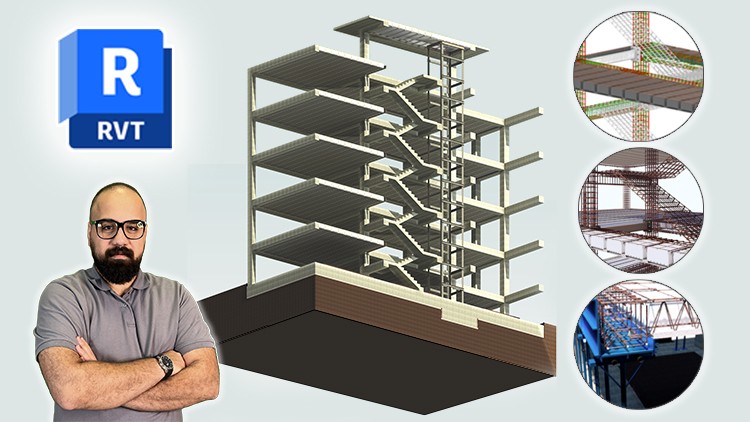
Learn step-by-step foundation, beams, columns, reinforcement, formwork & quantity takeoffs in Revit
⏱️ Length: 11.1 total hours
⭐ 4.89/5 rating
👥 2,141 students
🔄 September 2025 update
Add-On Information:
Note➛ Make sure your 𝐔𝐝𝐞𝐦𝐲 cart has only this course you're going to enroll it now, Remove all other courses from the 𝐔𝐝𝐞𝐦𝐲 cart before Enrolling!
- Course Overview
- Dive deep into the sophisticated world of Advanced Revit BIM, specifically tailored for LOD 400 concrete structure modeling. This isn’t just about creating shapes; it’s about engineering precision, constructability, and data integrity crucial for real-world projects.
- This specialized course transcends basic modeling, pushing you to integrate advanced design principles with real-world construction methodologies. You’ll learn to develop intelligent, fabrication-ready models that serve as a direct conduit for site execution.
- Explore the intricate nuances of concrete structural design, focusing on how to translate complex engineering specifications into actionable BIM data. The curriculum is meticulously crafted to empower you with skills that bridge the gap between design office and construction site.
- Understand the critical importance of Level of Development (LOD) 400 in concrete projects, where every element, from a rebar stirrup to a formwork panel, is modeled with sufficient detail and accuracy for actual fabrication, assembly, and installation.
- The course content, updated for September 2025, reflects the latest industry standards and Revit capabilities, ensuring you gain contemporary, in-demand expertise in structural BIM.
- Beyond static models, learn to simulate the dynamic progression of a construction project, understanding how BIM facilitates superior project planning, risk mitigation, and resource allocation for concrete structures.
- This program is designed for ambitious professionals eager to elevate their BIM proficiency and become indispensable assets in large-scale structural engineering and construction projects.
- Requirements / Prerequisites
- A foundational understanding and practical experience with Autodesk Revit, ideally having worked on architectural or simpler structural models. This course assumes familiarity with Revit’s user interface and basic functionalities.
- Basic knowledge of structural engineering principles and concrete construction processes will be highly beneficial, as the course delves into the practical application of these concepts within a BIM environment.
- Access to Autodesk Revit software (version 2023 or newer is recommended for optimal compatibility with course content).
- A commitment to detailed, precision-oriented work, as LOD 400 demands meticulous attention to every component and its attributes.
- A willingness to engage with advanced parametric modeling concepts and data-driven design workflows.
- No prior expertise in advanced Revit features or LOD 400 is strictly required, as the course will guide you step-by-step, but an eager learning attitude is essential.
- Skills Covered / Tools Used
- Mastering the creation and application of advanced parametric Revit families specifically for concrete structures, including smart rebar components, custom formwork elements, and specialized construction aids.
- Developing sophisticated BIM execution plans tailored for concrete structural projects, ensuring seamless integration of design, fabrication, and construction data.
- Proficiency in data-rich model management, learning to embed crucial information within model elements for procurement, scheduling, and asset management.
- Applying advanced graphic project management techniques within Revit, enhancing the clarity and impact of construction documentation and stakeholder presentations.
- Utilizing Revit’s analytical tools for early-stage clash detection and constructability reviews, specifically for complex reinforcement and structural connections.
- Implementing interdisciplinary coordination strategies, understanding how concrete structure models interact with other trades and resolve potential conflicts proactively.
- Techniques for optimizing model performance and file management when dealing with highly detailed LOD 400 models and large project datasets.
- Exploring automation potentials within Revit, such as scripting for repetitive tasks or custom data extraction, to streamline concrete detailing workflows.
- Enhancing visualization skills to create compelling 3D construction sequences and detailed assembly instructions directly from your BIM model.
- Benefits / Outcomes
- Transform into a highly competent BIM professional capable of delivering LOD 400 concrete models that meet rigorous industry standards for fabrication and construction.
- Significantly enhance your employability and career prospects in structural engineering firms, construction companies, and BIM consultancy roles.
- Gain the ability to lead and execute complex concrete structural projects, from concept to practical completion, with unparalleled precision and efficiency.
- Develop a strategic mindset for integrating BIM into the entire construction lifecycle, optimizing material usage, labor, and equipment planning.
- Become an expert in generating reliable, automated project deliverables, drastically reducing manual errors and saving substantial project time and costs.
- Cultivate advanced problem-solving skills, particularly in designing constructible solutions for intricate concrete elements and managing vast amounts of structural data.
- Position yourself as a key player in driving innovation and efficiency within your organization’s structural BIM workflows.
- PROS
- Highly Practical & Industry-Relevant: Focuses on real-world application, making your skills immediately deployable in demanding construction environments.
- Expert-Led & Proven: Taught by experienced professionals with a 4.89/5 rating from over 2,141 students, ensuring high-quality, reliable instruction.
- Comprehensive Coverage: Spans the entire concrete structure lifecycle from excavation to final detailing, including advanced concepts like formwork and phasing.
- Future-Proof Skills: Equips you with advanced BIM competencies that are increasingly vital for modern, efficient, and data-driven construction projects.
- Direct Impact on Project Efficiency: Learn to automate documentation, reduce errors, and optimize construction sequencing, leading to tangible project benefits.
- CONS
- Significant Time Commitment: The advanced nature and comprehensive scope require dedication, and the 11.1 total hours are just the instructional time, with practice likely requiring much more.
Learning Tracks: English,Design,Design Tools