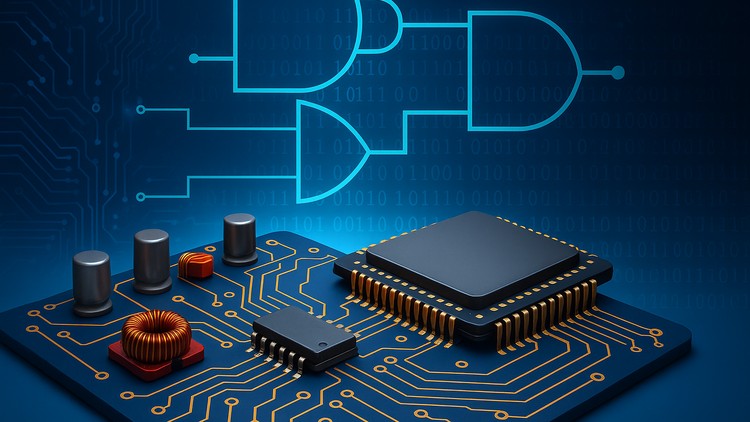
Master core computer science with electronics, C++, logic circuits & data structures—taught by real university professor
What you will learn
Note➛ Make sure your 𝐔𝐝𝐞𝐦𝐲 cart has only this course you're going to enroll it now, Remove all other courses from the 𝐔𝐝𝐞𝐦𝐲 cart before Enrolling!
Understand how computers communicate, calculate, and execute operations at the lowest level.
Learn the fundamentals of computer arithmetic, including signed and unsigned binary operations.
Master Boolean algebra and logic used in digital computing and circuit design.
Explore core electronics concepts such as capacitors, inductors, and power consumption in hardware.
Analyze how transistors, MOSFETs, and CMOS switches work in modern CPUs.
Build and understand logic circuits, including adders and combinational logic.
Gain deep proficiency in C++ programming, including variables, loops, enums, and data types.
Learn memory management using pointers, arrays, references, and dynamic memory allocation.
Work with data structures like ADTs, linked lists, vectors, and templates in real-world scenarios.
This is not the full list—you will learn much more inside the course. Check it out and explore your full potential.
Add-On Information:
- Unravel the Black Box: Dive beneath the surface of abstraction to grasp the fundamental physical principles that power every digital device.
- From Bits to Brilliance: See how simple on/off states (bits) are manipulated through electrical signals to perform complex computations, forming the bedrock of all software.
- The Language of Logic: Explore the elegant world of Boolean algebra, discovering how fundamental logic gates (AND, OR, NOT) form the building blocks of all digital decision-making.
- Electronic Foundations: Gain an intuitive understanding of how basic electronic components interact to process information, moving beyond abstract code to tangible hardware.
- The Heart of the Processor: Demystify the operation of transistors and CMOS technology, understanding how these microscopic switches enable the lightning-fast calculations within modern CPUs.
- Constructing Computation: Design and analyze fundamental digital circuits, recognizing how these physical structures execute arithmetic operations and control program flow.
- C++ Mastery at the Core: Leverage C++ as your primary tool to directly interact with low-level concepts, gaining unparalleled control and insight into program execution.
- Memory’s Inner Workings: Develop a profound understanding of how data is stored and accessed in computer memory, mastering techniques to optimize performance and prevent errors.
- Efficient Data Management: Implement and manipulate key data structures, recognizing their underlying efficiency and how they directly map to memory and computational performance.
- Bridging Hardware and Software: Cultivate a holistic view of computing, recognizing the intricate interplay between the physical hardware and the software instructions that command it.
- Building Blocks of Systems: Appreciate how fundamental digital logic and arithmetic form the basis for more complex computer architectures and system designs.
- Diagnosing Performance Bottlenecks: Develop the skills to identify performance limitations by understanding the direct impact of low-level operations on execution speed.
- Foundation for Advanced Study: Lay a robust groundwork for specialization in areas like operating systems, embedded systems, computer architecture, and compiler design.
- PRO: Gain a significant competitive edge in the job market by possessing a rare and valuable understanding of computing’s fundamental layers.
- PRO: Develop highly efficient and optimized code, making you a sought-after developer for performance-critical applications.
- PRO: Foster a deeper appreciation for the elegance and ingenuity inherent in computer design and functionality.
- CON: Requires a dedicated effort to bridge the gap between theoretical concepts and practical implementation in C++.
English
language