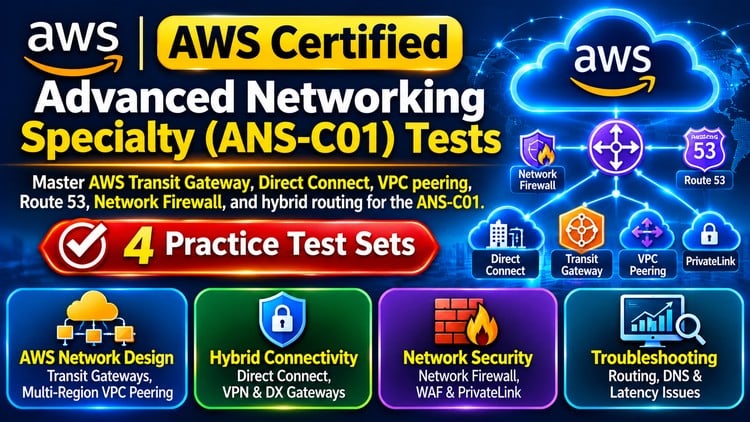
Master AWS Transit Gateway, Direct Connect, VPC peering, Route 53, Network Firewall, and hybrid routing for the ANS-C01.
What You Will Learn:
- Design and architect scalable AWS network topologies, Transit Gateways, multi-region VPC peering, and custom routing tables
- Configure hybrid connectivity using AWS Direct Connect, BGP routing, VPN Gateways, and Direct Connect Gateways.
- Implement network security perimeters using AWS Network Firewall, Security Groups, NACLs, WAF, and PrivateLink.
- Diagnose and troubleshoot complex network routing, DNS resolution, and latency issues using AWS Reachability Analyzer and Flow Logs.
- Diagnose and troubleshoot complex network routing, DNS resolution, and latency issues using AWS Reachability Analyzer and Flow Logs
- Show more
The Real-World Reality of Mastering AWS Networking
Look, I’ve been in the cloud trenches for a while now, and if there’s one thing I’ve learned, it’s that networking is usually where the “magic” of the cloud falls apart for most architects. You can spin up EC2 instances all day, but when you have to connect a legacy data center in London to a VPC in Northern Virginia via AWS Direct Connect while maintaining sub-millisecond latency and strict network security perimeters, things get hairy. This certification prep for the ANS-C01 isn’t just about passing a test; it’s about surviving the complexity of enterprise-scale infrastructure.
The AWS Certified Advanced Networking Specialty (ANS-C01) practice exams are designed to humble you. They don’t just ask “What is a VPC?” They drop you into a nightmare scenario involving overlapping CIDR blocks, complex BGP routing over Transit Gateways, and failing VPN Gateways. What I appreciated about this specific set of tests was the shift away from rote memorization toward job-ready skills. You aren’t just clicking buttons; you are designing scalable AWS network topologies that have to function under the weight of real-world traffic and compliance audits.
Prerequisites for the Brave
Let’s be honest: this is not a beginner to advanced transition you can make in a weekend. To get the most out of these tests, you need a solid baseline. At a minimum, you should have your Solutions Architect Associate under your belt. Ideally, you’ve spent some time in the AWS Management Console actually breaking things. You need to understand the fundamentals of the OSI model, how TCP/IP works, and why BGP is the heartbeat of the internet. If you don’t know your way around a route table or a NACL, these practice exams will feel like reading ancient Greek. This is the “Everest” of AWS certs for a reason.
Industry-Standard Tools & Technical Skills
The curriculum covered in these tests hits every major industry-standard tool you’ll encounter in a high-level Cloud Engineer role. You’ll dive deep into:
- AWS Transit Gateway (TGW): Learning how to manage thousands of VPCs without losing your mind.
- Direct Connect (DX) & DX Gateway: Mastering the physical-to-virtual handshake and hybrid routing.
- AWS PrivateLink & VPC Endpoints: Keeping traffic off the public internet for security and cost.
- Route 53: Managing complex DNS resolution and failover policies across regions.
- Traffic Mirroring & Flow Logs: Utilizing AWS Reachability Analyzer and VPC Flow Logs to find that one needle-in-a-haystack routing error.
Career Benefits & Job Roles
Earning this specialty isn’t just a badge for your LinkedIn profile; it’s a massive signal for career growth. We are seeing a huge demand for “Cloud Network Architects” and “Senior DevOps Engineers” who actually understand the underlying plumbing. Organizations are moving away from simple “lift and shift” to complex multi-cloud and hybrid environments. By mastering these real-world projects and scenarios, you position yourself as the person who can save a company millions in data transfer costs or prevent a catastrophic network security breach. If you want to move into high-ticket consulting or lead infrastructure for a Fortune 500, this is your ticket.
Pros of These Practice Tests
- Scenario-Based Depth: The questions aren’t “what is this tool?” but rather “everything is broken, how do you fix it using AWS Network Firewall and Transit Gateway?” This builds genuine hands-on labs style intuition.
- Hybrid Cloud Focus: It nails the hardest part of the exam: Direct Connect. The nuances of BGP community tags and AS-PATH prepping are covered in a way that actually makes sense.
- Detailed Explanations: Every wrong answer is a teaching moment. The explanations don’t just cite documentation; they explain the why behind the architecture, which is crucial for long-term retention.
The One Big “Cons” (An Honest Take)
The difficulty curve is vertical. If you are using these tests as your primary learning source without having touched the AWS CLI or designed a multi-region VPC peering setup before, you will likely get discouraged. The tests assume you already have a “Pro” level mindset, which can be a bit of a slap in the face for those who are just starting their networking journey. It’s a “tough love” approach that might feel overwhelming at first.