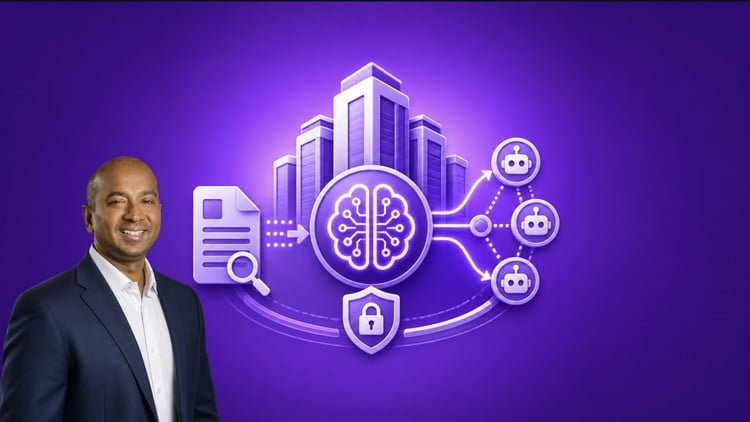
Design secure enterprise GenAI systems with RAG, AI agents, governance, monitoring, and production-scale architecture.
What You Will Learn:
- Explain the business drivers behind enterprise generative AI adoption and identify where GenAI can create measurable value.
- Understand common enterprise GenAI architecture patterns, deployment models, and integration approaches.
- Compare public cloud, private cloud, hybrid, and on-premises deployment considerations.
- Identify enterprise knowledge sources suitable for retrieval-augmented generation.
- Design RAG pipelines involving document ingestion, chunking, embeddings, indexing, retrieval, and grounded generation.
- Apply retrieval, ranking, filtering, and metadata strategies to improve response relevance.
- Show more
Cutting Through the Hype: My Honest Take on Enterprise GenAI with RAG and Agents
Let’s be honest: the internet is currently drowning in “Hello World” AI tutorials. Anyone can plug an API key into a basic script and call themselves an AI developer. But there is a massive, gaping chasm between building a weekend toy and deploying a production-scale architecture that won’t leak sensitive company data or hallucinate during a board meeting. That is exactly where the Enterprise GenAI with RAG and Agents course fits in. I went into this looking for more than just code snippets—I wanted to understand the “how” and “why” behind building resilient, secure systems, and frankly, I was impressed by the lack of fluff.
What sets this course apart is its focus on the “Enterprise” side of the equation. We aren’t just talking about chat interfaces; we’re talking about governance, monitoring, and orchestration. In a corporate environment, you can’t just throw data at a model and hope for the best. You have to worry about SOC2 compliance, data residency, and grounded generation. This course treats GenAI as a serious software engineering discipline rather than a magic trick, which is a breath of fresh air for anyone looking to gain job-ready skills that actually translate to a paycheck.
Who Should Sign Up? (Prerequisites)
While the curriculum claims to go from beginner to advanced, I’d argue you’ll get the most out of it if you aren’t starting from zero. You don’t need to be a PhD in machine learning, but you should have a solid handle on Python and a basic understanding of how APIs work. If you’ve never heard of a vector database or don’t know the difference between a private and public cloud, you might find yourself hitting the pause button quite a bit. However, the hands-on labs do a great job of bridging the gap for those who are willing to put in the extra hours of research.
The Tech Stack: Skills & Tools
One of the biggest wins here is the exposure to industry-standard tools. You aren’t learning some proprietary, throwaway framework. Instead, you’re getting your hands dirty with the tools that companies are actually hiring for. Throughout the real-world projects, you’ll likely find yourself working with:
- Orchestration Frameworks: LangChain and LlamaIndex for building agentic workflows.
- Vector Databases: Deep dives into Pinecone, Weaviate, or Milvus for efficient retrieval.
- Cloud Infrastructure: Comparisons and deployments across AWS, Azure, and GCP.
- Monitoring & Observability: Tools like Arize Phoenix or LangSmith to ensure your agents aren’t going rogue in production.
- Deployment Models: Navigating the tricky waters of on-premises versus hybrid cloud setups.
Career Growth & Future-Proofing Your Role
The career growth potential in this niche is astronomical. We are seeing a shift where “AI Engineer” is becoming the new “Full Stack Developer.” By focusing on RAG (Retrieval-Augmented Generation) and AI agents, you’re positioning yourself at the top of the talent pool. This course serves as excellent certification prep for anyone looking to pivot into roles such as:
- AI Solutions Architect: Designing the high-level flow of data and security.
- Machine Learning Engineer: Fine-tuning and optimizing retrieval pipelines.
- Enterprise Data Architect: Managing how internal knowledge sources are ingested and indexed.
- Generative AI Developer: Building the actual agentic systems that automate complex business tasks.
The Pros
- Production-First Mindset: It doesn’t just teach you to build; it teaches you to build securely. The sections on metadata strategies and filtering are worth the price of admission alone because they solve the “relevance” problem that plagues most RAG systems.
- Architectural Depth: Most courses skip the “boring” stuff like chunking strategies and document ingestion pipelines. This course dives deep into the plumbing, which is where 90% of AI projects actually fail.
- Agentic Focus: Moving beyond simple RAG into AI agents is the next frontier. Learning how to design systems that can actually “think” and use tools is a massive competitive advantage in the job market.
The Cons
- The Velocity Challenge: The GenAI space moves at a breakneck pace. While the core architecture patterns taught here are timeless, some of the specific library versions in the hands-on labs might feel slightly dated by the time you watch them. You’ll need to be comfortable checking documentation to account for the latest syntax changes in the fast-evolving AI ecosystem.