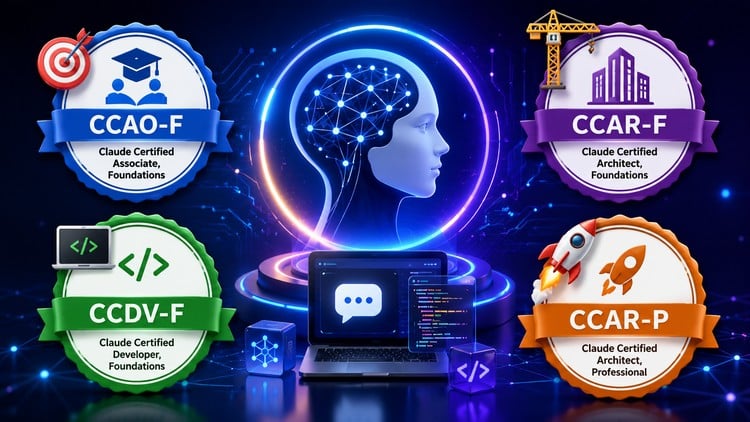
Claude Certified Associate (CCAO-F), Developer -(CCDV-F),Architect – Foundations (CCAR-F), Professional (CCAR-P) Exams
What You Will Learn:
- Prepare for Claude Certified Architect – Foundations (CCAR-F) certification.
- Prepare for Claude Certified Architect – Professional (CCAR-P) certification.
- Prepare for Claude Certified Associate – Foundations (CCAO-F) certification.
- Prepare for Claude Certified Developer – Foundations (CCDV-F) certification.
Prepare for Claude Certified Architect – Professional (CCAR-P) certification.
Prepare for Claude Certified Associate – Foundations (CCAO-F) certification.
Prepare for Claude Certified Developer – Foundations (CCDV-F) certification.
Overview
Let’s be real: the AI landscape is shifting at warp speed, and having verifiable skills is no longer a nice-to-have – it’s crucial. Anthropic’s Claude, with its impressive capabilities, is rapidly becoming a significant player in the LLM space, and these certifications are their answer to the growing demand for skilled practitioners. This isn’t just about passing an exam; it’s a structured journey designed to validate your expertise across various facets of the Claude ecosystem. From understanding core concepts as an Associate to building sophisticated applications as a Developer, and designing robust solutions as an Architect, this certification path offers a clear progression. It’s about demonstrating concrete, job-ready skills that employers are actively seeking in today’s competitive AI market, signifying a deep dive into an emerging industry-standard tool.
Prerequisites
To truly get value out of pursuing these Claude certifications, you’ll need a foundational understanding of a few key areas. For the CCAO-F and CCDV-F, a grasp of general programming concepts, preferably Python, is highly recommended. You should be comfortable with basic data structures and algorithms. For the more advanced CCAR-F and CCAR-P levels, familiarity with cloud computing platforms (AWS, Azure, GCP), basic machine learning principles, and an understanding of API interactions are essential. While direct experience with Claude isn’t strictly necessary to start the certification prep, prior exposure to large language models or natural language processing will definitely give you a significant head start. Think of it as needing to know how to walk before you can run an AI marathon.
Skills & Tools
Embarking on this certification journey equips you with a formidable set of skills. You’ll master prompt engineering techniques specific to Claude, learning how to coax the best responses and optimize interactions. For developers, expect to delve deep into the Claude API, understanding how to integrate it into various applications, handle input/output, and manage conversational flows. Architects will gain expertise in designing scalable and secure Claude-powered solutions, considering factors like cost optimization, ethical AI implementation, and model deployment strategies within broader system architectures. You’ll work with the Claude API directly, likely through Python SDKs, and potentially interface with various cloud services for deployment and data management. These are not just theoretical concepts; they’re designed to foster practical competence in using cutting-edge LLM development tools.
Career Benefits & Job Roles
From where I stand, earning a Claude certification can be a powerful accelerator for your career growth. It provides official validation of your proficiency with a major LLM technology, which can significantly enhance your resume and marketability. Companies are scrambling for talent that can effectively harness AI, and these certifications signal that you’re not just curious, but competent. Successful candidates could target roles such as AI Engineer, ML Engineer, Data Scientist, Prompt Engineer, AI/ML Developer, Solutions Architect (with an AI focus), or even Product Manager overseeing AI initiatives. It tells potential employers you’re serious about staying current and have invested in acquiring valuable job-ready skills in a critical domain. In an ecosystem hungry for specialized knowledge, these credentials set you apart.
Pros
- Industry Relevance & Validation: Claude is a rapidly growing force in the LLM space. These certifications directly address the industry’s need for verified skills in this specific, powerful AI. It’s an official nod that you understand and can work with a leading industry-standard tool.
- Structured Learning Path: The tiered approach (Associate, Developer, Architect Foundations, Architect Professional) provides a clear and logical progression. Whether you’re a beginner aiming for foundational knowledge or an experienced professional looking for advanced solution architecture expertise, there’s a relevant certification for your level, enabling genuine career growth.
- Practical Application Focus: While certifications always have a theoretical component, the expectation is that these will heavily emphasize practical application, akin to what you’d find in hands-on labs or when working on real-world projects. This ensures that the skills you gain are directly transferable and valuable.
- Early Adopter Advantage: Being certified in a rapidly evolving technology like Claude positions you as an early adopter and expert. This can be a significant differentiator in a competitive job market, showcasing your proactive approach to mastering cutting-edge AI.
Cons
- Nascent Ecosystem & Study Materials: As Claude certifications are relatively new compared to, say, AWS or Azure, the ecosystem of third-party study guides, practice exams, and community forums might not be as mature or extensive yet. This could mean more self-reliance in finding high-quality certification prep resources and potentially a steeper learning curve for some.