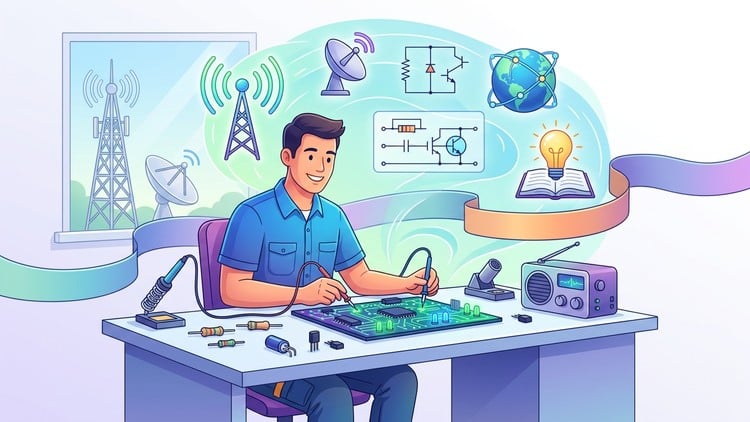
Pass Your Maritime Radio Law & Electronics Exam with 2026 updated Practice Questions and Easy Explanations.
What You Will Learn:
- Understand maritime radio laws and correct communication procedures.
- Learn basic electrical principles and how circuit components work.
- Troubleshoot practical circuits and understand digital logic systems.
- Explain how transmitters, receivers, and radio antennas operate
- Learn GMDSS operations and important RF safety practices for the exam.
Overview: Why This 2026 Update Actually Matters
If you’ve been in the technical or maritime space for any length of time, you know the FCC General Radiotelephone Operator License (GROL) is basically the “Golden Ticket.” Unlike many tech certs that expire every three years, the GROL is a lifetime certification prep milestone that carries massive weight in avionics, maritime communications, and even high-end manufacturing. However, the biggest mistake I see “old school” techs make is studying with outdated materials. The “Practice Tests For FCC GROL Element 1 & 3- 2026” course is a timely response to the evolving landscape of RF safety and digital logic that the FCC is leaning into for the next cycle.
I’ll be honest: most FCC study guides are as dry as a desert. This course, however, cuts through the fluff. It focuses on the synergy between Element 1 (Marine Radio Law) and Element 3 (General Electronics). Instead of just memorizing question pools, the course attempts to provide a “why” behind the “what.” Whether you are looking for career growth or just trying to prove you know your way around a circuit board, this 2026-focused material is designed to bridge the gap between theoretical physics and the job-ready skills required on a vessel or in a hangar. It’s less about being a walking textbook and more about becoming a competent operator who won’t accidentally violate international GMDSS protocols.
Prerequisites: What You Need Before You Dive In
While this course is marketed as beginner to advanced, don’t walk in thinking you can ignore the fundamentals. You don’t need an engineering degree, but having a basic grasp of algebra will save you a lot of headaches when you hit the electronics section. Here is what I recommend having in your mental toolkit:
- A basic understanding of Ohm’s Law and Watts’ Law (though the course does a decent job of reviewing these).
- A “tinkerer’s mindset”—if you’ve never looked at a schematic, you’ll need to spend extra time in the troubleshooting modules.
- An active FRN (FCC Registration Number), which you’ll need anyway to sit for the actual exam.
- Patience. Element 3 is a beast, covering everything from transistors to digital logic systems, so don’t expect to cram this in a single weekend.
Skills & Tools: Mastering the RF Landscape
One thing I appreciated about this specific certification prep is the emphasis on industry-standard tools. While you aren’t physically soldering in a practice test course, the explanations treat you like a professional. You’ll learn how to interpret readings from oscilloscopes, multimeters, and spectrum analyzers within the context of the exam questions. You are essentially building a mental hands-on lab.
- Circuit Troubleshooting: You’ll gain the ability to look at a practical circuit and identify where a component failure might occur.
- RF Safety Mastery: This is huge in the 2026 updates. You’ll understand Maximum Permissible Exposure (MPE) limits, which is a critical real-world project safety skill.
- GMDSS Proficiency: Navigating the Global Maritime Distress and Safety System isn’t just for passing the test; it’s a life-saving skill in the maritime industry.
- Digital Logic & Microprocessors: The course breaks down how modern radio equipment uses digital processing, moving beyond simple analog theories.
Career Benefits & Job Roles: Beyond the Exam
Let’s talk about the money. Holding a GROL license significantly increases your leverage during salary negotiations. It’s a formal recognition that you understand the maritime radio laws and the complex electronics that keep ships and planes moving. This course prepares you for roles that are increasingly in demand as global logistics expand. Potential job roles include:
- Avionics Technician: Maintaining the communication and navigation systems on aircraft.
- Marine Radio Technician: Working on deep-sea vessels or at port facilities to ensure GMDSS compliance.
- Broadcast Engineer: Managing high-power transmitters for radio and television stations.
- Field Service Engineer: Specialized roles for government contractors or telecommunications firms.
The Pros: What Makes This Course Stand Out
- Current Content: Most study materials are stuck in 2018. This 2026 update ensures you aren’t blindsided by new questions on RF safety or digital components.
- Logic-Based Explanations: Instead of just giving you the answer key, the course explains the basic electrical principles. This turns rote memorization into actual knowledge.
- Exam Simulation: The practice tests mimic the actual weight of the FCC categories, so you aren’t over-studying one niche at the expense of others.
- Accessibility: It’s designed for those who need job-ready skills quickly, making it an excellent choice for working professionals looking to pivot.
The Cons: An Honest Critique
If I have one gripe, it’s that the “Maritime Law” section (Element 1) is inherently tedious. While the course does its best to make maritime radio laws digestible, there is no way to make legal jargon “exciting.” It requires a lot of repetitive reading, and the course could benefit from more interactive visual aids or flowcharts to help categorize the various radio fine structures and treaty regulations.