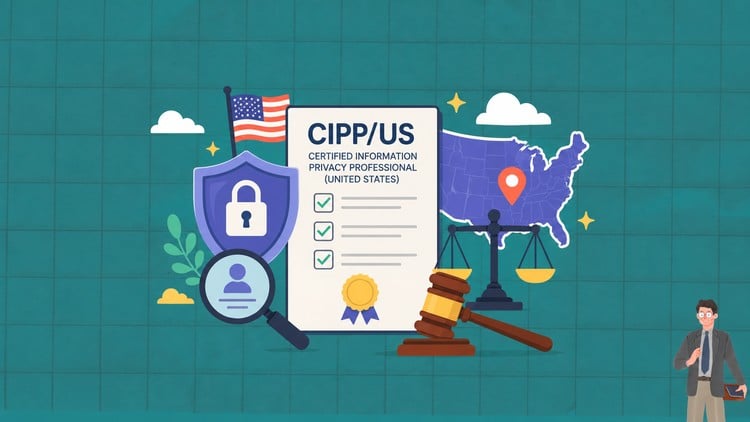
540 exam-realistic questions with full explanations across all 5 CIPP/US domains, mapped to the 2025 IAPP blueprint
What You Will Learn:
- Test your readiness for the IAPP CIPP/US exam with 540 realistic, exam-style multiple-choice questions across all five official domains.
- Master the five CIPP/US domains: the U.S. privacy environment, federal laws, state laws, workplace privacy, and government access to data.
- Know the key U.S. privacy laws the exam tests: HIPAA, GLBA, FCRA, FERPA, COPPA, TCPA, CAN-SPAM, ECPA, FISA and state laws like the CCPA.
- Pinpoint your weak areas using detailed explanations that teach the concept behind every answer, not just the correct option.
- Practice under the real 90-question, 2.5-hour exam format, including scenario/case-study questions, to build exam-day timing and stamina.
- Walk into test day confident and ready to pass the IAPP CIPP/US on your first attempt.
- Show more
Overview: More Than Just a Memory Game
Let’s be honest: the IAPP CIPP/US is widely considered the “gold standard” for privacy professionals, but it’s also a notorious gatekeeper. I’ve seen brilliant techies and seasoned lawyers fail this thing because they treated it like a simple history quiz. The 2025 version of the exam is particularly brutal because it moves away from rote memorization of acronyms and forces you to apply industry-standard tools and frameworks to messy, real-world scenarios.
This practice test suite isn’t just a collection of questions; it’s a simulation of the mental gymnastics required on test day. With 540 questions mapped to the latest blueprint, it covers everything from the nuances of HIPAA and GLBA to the evolving landscape of state laws like the CCPA. What I appreciate most here is the shift in focus. Instead of just asking “What does TCPA stand for?”, these tests throw you into real-world projects where you have to decide if a marketing department’s new “growth hack” is actually a massive liability under CAN-SPAM. If you’re looking for certification prep that actually prepares you for the “oh crap” moments of a privacy career, this is where you start.
Prerequisites: Setting the Foundation
While this course is marketed as a beginner to advanced resource, don’t walk in totally cold. You should have at least a surface-level understanding of the U.S. legal system—think the difference between a statute and a regulation. If you’ve spent some time reading the official IAPP textbook (the “Body of Knowledge”), you’re in a good spot.
However, you don’t need to be a practicing attorney. These practice tests are designed to bridge the gap between “I’ve read the law” and “I can apply the law.” If you have a background in IT, cybersecurity, or compliance, you’ll have a head start, but even if you’re transitioning from a different field, the detailed explanations provided for each answer act as a mini-tutorial for the foundational concepts you might have missed.
Skills & Tools: Developing the Privacy Mindset
The primary “tool” you’re mastering here is the privacy legal framework. It’s not about using software; it’s about using logic to navigate the U.S. privacy environment. You’ll sharpen your ability to perform legal analysis on the fly, which is a crucial job-ready skill.
The course effectively acts as a series of hands-on labs for your brain. You are tasked with analyzing scenario/case-study questions that mimic the actual exam format. You’ll learn how to distinguish between sectoral laws (like FERPA for education or FCRA for credit reporting) and how they overlap with government access to data via FISA or the ECPA. By the time you finish the fifth domain, you’ll have a mental toolkit for identifying workplace privacy violations and managing cross-border data transfers—skills that are indispensable in a modern tech stack.
Career Benefits & Job Roles: Beyond the Digital Badge
Earning your CIPP/US is one of the fastest ways to supercharge your career growth in the tech and legal sectors. It’s the difference between being a “generalist” and being a specialized Privacy Officer or Data Protection Officer (DPO).
In terms of job roles, this certification prep opens doors to high-paying positions like:
- Privacy Engineer: Bridging the gap between code and compliance.
- Compliance Manager: Ensuring the company doesn’t get hit with a multi-million dollar CCPA fine.
- Legal Counsel: Specifically focusing on data privacy and cybersecurity law.
- Data Auditor: Reviewing how organizations handle sensitive PII (Personally Identifiable Information).
The market is starving for people who actually understand these laws, and having these job-ready skills on your resume makes you a top-tier candidate in a crowded market.
Pros: Why This Is the Real Deal
- Realistic Stamina Training: The 90-question, 2.5-hour format is no joke. These tests build the stamina you need so you don’t “brain fog” out at the two-hour mark during the actual exam.
- The “Why” Behind the “What”: The detailed explanations are the secret sauce. They don’t just tell you that “B” is correct; they explain why “A,” “C,” and “D” are wrong, which is how you actually learn the 2025 blueprint.
- Scenario-Based Mastery: The IAPP loves case studies. This course mirrors that exam-style perfectly, helping you parse long, complex stories to find the one legal detail that changes the whole answer.
Cons: The Honest Truth
- Purely Assessment-Focused: If you are looking for a lecture-based course with video modules or real-world projects involving actual software configurations, you won’t find them here. This is a practice test bank through and through. You’ll need a separate resource (like the official textbook) if you’re looking for a traditional teaching style from scratch.