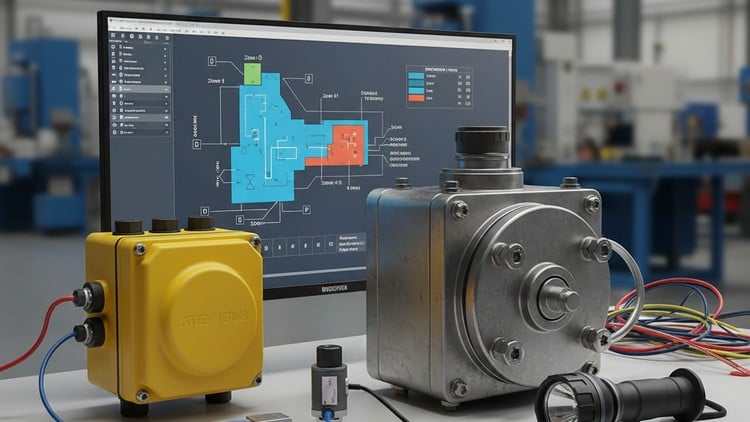
Detailed Practice Tests to Build Confidence for Explosive Atmosphere Exams
What You Will Learn:
- Understand hazardous concepts
- Interpret exam scenarios
- Analyze MCQ distractors
- Apply safety logic
Alright, let’s talk about the ‘CompEx Hazardous Atmosphere Practice Tests – MCQ Focus’ course. If you’re eyeing that CompEx certification, you know it’s not just about knowing your stuff; it’s about *proving* you know it under exam conditions. This isn’t a substitute for the actual CompEx course, but it’s a seriously valuable booster pack for anyone heading into those assessments.
Overview
Forget the dry textbook rote learning. This course is explicitly designed to sharpen your exam acumen, not just regurgitate facts. It delves deep into the often-tricky nuances of CompEx multi-choice questions. We’re talking about developing a sixth sense for spotting those subtle traps and understanding the underlying logic behind seemingly similar answers. It’s less about simply knowing the correct answer and more about building a robust framework for hazard assessment and safety application. My take? This is where you really solidify your comprehension of zone classifications, protection concepts, and installation requirements, moving beyond theoretical knowledge to practical, exam-ready wisdom. It helps you internalize the thought process required to interpret complex scenarios under pressure, which is invaluable for actual site work too, not just the exam.
Prerequisites
Honestly, don’t jump into this cold. This course assumes you’ve either completed a CompEx training course (e.g., CompEx Ex01-Ex04, Ex12, etc.) or have a solid foundation in electrical or instrumentation principles within hazardous environments. You should already be familiar with basic concepts like ATEX directives, IEC 60079 series standards, and the fundamental principles of explosion protection. Think of it as a sharpening stone for an already decent blade, not a blacksmith’s forge. If you’re a complete beginner to the world of hazardous areas, you’ll likely find yourself playing catch-up on core concepts rather than refining your **certification prep** strategy. A background in industrial electrical work or an engineering diploma is a good starting point.
Skills & Tools
This isn’t about teaching you how to wire a motor, but it’s crucial for honing your analytical skills. You’ll significantly improve your ability to:
- Interpret complex technical scenarios under exam pressure.
- Rigorously apply safety logic to ambiguous situations, mirroring real-world decision-making.
- Efficiently manage your time during timed assessments.
- Identify and deconstruct common MCQ distractors – those answers that look plausible but are fundamentally incorrect. This is a game-changer for exam performance.
- Reinforce understanding of industry-standard tools – not physical tools, but the *mental models* derived from international standards like IEC 60079 that govern hazardous area work.
Ultimately, it arms you with the mental toolkit to confidently tackle not just the CompEx exam, but also to approach on-site challenges with a more critical, safety-first mindset. This builds genuine **job-ready skills** in hazardous area compliance.
Career Benefits & Job Roles
Passing CompEx is a big deal in many industries, and this practice course directly supports that goal. A CompEx certification opens doors and solidifies your position in roles such as:
- Electrical Technician (Hazardous Areas)
- Instrumentation Engineer
- E&I Supervisor
- Maintenance Lead in oil & gas, chemical, pharmaceutical, and mining sectors.
- Safety Officer specializing in explosion protection.
The confidence and detailed understanding you gain directly contribute to your **career growth**. Employers actively seek certified professionals who can demonstrate a robust understanding of hazardous area principles. It’s a clear signal that you’re capable of handling **real-world projects** safely and competently, reducing risks and ensuring compliance. This isn’t just a certificate; it’s a testament to a specialized skillset that commands respect and offers significant professional advantages across a range of **beginner to advanced** roles in critical industries.
Pros
- Uncannily Realistic MCQs: The practice tests genuinely feel like the real CompEx exam. The questions are structured similarly, covering a broad spectrum of topics and often presenting the same kind of nuanced challenges you’ll face in the actual assessment. This is gold for **certification prep**.
- Deep Dive into Distractors: This is where the course truly shines. It doesn’t just tell you the right answer; it helps you understand *why* the wrong answers are wrong. This analytical approach is critical for truly grasping the concepts and not just memorizing solutions. It transforms how you approach complex problem-solving.
- Confidence Multiplier: Repeatedly tackling these challenging questions and seeing your scores improve is a massive confidence booster. You walk into the actual exam knowing you’ve already faced similar gauntlets and emerged stronger, reducing pre-exam anxiety significantly.
- Targeted Revision: The detailed feedback helps you quickly identify your weak spots. Instead of blindly reviewing everything, you can focus your revision efforts on specific areas where you’re consistently making mistakes, making your study time much more efficient.
Cons
My one honest gripe? While it excels at MCQ practice, it doesn’t offer any equivalent for the practical, **hands-on labs** component of a full CompEx course. Obviously, it’s not advertised to do so, but it’s a reminder that this is purely for the theoretical assessment prep. You’ll still need to secure practical training elsewhere to fully round out your CompEx journey. It’s a fantastic mental workout, but it won’t teach you how to physically inspect an Ex-rated enclosure. Keep that in mind, and ensure your practical skills are as sharp as your theoretical knowledge.