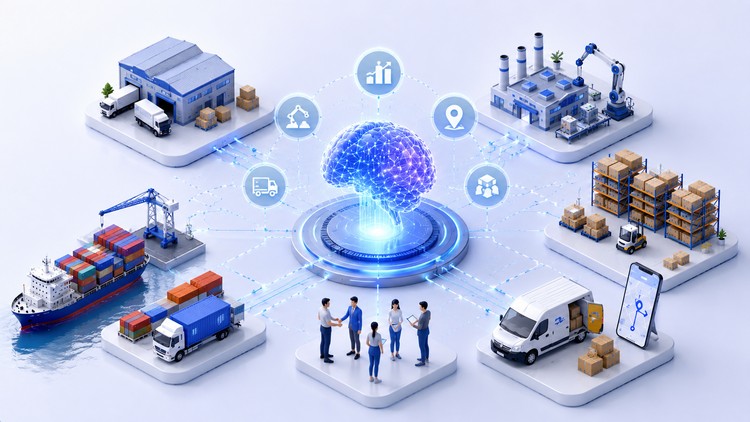
Master AI tools for supply chain — real-world use cases, hands-on demos, and career-ready skills for operations
What You Will Learn:
- Apply AI and ML to core supply chain functions including forecasting, inventory, and logistics
- Evaluate and select the right AI tools for your supply chain use case
- Build a practical AI implementation roadmap for your organization
- Analyze supplier risk, optimize procurement spend, and use contract intelligence tools
- Understand warehouse automation, computer vision, and WMS-AI integration
- Prepare confidently for AI-related interviews in the supply chain domain
Beyond the Buzzwords: A Realist’s Take on AI in Supply Chain
Let’s be honest: the supply chain world has been drowning in “AI” marketing fluff for the last three years. Every legacy ERP provider claims they have a magic “AI button” that solves global logistics meltdowns. After spending a decade in the tech and operations space, I’ve learned to be skeptical. However, the AI in Supply Chain: Demand Forecasting, Inventory, Logistics course actually manages to cut through the noise.
Instead of treating AI like a mystical oracle, this program treats it as a high-performance toolset for solving the messiest parts of global commerce. What caught my attention wasn’t just the technical walkthroughs, but the focus on the “why” and the “how-to-actually-implement.” Most courses teach you how to build a model in a vacuum; this one teaches you how to deploy that model when your data is fragmented, your suppliers are late, and your warehouse is running on legacy systems. It’s a beginner to advanced journey that feels grounded in the grit of actual operations rather than a sanitized lab environment.
Prerequisites: Who Should Actually Sign Up?
You don’t need to be a senior data scientist to get value here, but you shouldn’t walk in totally cold either. The course is designed for career growth-minded professionals who have at least a foundational understanding of how a product moves from point A to point B. If you know your way around a spreadsheet and understand basic statistical concepts (like mean and standard deviation), you’ll keep pace.
While the course covers industry-standard tools, having a bit of curiosity about Python or SQL is a plus. However, the curriculum is structured to support those transitioning from traditional logistics roles into tech-driven operations. It’s perfect for someone who realizes that “the way we’ve always done it” is no longer a viable strategy in a post-2020 world.
The Toolkit: Skills & Tools You’ll Actually Use
This isn’t just a lecture series; it’s a hands-on labs experience. You aren’t just reading about machine learning algorithms; you’re looking at how they apply to demand sensing and predictive maintenance. Some of the core competencies you’ll walk away with include:
- Demand Forecasting & Sensing: Moving past simple moving averages to incorporate external variables like weather, social trends, and economic indicators.
- Inventory Optimization: Using AI to find that “Goldilocks zone” where you aren’t overstocked but never face a stockout.
- Warehouse Automation & Computer Vision: Seeing how computer vision is used for real-time inventory counting and safety monitoring—stuff that used to be science fiction.
- Contract Intelligence: Learning how NLP (Natural Language Processing) can scan thousands of supplier contracts to identify procurement risk in seconds.
- Strategic Implementation: This was a highlight for me—learning to build a practical AI implementation roadmap so you don’t waste millions on “pilot purgatory.”
Career Benefits: From Analyst to Architect
The job-ready skills provided here are specifically calibrated for the current hiring market. Companies are desperate for people who can bridge the gap between “the data guys” and “the warehouse guys.” By completing the real-world projects included in the syllabus, you’re essentially building a portfolio that proves you can drive ROI, not just talk about it.
Graduates are well-positioned for roles like AI Supply Chain Architect, Digital Transformation Manager, or Senior Operations Analyst. The inclusion of certification prep and AI-related interview coaching is a massive bonus. They teach you how to explain a “black box” model to a skeptical COO, which is perhaps the most underrated skill in the entire tech industry.
The Pros: Why This Course Stands Out
- Framework-First Approach: Instead of just teaching a specific software, it teaches you how to evaluate and select the right tools. This prevents your skills from becoming obsolete when the next “big thing” in software hits the market.
- High-Level Strategy Meets Ground-Level Tactics: You get to see the 30,000-foot view of logistics optimization while also diving into the weeds of WMS-AI integration.
- Risk Management Focus: The section on analyzing supplier risk is worth the price of admission alone. In an era of geopolitical instability, using AI for resilient sourcing is a superpower.
- No Fluff Interview Prep: The interview coaching modules are tailored specifically to supply chain nuances, helping you tackle the “how would you optimize this network?” questions with data-backed confidence.
The Cons: An Honest Reality Check
If there’s one drawback, it’s the sheer density of the material. This isn’t a “passive” course you can just watch while scrolling on your phone. Because it spans beginner to advanced topics, the learning curve can feel steep when you hit the warehouse automation and computer vision modules. If you aren’t prepared to pause, re-watch, and actually engage with the hands-on labs, you might feel overwhelmed by the technical depth. It’s a marathon, not a sprint.