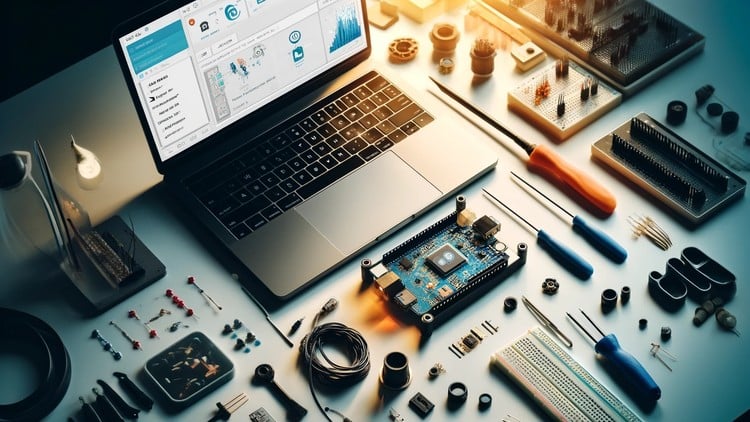
Discover an Intuitive Approach to ESP32—Program Effortlessly in a Professional Environment Without Writing a Single Line
⏱️ Length: 2.0 total hours
⭐ 3.98/5 rating
👥 18,365 students
🔄 June 2025 update
Add-On Information:
Note➛ Make sure your 𝐔𝐝𝐞𝐦𝐲 cart has only this course you're going to enroll it now, Remove all other courses from the 𝐔𝐝𝐞𝐦𝐲 cart before Enrolling!
-
Course Overview
- This intensive two-hour course pioneers a groundbreaking, code-free approach to mastering the versatile ESP32 microcontroller, ideal for anyone entering IoT, automation, or embedded systems.
- Explore an intuitive visual development environment, transforming abstract concepts into tangible hardware functionalities with direct drag-and-drop ease.
- Championing rapid prototyping and immediate gratification, this course empowers you to design and implement sophisticated device logic using a graphical interface.
- It’s a journey into empowering creation, proving advanced hardware control is accessible to everyone, regardless of prior coding experience.
- Focus on creative problem-solving and turning innovative ideas into functional, connected devices, prioritizing visual clarity and interactive development.
-
Requirements / Prerequisites
- No prior programming or extensive electronics background is assumed; basic computer literacy suffices.
- Access to a computer (Windows, macOS, or Linux) with administrative rights for installing visual development software and drivers.
- A reliable internet connection is necessary for software downloads and accessing course materials.
- An ESP32 development board (e.g., ESP32-DevKitC, NodeMCU ESP32) is recommended for practical exercises and real-world project building.
- A compatible USB cable for your ESP32 board for both power and data communication.
- An open mind and genuine enthusiasm for experimenting with embedded systems, eager to bring digital ideas into the physical world.
-
Skills Covered / Tools Used
- Graphical Logic Design: Develop proficiency in crafting complex operational sequences and conditional behaviors using an intuitive block-based visual programming environment.
- Hardware Interaction Principles: Understand core concepts of how microcontrollers interface with their physical surroundings via diverse digital and analog signals.
- Sensor Integration Logic: Gain the ability to interpret data from various environmental sensors and formulate automated, event-driven responses.
- Actuator Control Strategies: Master precise logical sequencing and timing required to effectively command different types of output devices and physical actuators.
- Rapid Prototyping Mindset: Cultivate a development approach focused on quickly validating ideas and iterating designs, significantly accelerating project turnaround.
- Component Interoperability: Learn to visually configure and orchestrate multiple hardware modules and peripherals to function cohesively within integrated ESP32 systems.
- Visual Development Environment Mastery: Become adept at navigating and efficiently utilizing a powerful graphical user interface engineered for streamlined no-code microcontroller programming.
-
Benefits / Outcomes
- Accelerated Project Development: Drastically reduce time from conceptualization to a working prototype, swiftly validating innovative ESP32-based ideas.
- Democratized Hardware Innovation: Overcome coding barriers, making advanced microcontroller applications accessible to hobbyists, entrepreneurs, and non-technical professionals.
- Enhanced Problem-Solving Acumen: Develop a systematic, logical approach to real-world challenges, conceptualizing solutions through interconnected hardware behaviors and visual logic flows.
- Foundational IoT Competency: Establish a solid groundwork for understanding and contributing to the Internet of Things ecosystem by controlling and monitoring physical devices code-free.
- Creative Empowerment: Unlock your potential to design custom smart devices, automate tasks, and build interactive installations, personalizing your environment.
- Cost-Effective Experimentation: Gain ability to rapidly experiment with diverse hardware configurations and project ideas, saving resources by validating concepts efficiently.
- Professional Skill Augmentation: Add a valuable, in-demand skill set – the capacity to swiftly develop and deploy embedded solutions, an asset in product development and automation roles.
- Seamless Transition Potential: While code-free, the logical thinking fostered provides an excellent foundation for exploring traditional coding for more bespoke or complex applications later.
-
PROS
- Incredibly Low Barrier to Entry: Ideal for absolute beginners, making ESP32 development accessible without prior programming or electronics expertise.
- Rapid Prototyping Capability: Significantly speeds up idea validation and project iteration, allowing for quick testing and refinement.
- Visual and Intuitive Learning: The graphical programming interface simplifies complex logic, enhancing understanding and engagement for all learners.
- Focus on Concepts, Not Syntax: Enables learners to concentrate purely on project logic and functionality, bypassing programming language specifics.
- Empowers Non-Developers: Opens the world of hardware creation and automation to designers, artists, product managers, and other non-coders.
- Excellent Introduction to IoT: Provides a practical, hands-on pathway to understanding the operation and communication of smart devices.
-
CONS
- Potential for Limited Customization: No-code platforms may inherently offer less granular control or optimization compared to traditional hand-written code for highly specialized or performance-critical applications.
Learning Tracks: English,IT & Software,Hardware