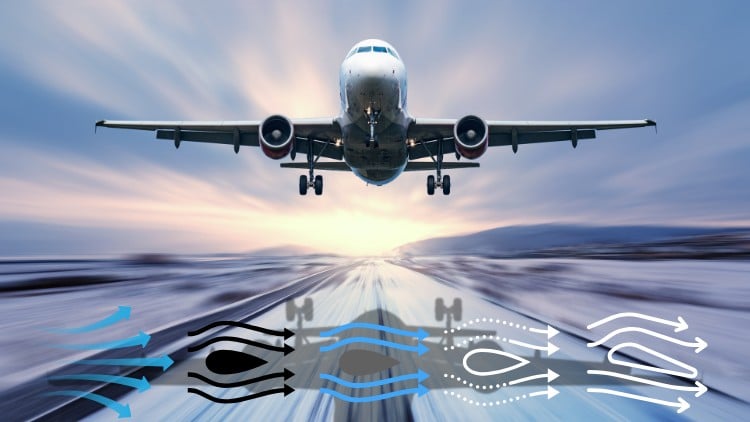
Master the principles of aerodynamics, explore transonic flight, and design airfoils using professional aerospace tools.
⏱️ Length: 7.0 total hours
👥 29 students
Add-On Information:
Note➛ Make sure your 𝐔𝐝𝐞𝐦𝐲 cart has only this course you're going to enroll it now, Remove all other courses from the 𝐔𝐝𝐞𝐦𝐲 cart before Enrolling!
- Course Overview
- This comprehensive guide meticulously explores the complex interplay of fluid dynamics and forces governing safe and efficient flight, bridging theoretical foundations with cutting-edge practical applications.
- Trace the fascinating historical evolution of aerodynamic thought, from early concepts to modern computational methods, understanding its impact on technological advancements.
- Gain critical insight into the multifaceted role of aerodynamicists in the aerospace industry, covering design, performance optimization, flight testing, and certification.
- Uncover nuanced fluid flow phenomena, including laminar/turbulent flows, separation, and vortex generation, and their profound impact on vehicle efficiency, stability, and safety.
- Delve into the foundational governing equations of fluid motion, like Navier-Stokes and Bernoulli’s principle, contextualizing their application in real-world aerospace scenarios.
- Investigate the unique challenges and innovations in high-speed flight, particularly beyond critical Mach numbers, preparing you for future developments in supersonic and hypersonic travel.
- Understand the critical interaction between aerodynamics and other aerospace disciplines, such as propulsion integration, structural load analysis, and flight control system design.
- Requirements / Prerequisites
- A solid foundational understanding of college-level physics, with emphasis on classical mechanics and energy conservation principles.
- Familiarity with core calculus concepts, including differentiation, integration, and multivariate calculus, essential for comprehending aerodynamic theory.
- An inherent curiosity and strong intellectual passion for aerospace engineering, flight dynamics, and high-performance vehicle design.
- Prior introductory exposure to fluid mechanics or aerospace principles is beneficial, though the course builds from foundational elements.
- Access to a computer capable of running professional-grade design and simulation software.
- Skills Covered / Tools Used
- Advanced Aerodynamic Data Interpretation: Develop sophisticated analytical abilities to critically evaluate CFD outputs, wind tunnel test results, and flight data for informed design decisions.
- Iterative Conceptual Design: Master methodologies crucial for developing novel aerodynamic components, balancing performance with manufacturing feasibility and operational factors.
- Professional Aerodynamic Software Proficiency: Gain comprehensive, hands-on experience with industry-standard software packages for advanced airfoil and aerodynamic surface design, analysis, and optimization.
- Computational Fluid Mechanics Principles: Develop a deep understanding of underlying numerical methods, turbulence models, and assumptions behind simulations for accurate tool selection and result interpretation.
- Aerodynamic Optimization Techniques: Acquire expertise in applying contemporary optimization strategies to refine aerodynamic shapes for minimal drag, maximum lift-to-drag, or specific stability characteristics.
- Aircraft Performance Prediction & Analysis: Cultivate strong analytical skills in accurately predicting and analyzing key aircraft performance parameters based on aerodynamic characteristics.
- Boundary Layer Control Strategies: Explore advanced techniques like suction, blowing, and vortex generators to enhance lift, reduce drag, and mitigate flow separation.
- Benefits / Outcomes
- Significantly Enhanced Career Prospects: Position yourself for coveted roles in aerospace design, R&D, performance engineering, or flight analysis within aviation, automotive, or defense sectors.
- Robust Analytical Foundation: Cultivate a powerful analytical framework for methodically approaching and resolving complex aerodynamic problems, fostering critical thinking and problem-solving abilities.
- Tangible Practical Design Acumen: Gain the practical confidence and capability to meaningfully contribute to the conceptualization, design, and optimization of airfoils and other critical aerodynamic surfaces.
- Insight into Cutting-Edge Technologies: Develop profound insights and a forward-looking perspective on emerging aerospace technologies and design methodologies.
- Contribution to Sustainable Aviation: Understand how superior aerodynamic efficiency is paramount in reducing fuel consumption and emissions, enabling contributions to greener aviation solutions.
- Solid Foundation for Advanced Academic Pursuits: Establish an exceptionally strong academic base for pursuing further specialized research, graduate studies, or professional training in related fields.
- Ability to Evaluate and Innovate: Develop the critical ability to thoroughly evaluate existing aerodynamic designs, identify improvements, and conceptualize innovative solutions to engineering challenges.
- PROS
- Comprehensive & In-Depth Coverage: Delivers an exceptionally thorough exploration of advanced aerodynamics, suitable for a wide spectrum of learners.
- Strong Practical, Hands-on Approach: Emphasizes real-world professional tool usage and design exercises, providing invaluable practical experience.
- Directly Industry-Relevant Skills: Equips learners with highly sought-after and immediately applicable skill sets for current industry challenges.
- Flexible Self-Paced Online Learning: Offers the significant convenience and autonomy of self-paced study.
- Expert-Led & Up-to-Date Content: Benefits from meticulously crafted instruction by experienced aerospace professionals.
- CONS
- Potential for Limited Direct Interaction: As an online, self-paced course, it may offer less personalized feedback or instantaneous engagement compared to traditional in-person learning environments.
Learning Tracks: English,Business,Industry