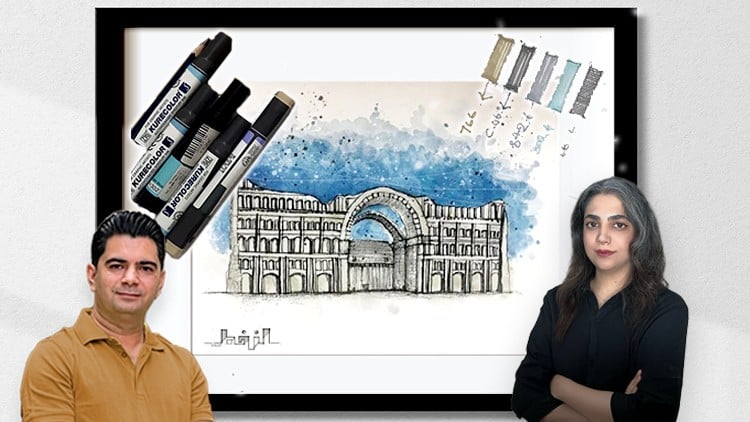
Sketch Lines + Shading + Hatching + Perspectives. For Architecture, Urban Design, Graphic & Interior Design Students
⏱️ Length: 1.1 total hours
⭐ 4.67/5 rating
👥 2,054 students
🔄 October 2025 update
Add-On Information:
Note➛ Make sure your 𝐔𝐝𝐞𝐦𝐲 cart has only this course you're going to enroll it now, Remove all other courses from the 𝐔𝐝𝐞𝐦𝐲 cart before Enrolling!
-
Course Overview
- This introductory course provides a foundational entry point into the dynamic world of architectural visualization through freehand drawing. It’s meticulously designed for complete beginners and those looking to solidify their basic sketching skills, transforming abstract ideas into tangible visual representations with an update planned for October 2025.
- You will embark on a journey to demystify the art of architectural sketching, understanding it not just as a technical skill but as an intuitive language fundamental to all design disciplines. The curriculum emphasizes developing a strong analytical eye combined with the dexterity of hand, fostering a seamless connection between thought and paper.
- Beyond merely teaching drawing techniques, this course cultivates a designer’s mindset, encouraging keen observation, acute spatial awareness, and the ability to rapidly translate complex three-dimensional concepts onto a two-dimensional surface with clarity and impact.
- It’s a compact yet comprehensive module, highly rated at 4.67/5 by a significant student base of 2,054 learners, ensuring a proven path to kickstart your sketching proficiency relevant for Architecture, Urban Design, Graphic & Interior Design students.
-
Requirements / Prerequisites
- Absolute Beginners Welcome: No prior drawing experience or artistic talent is required. This course is specifically structured to guide you from scratch, making it accessible to anyone with an interest in design and a willingness to learn.
- Basic Drawing Supplies: You will need minimal and easily accessible tools, primarily a sketchbook (preferably A4 or A3 size), a set of pencils with varying lead hardness (e.g., HB, 2B, 4B), an eraser, and potentially a ruler for initial setup guides.
- Curiosity and an Open Mind: A desire to observe your surroundings with a designer’s eye and an eagerness to practice are the most crucial prerequisites. Consistent engagement with the exercises provided will yield the best and most rapid results.
- Digital Access: Ability to access online course materials via a computer or tablet is necessary, as the entire curriculum and demonstrations are delivered digitally for your convenience.
-
Skills Covered / Tools Used
- Line Hierarchy and Expressiveness: Develop an understanding of how varying line weight and pressure can convey different information within your sketch, from prominent foreground elements to subtle background details, imbuing your drawings with vitality and depth.
- Compositional Principles: Learn basic principles of arranging elements within your sketch frame to create visually appealing and balanced architectural compositions, effectively guiding the viewer’s eye through your design ideas.
- Understanding Orthographic vs. Perspective Views: Gain an introductory grasp of how different drawing types (e.g., plan, section, elevation sketches vs. single-point, two-point perspectives) serve distinct purposes in architectural communication and ideation.
- Introduction to Measuring by Eye: Practice foundational techniques for accurately proportioning elements within your sketch without the constant aid of a ruler, fostering a more intuitive and truly freehand approach to drawing.
- Applying Textures through Mark-Making: Explore diverse mark-making strategies beyond simple hatching, such as stippling, scumbling, and cross-hatching variations, to represent a wide range of material textures like brick, wood, glass, or foliage effectively.
- Basic Environmental Context: Learn to incorporate simplified contextual elements such as trees, human figures, and basic sky representations to give appropriate scale, context, and life to your architectural sketches.
- Pencil Techniques: Master various ways to hold and maneuver your pencil to achieve different effects, from light, airy exploratory strokes to bold, definitive lines and smooth tonal gradients for impactful visualization.
- Ink Pen Introduction (Optional but Encouraged): While primarily pencil-focused, the course subtly encourages exploring the transition to fine-liner pens for sharpening lines, adding permanence, and developing a distinctive personal style in your sketches.
-
Benefits / Outcomes
- Accelerated Visual Communication: Equip yourself with the ability to quickly translate complex design concepts, spatial arrangements, and aesthetic intentions into clear, comprehensible visual forms for clients, collaborators, or personal exploration.
- Enhanced Spatial Reasoning: Sharpen your perception of three-dimensional space, developing an innate capacity to visualize and articulate forms, volumes, and relationships before construction or detailed design even begins.
- Foundation for Advanced Studies: Lay a robust groundwork for further learning in architectural representation, digital rendering, and advanced design methodologies, making subsequent courses and professional development more accessible and rewarding.
- Boosted Creative Confidence: Overcome the initial intimidation of a blank page, gaining the self-assurance to tackle any drawing challenge and express your unique design voice and ideas without hesitation.
- Critical Observation Skills: Develop an acute awareness of light, shadow, form, and texture in the built environment, enriching your overall understanding and appreciation of architecture, urban design, and interior spaces.
- Personalized Sketchbook Development: Cultivate a habit of regular sketching, leading to the creation of a personal sketchbook that serves as a rich, evolving repository of your ideas, observations, and design experiments.
- Professional Readiness: For aspiring professionals in architecture, urban planning, interior design, and graphic design, this skill set provides a crucial edge in professional practice, enabling faster iteration and more effective ideation processes.
- Artistic Enjoyment and Stress Relief: Discover the meditative and enjoyable aspects of freehand drawing, finding a creative outlet that can also serve as a relaxing and fulfilling personal pastime, enhancing overall well-being.
-
PROS
- Concise and Focused Learning: With a length of just 1.1 total hours, it’s perfect for fitting into busy schedules, offering impactful learning without a significant time commitment.
- High Student Satisfaction: A remarkable 4.67/5 rating from over 2,000 students indicates a highly effective, engaging, and well-received learning experience.
- Industry Relevance: Directly addresses core skills critical for success across multiple design disciplines: architecture, urban design, graphic design, and interior design.
- Practical Skill Development: Delivers actionable techniques that can be immediately applied to real-world design challenges and personal creative projects.
- Accessible for All Levels: Specifically tailored to welcome absolute beginners, fostering an inclusive and unintimidating learning environment.
-
CONS
- Limited Depth for Advanced Users: As a beginner-focused course, it may not delve into highly advanced theoretical concepts or complex, niche techniques required by seasoned professionals or those seeking master-level instruction.
Learning Tracks: English,Design,Architectural Design