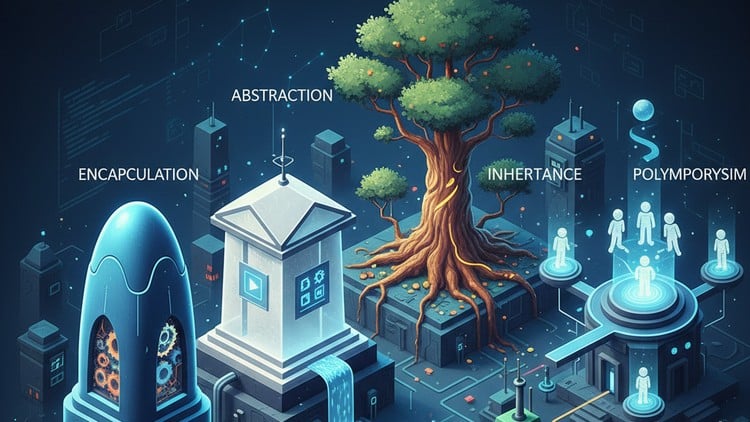
Dive into the foundational principles of Object-Oriented Programming (OOP) and transform your coding approach.
👥 50 students
Add-On Information:
Note➛ Make sure your 𝐔𝐝𝐞𝐦𝐲 cart has only this course you're going to enroll it now, Remove all other courses from the 𝐔𝐝𝐞𝐦𝐲 cart before Enrolling!
- Course Caption: Dive into the foundational principles of Object-Oriented Programming (OOP) and transform your coding approach. 50 students
-
Course Overview
- This intensive course, ‘Practise Question for OOPs’, bridges OOP theory and real-world application. It focuses on hands-on problem-solving through diverse coding challenges and design scenarios to deepen practical skills. The curriculum is meticulously crafted to move beyond abstract definitions, fostering an active learning environment.
- You will engage in active problem-solving across core OOP pillars: encapsulation, inheritance, polymorphism, and abstraction. Each challenge is designed to refine your ability to analyze requirements, design robust object-oriented solutions, and implement them efficiently, fostering critical thinking and effective decision-making in software development.
- The emphasis is on experiential learning, guiding you to identify common OOP pitfalls, apply industry best practices, and develop elegant, scalable, and maintainable OOP code. This rigorous training prepares you thoroughly for the complexities of modern software engineering roles.
-
Requirements / Prerequisites
- Solid OOP Fundamentals: An essential prerequisite is a strong theoretical understanding of core OOP concepts, including classes, objects, encapsulation, inheritance, polymorphism, and abstraction. This course builds on existing knowledge for application, not introduction.
- Proficiency in an OOP Language: You must be comfortable coding in at least one modern object-oriented programming language, such as Java, Python, C++, or C#. Practical exercises demand hands-on implementation skills in your chosen language.
- Basic Programming Logic: Familiarity with fundamental programming logic, data types, control structures, and basic data structures (e.g., arrays, lists) is expected. This ensures focus remains on advanced OOP application, not basic syntax.
-
Skills Covered / Tools Used
- Advanced OOP Design Principles: Master the practical application of design principles like SOLID (Single Responsibility, Open/Closed, Liskov Substitution, Interface Segregation, Dependency Inversion) and GRASP (General Responsibility Assignment Software Patterns) to construct highly maintainable and flexible object-oriented systems.
- Object-Oriented Problem Decomposition: Learn systematic approaches to break down complex problems into modular, well-defined objects and classes with clear responsibilities, promoting high cohesion and low coupling in your designs.
- Practical Design Pattern Implementation: Gain hands-on experience implementing classic design patterns such as Strategy, Observer, Factory Method, Singleton, and Decorator. Understand when and why to apply them to solve common software architecture challenges, enhancing code reusability and extensibility.
- Effective OOP Debugging: Develop advanced debugging strategies tailored for complex object-oriented applications. This includes utilizing powerful IDE tools, interpreting stack traces, and employing systematic fault isolation techniques across multiple classes and inheritance hierarchies.
- Code Refactoring for OOP: Acquire practical techniques to refactor existing object-oriented code, improving its internal structure, readability, and adherence to design principles without altering its external behavior, thus enhancing long-term maintainability.
- Unit Testing with Frameworks: Understand how to write comprehensive unit tests for your object-oriented code using popular frameworks (e.g., JUnit for Java, pytest for Python, NUnit for C#). This ensures robustness and facilitates safer development cycles.
- Version Control (Git/GitHub): Practical application of Git and GitHub will be integrated for managing code changes, collaborating on solutions (even individually, simulating team environments), and maintaining project history—skills crucial for modern development workflows.
-
Benefits / Outcomes
- Deepened OOP Application Mastery: Achieve a profound practical mastery of OOP, enabling you to confidently design and implement robust, scalable software solutions across various contexts.
- Enhanced Problem-Solving Acumen: Significantly boost your analytical and problem-solving skills, equipping you to deconstruct challenging software requirements and architect elegant object-oriented solutions with confidence.
- Production-Ready Code Quality: Learn to produce high-quality, clean, and maintainable object-oriented code that rigorously adheres to industry best practices, making your contributions valuable and future-proof.
- Interview & Career Readiness: Improve your performance dramatically in technical interviews focused on OOP design and problem-solving, accelerating your career trajectory in software engineering and architecture roles.
-
PROS of this Course
- Intensive Practical Focus: An overwhelming emphasis on hands-on problem-solving ensures direct application and reinforcement of OOP concepts, moving far beyond passive theoretical learning.
- Skill-Centric Development: Directly targets the development of actionable, real-world OOP design and implementation skills that are highly valued and sought after in the software industry.
- Interview Preparation: The structured, challenging practice environment directly prepares participants for the rigorous OOP-centric questions encountered in technical job interviews.
- Personalized Learning: A limited class size of 50 students allows for more individualized attention and tailored feedback on solutions from instructors, fostering deeper engagement.
-
CONS of this Course
- High Prerequisite Demands: This course requires a substantial prior understanding of OOP fundamentals, making it unsuitable for absolute beginners, as it focuses on advanced application rather than initial introduction, potentially being a barrier for some.
Learning Tracks: English,IT & Software,Other IT & Software