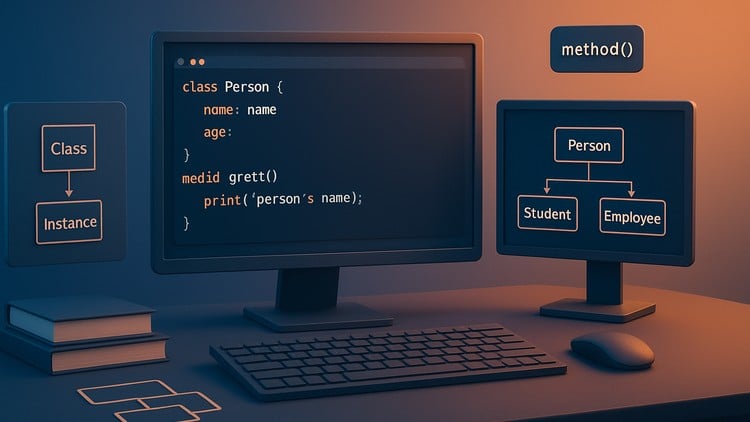
“Master OOP in Python: 100 Coding Challenges to Ace Exams & Real-World Applications
👥 1 students
🔄 October 2025 update
Add-On Information:
Note➛ Make sure your 𝐔𝐝𝐞𝐦𝐲 cart has only this course you're going to enroll it now, Remove all other courses from the 𝐔𝐝𝐞𝐦𝐲 cart before Enrolling!
-
Course Overview
- This intensive course is engineered to immerse learners in the practical application of Object-Oriented Programming (OOP) principles through a curated set of 100 Python coding challenges. Moving beyond theoretical concepts, the curriculum directly engages participants in real-world problem-solving scenarios, reinforcing core OOP pillars like encapsulation, inheritance, polymorphism, and abstraction. It is specifically designed to not only prepare students for rigorous technical examinations and professional certifications that demand a deep understanding of OOP but also to cultivate the robust, scalable software development skills essential for modern engineering roles. Each challenge is meticulously crafted to progressively build expertise, transitioning from foundational concept application to complex system design. This ensures a comprehensive grasp of how OOP paradigms translate into efficient, maintainable, and elegant Python code. The course prioritizes a hands-on, problem-solving approach, providing detailed solutions and explanations for every challenge, fostering a continuous learning cycle of practice, feedback, and refinement. This method guarantees that learners internalize OOP principles and gain the confidence to apply them effectively in diverse programming contexts.
-
Requirements / Prerequisites
- Foundational Python Proficiency: Solid understanding of basic Python syntax, including variables, data types, control flow, functions, and fundamental data structures (lists, dictionaries). This ensures a smooth transition into OOP concepts.
- Basic Programming Logic: Familiarity with general programming logic, algorithmic thinking, and the ability to deconstruct problems into manageable components is highly beneficial for conceptualizing and implementing object-oriented solutions.
- Development Environment Setup: Access to a computer with Python 3.8+ installed and a preferred Integrated Development Environment (IDE) like VS Code or PyCharm. Learners are expected to manage their environment for writing, running, and testing Python code.
- Commitment to Active Practice: A crucial commitment to consistent, hands-on coding and problem-solving is required. Success in this challenge-driven course hinges on persistent and proactive engagement with the 100 programming exercises.
-
Skills Covered / Tools Used
- Mastery of Core OOP Principles: Practical application and deep understanding of encapsulation, inheritance (single and multiple), polymorphism (method overriding, operator overloading), and abstraction using Python’s object model.
- Advanced Python Class Design: Expertise in designing robust classes utilizing instance/class variables, various method types (instance, class, static), properties, and decorators for maintainable and reusable code.
- Modular Software Architecture: Skills in structuring Python projects using object-oriented principles to enhance modularity, reduce coupling, and improve scalability, preparing for larger application development.
- Problem-Solving with Design Patterns: Exposure to practical scenarios where common object-oriented design patterns (e.g., Factory Method, Singleton, Strategy) can be applied to solve recurring software design problems.
- Effective Error Handling: Implementation of robust error handling strategies within an OOP context, including custom exceptions and proper use of try-except blocks, ensuring application resilience.
- Python Development Ecosystem: Practical experience working with Python 3.8+ and common IDEs like VS Code or PyCharm, along with command-line tools for executing and debugging object-oriented Python applications.
-
Benefits / Outcomes
- Exceptional Exam Readiness: Gain unparalleled confidence and proficiency to excel in any OOP-centric exam or technical interview, supported by a vast portfolio of solved problems demonstrating deep understanding and application.
- Refined Object-Oriented Problem-Solving: Develop a highly analytical and systematic approach to complex programming challenges, expertly applying OOP paradigms to design efficient, scalable, and elegant solutions.
- Production-Quality Code Development: Acquire the ability to write clean, modular, and industry-standard Python code that is easy to maintain, extend, and collaborate on, making you a highly valuable asset in professional environments.
- Foundation for Advanced Software Engineering: Build an incredibly strong and practical foundation in OOP, essential for progressing into specialized fields such as software architecture, framework development, and complex system design.
- Portfolio of Practical OOP Projects: Compile a substantial collection of practical, well-engineered OOP solutions that can be showcased in your professional portfolio, serving as concrete evidence of your advanced coding and design capabilities.
- Accelerated Skill Acquisition: Through an intensive, challenge-driven learning methodology, achieve rapid and profound mastery of object-oriented programming principles, significantly reducing the time required to become proficient.
-
PROS
- Unmatched Hands-On Experience: Provides 100 coding challenges, offering an exceptional volume of active practice critical for internalizing complex OOP concepts and transitioning from theory to practical expertise.
- Dual Focus on Exams and Real-World: Strategically designed to simultaneously prepare learners for academic/certification exams and equip them with the practical skills demanded by industry, ensuring comprehensive readiness.
- Python-Specific Best Practices: Emphasizes idiomatic Python implementations of OOP, ensuring learners not only understand the concepts but also how to apply them effectively and “Pythonically.”
- Direct Feedback Loop: The challenge-solution format inherently provides immediate validation and learning opportunities, crucial for reinforcing correct understanding and quickly rectifying misconceptions.
- Comprehensive Skill Development: Fosters not just coding ability, but also critical thinking, problem decomposition, and robust design principles, invaluable for any aspiring or practicing software engineer.
-
CONS
- Demanding Time Commitment: The extensive nature of 100 coding challenges requires a significant and sustained time investment, which might be a barrier for individuals with tight schedules or limited daily availability.
Learning Tracks: English,IT & Software,IT Certifications