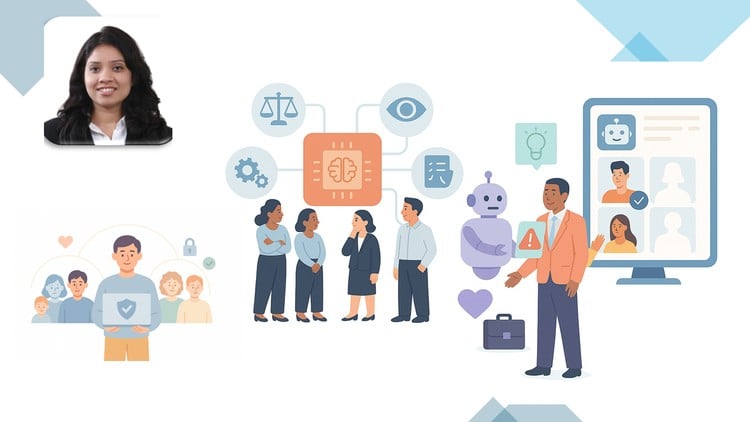
Practical guide to fairness, transparency, accountability, and privacy in ethical AI for workplace applications.
⏱️ Length: 58 total minutes
👥 151 students
🔄 October 2025 update
Add-On Information:
Note➛ Make sure your 𝐔𝐝𝐞𝐦𝐲 cart has only this course you're going to enroll it now, Remove all other courses from the 𝐔𝐝𝐞𝐦𝐲 cart before Enrolling!
-
Course Overview
- This course empowers business leaders to proactively integrate ethical considerations into AI strategies, transforming potential risks into competitive advantage.
- Delve into embedding ethics throughout the entire AI lifecycle, ensuring deployments align with organizational values and societal expectations.
- Gain a strategic perspective on fostering a corporate culture where ethical AI principles are championed, building essential trust with all stakeholders.
- Explore the critical nexus of technology, human values, and sound business strategy, preparing you to lead through complex AI ethical dilemmas.
- Understand that ethical AI is not merely compliance, but foundational for sustainable business growth, responsible innovation, and long-term value.
-
Requirements / Prerequisites
- Foundational Business Acumen: A general grasp of business operations and strategic decision-making; no deep technical AI expertise is required.
- Proactive Mindset: Eagerness to critically analyze technology’s societal impact and engage in constructive dialogue about responsible innovation.
- Leadership Orientation: Ideal for current and aspiring managers, directors, and strategists committed to integrating ethical leadership into AI roles.
- Basic Digital Fluency: Familiarity with common business software and data’s role in an organizational context, without requiring coding or data science skills.
- Commitment to Responsibility: A genuine desire to drive technological advancements yielding positive outcomes for customers, employees, and the community.
-
Skills Covered / Tools Used
- Strategic Ethical AI Integration: Master techniques for embedding ethical considerations seamlessly into AI project planning, moving beyond reactive problem-solving.
- Conceptual Ethical Assessment: Learn to design and apply frameworks for evaluating potential ethical, social, and economic impacts of AI systems pre-deployment.
- Advanced Stakeholder Dialogue: Develop sophisticated methods for transparently communicating about AI use to diverse audiences, fostering consensus and buy-in.
- Internal Governance Development: Acquire skills to contribute to or lead the establishment of organizational ethical AI guidelines and review processes.
- Third-Party AI Vetting: Understand how to systematically assess external AI vendors and partners for their adherence to robust ethical AI standards.
- Proactive Ethical Risk Scanning: Cultivate foresight to anticipate emerging AI ethical challenges and develop resilient organizational strategies to address them preventatively.
- Ethical AI Communication: Build capacity to clearly articulate complex AI ethics to non-technical stakeholders, fostering understanding and aligning objectives.
-
Benefits / Outcomes
- Enhanced Business Resilience: Strengthen your organization’s capacity to navigate public scrutiny and evolving regulations, securing its reputation as an ethical AI leader.
- Deepened Stakeholder Trust: Cultivate stronger relationships with customers, employees, and investors by demonstrably committing to fair, transparent, and accountable AI.
- Competitive Market Edge: Achieve significant differentiation by proactively addressing ethical concerns, attracting top talent and discerning customers.
- Strategic Regulatory Foresight: Gain a forward-looking perspective to anticipate and constructively engage with the dynamic evolution of AI ethics and policy.
- Catalyst for Ethical Innovation: Empower an organizational culture where ethical considerations drive innovation, yielding creative, human-centric solutions.
- Mitigated Future Liabilities: Proactively reduce potential financial, legal, and reputational damages from irresponsible or biased AI deployments.
- Empowered Ethical Leadership: Emerge as a confident, well-informed leader capable of making nuanced, principled decisions regarding AI’s impact on business and society.
-
Pros
- Immediate Business Impact: Delivers actionable knowledge for leaders to implement ethical AI strategies directly into current and future business operations.
- Future-Proofing Organizations: Equips professionals with essential insights to navigate the continually evolving AI ethical and regulatory environment.
- Efficient Learning: Provides critical information in a concise, high-impact format, optimized for busy professionals seeking to quickly grasp core principles.
- Reputation Enhancement: Positions individuals and companies as responsible, forward-thinking pioneers in ethical application of advanced technology.
- Universal Applicability: Ethical frameworks and principles are relevant across diverse industries, making this course valuable for leaders in any sector.
-
Cons
- Depth Limitation: The brief duration (58 minutes) may limit extensive practical immersion, in-depth case studies, or interactive exercises, potentially requiring further self-directed learning for mastery.
Learning Tracks: English,Business,Other Business