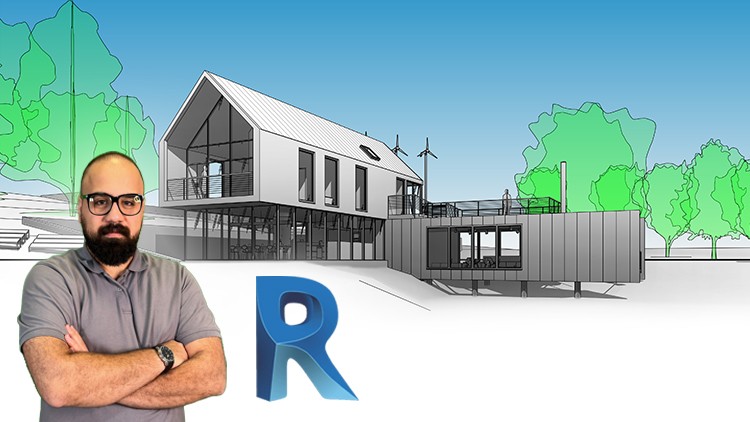
Architectural Form Creation in Revit: Massing, Components, Conceptual Mass and Enscape Visualization
⏱️ Length: 14.3 total hours
⭐ 4.84/5 rating
👥 8,909 students
🔄 September 2025 update
Add-On Information:
Note➛ Make sure your 𝐔𝐝𝐞𝐦𝐲 cart has only this course you're going to enroll it now, Remove all other courses from the 𝐔𝐝𝐞𝐦𝐲 cart before Enrolling!
-
Course Overview
- This comprehensive course, “Revit Mass Modeling- From Basic to Advanced level,” empowers architects, designers, and students to translate abstract concepts into tangible, constructible architectural forms using Revit. Moving beyond conventional element placement, this program delves into Revit’s advanced massing tools, providing a robust framework for conceptual design exploration and complex geometry creation.
- The journey progresses from foundational free-form massing through parametric manipulation, culminating in sophisticated visualization using Enscape. The curriculum emphasizes an iterative design process, where massing facilitates rapid prototyping and intelligent response to site and program requirements.
- It uniquely bridges conceptual ideation and detailed architectural production, demonstrating how initial mass models evolve into fully documented BIM. The course addresses challenges of designing non-rectangular, organic, or contextually responsive structures, preparing you for diverse architectural complexities.
- With a focus on both theory and application, you will leverage Revit’s power to develop innovative forms, understand their logic, and effectively communicate complex designs through high-quality visualizations. This course is an essential step to elevate Revit proficiency from basic drafting to advanced architectural design.
-
Requirements / Prerequisites
- Basic Revit Familiarity: A foundational understanding of the Revit interface, navigation, and file management is highly recommended to ensure focus on advanced massing concepts.
- Architectural Design Principles: Grasp of basic architectural concepts, spatial relationships, and design intent will be beneficial.
- Software Access: A licensed copy (or educational version) of Autodesk Revit (2023+ recommended) and Enscape (trial or licensed) are required.
- Suitable Hardware: A computer meeting minimum hardware requirements for both Revit and Enscape for optimal performance.
-
Skills Covered / Tools Used
- Advanced Mass Creation Techniques: Master complex 3D forms using direct manipulation, profile-based massing, and void forms to sculpt unique architectural geometries.
- Conceptual Mass Environment Mastery: Deep dive into Revit’s Conceptual Massing environment, utilizing reference planes, splines, and form-generating tools for intricate, parametrically driven design concepts.
- Parametric Form Generation: Establish intelligent relationships and parameters within mass models for dynamic adjustments and iterative design exploration.
- Adaptive Components for Complex Skins: Apply adaptive components to generate intricate building envelopes, facade systems, and repetitive structural elements conforming to complex massing.
- Mass to BIM Workflow: Understand converting conceptual mass models into detailed architectural elements (walls, roofs, curtain systems), carrying design intent through to documentation.
- Site Contextual Modeling: Integrate site topography, surrounding buildings, and environmental factors into massing studies for contextually responsive designs.
- Enscape Real-Time Visualization: Gain proficiency in leveraging Enscape for high-quality, real-time rendering and walkthroughs of mass models, effectively communicating design intent.
- Enscape Material and Lighting Studies: Apply realistic materials, set up dynamic lighting scenarios, and create compelling visual narratives to enhance conceptual design presentations.
- Design Option Management: Utilize Revit’s design option features for efficiently exploring multiple massing alternatives and design iterations.
-
Benefits / Outcomes
- Elevated Conceptual Design Capabilities: Rapidly prototype, explore, and refine complex architectural forms, fostering an innovative, iterative design process.
- Proficiency in Advanced Revit Workflows: Master sophisticated Revit tools for non-standard building geometries, expanding professional skills beyond basic elements.
- Enhanced Design Communication: Produce compelling real-time visualizations and walkthroughs with Enscape, effectively conveying design intent and spatial qualities.
- Improved Problem-Solving: Develop a systematic approach to designing and modeling challenging architectural forms, from organic shapes to parametrically driven facades.
- Streamlined Design to Documentation: Seamlessly transition from conceptual massing to detailed architectural modeling, ensuring consistency and efficiency.
- Competitive Career Advantage: Acquire highly sought-after skills in advanced BIM modeling and visualization, enhancing your portfolio and career prospects.
- Empower Creative Expression: Gain the technical expertise to realize ambitious architectural visions, overcoming previous modeling challenges.
-
PROS
- Comprehensive Skill Development: Offers a holistic journey from basic conceptual massing to advanced parametric design and professional visualization.
- Industry-Relevant Tools: Focuses on practical application of Revit’s powerful massing tools and Enscape, widely used in architectural practice.
- Boosts Creative Freedom: Equips learners with the technical ability to design and model complex, unique, and non-standard architectural forms.
- Enhanced Portfolio & Career Prospects: Provides tangible skills and outputs (visualizations) that significantly strengthen a professional portfolio.
- Efficient Workflow Integration: Teaches a seamless process from early-stage conceptual design through to detailed BIM, optimizing project workflows.
-
CONS
- Requires Consistent Practice: Mastering advanced mass modeling and visualization techniques demands dedicated time and consistent practice beyond the course hours to achieve proficiency.
Learning Tracks: English,Design,Architectural Design