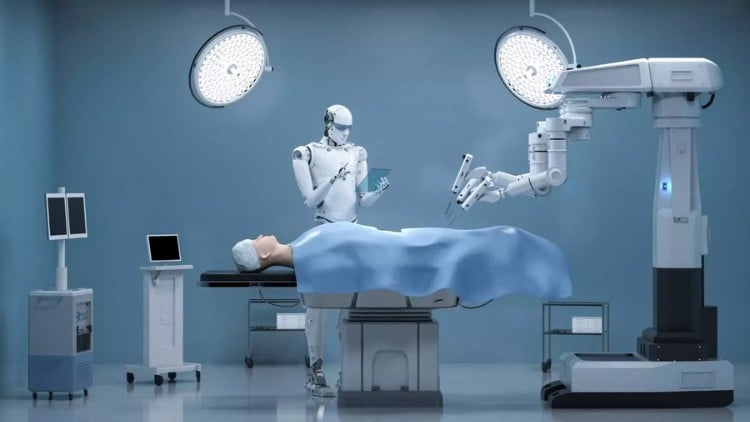
Unlock the Future of Healthcare with Advanced Skills and Expertise
⏱️ Length: 4.8 total hours
⭐ 4.06/5 rating
👥 10,252 students
🔄 September 2023 update
Add-On Information:
Note➛ Make sure your 𝐔𝐝𝐞𝐦𝐲 cart has only this course you're going to enroll it now, Remove all other courses from the 𝐔𝐝𝐞𝐦𝐲 cart before Enrolling!
- Course Overview
- Explore the foundational landscape of medical robotics, a rapidly evolving domain positioned at the intersection of advanced engineering, computer science, and clinical medicine. This course provides an essential, high-level introduction to the core principles and multifaceted applications of robotic systems within diverse healthcare environments, aiming to demystify complex technologies for a broad audience.
- Delve into the historical progression of medical robotics, tracing its evolution from early prototypes and conceptual designs to the sophisticated autonomous and semi-autonomous systems actively employed today, offering vital context for understanding current innovations and predicting future trajectories within the industry.
- Understand the diverse categories of medical robots, which extend beyond surgical systems to include rehabilitation robots, assistive devices for patient care, automated hospital logistics systems, and even miniature robots for targeted drug delivery, examining their unique functionalities and operational contexts.
- Investigate the fundamental components that constitute a typical medical robotic system, ranging from advanced sensors and precision actuators to sophisticated control algorithms, embedded software, and intuitive user interfaces, emphasizing the intricate integration required for safe and effective performance in critical clinical settings.
- Gain insight into the critical ethical dimensions, stringent regulatory frameworks, and broader societal implications associated with developing and deploying robotics in sensitive medical settings, fostering a responsible and conscientious perspective on technological advancement.
- Uncover emerging trends and prospective future directions in medical robotics, such as the integration of artificial intelligence for enhanced diagnostics, the development of micro-robotics for ultra-precise interventions, and the proliferation of collaborative human-robot systems, preparing learners for continuous innovation.
- Examine the crucial role of human factors engineering in designing intuitive, ergonomic, and user-friendly robotic interfaces that significantly enhance clinical workflows, improve operator performance, and ultimately bolster patient safety, focusing on the seamless collaboration between human operators and robotic systems.
- Requirements / Prerequisites
- Designed meticulously for individuals possessing a foundational interest in technology, engineering, biological sciences, or healthcare, requiring absolutely no prior specialized knowledge in advanced robotics or complex medical procedures to embark on this foundational learning journey.
- A general understanding of basic scientific principles, coupled with an inherent curiosity about how cutting-edge technology is actively transforming modern medicine, will prove highly beneficial, enabling participants to grasp and synthesize complex concepts more readily.
- Familiarity with foundational computer literacy is implicitly expected, as the course may involve interacting with digital learning resources, navigating online platforms, and potentially exploring conceptual aspects of simulation environments.
- This course warmly welcomes professionals and students from exceptionally diverse academic and professional backgrounds, including but not limited to medical students, engineering undergraduates, allied health professionals, and technology enthusiasts seeking to broaden their horizons.
- No specific programming language proficiency, advanced mathematical background, or in-depth clinical experience is mandatory, ensuring broad accessibility for a wide spectrum of learners eager to explore the fascinating and impactful world of medical robotics.
- Skills Covered / Tools Used
- Develop a conceptual understanding of robotic kinematics and dynamics as they apply specifically to medical devices, appreciating how robots execute precise movements and interact with their environments in controlled clinical contexts, without requiring deep mathematical derivations.
- Acquire an introductory comprehension of core control system design principles, particularly as applied to medical robotic devices, focusing on critical aspects such as stability, precision, responsiveness, and safety, which are paramount for surgical and diagnostic accuracy.
- Explore methodologies for evaluating the performance, reliability, and safety of medical robotic systems, including key metrics, standardized testing protocols, and validation procedures that ensure compliance with stringent healthcare and regulatory standards.
- Familiarization with high-level architectural design considerations for various medical robotic applications, understanding how different functional modules of a complex system integrate seamlessly to achieve specific clinical objectives and improve patient outcomes.
- Introduction to basic data acquisition and sophisticated sensor interpretation concepts, which are crucial for enabling medical robots to accurately perceive their operating environment, understand patient physiology, and execute tasks with unparalleled accuracy and safety.
- Conceptual exposure to widely used simulation software environments prevalent in medical robotics research and development, providing a virtual playground for understanding system behavior, validating design iterations, and conducting virtual trials before physical prototyping.
- Gain insight into the fundamental principles of sterile field management, advanced robotic instrument handling, and contamination prevention protocols within operating room settings, emphasizing the meticulous procedures that maintain patient safety and prevent infections.
- Understand the foundational aspects of human-machine interface (HMI) design for medical robots, focusing on creating intuitive controls, providing clear and actionable feedback mechanisms, and integrating ergonomic considerations for optimal use by clinical personnel.
- Benefits / Outcomes
- Establish a robust foundational understanding of the expansive medical robotics landscape, equipping learners with the necessary vocabulary, conceptual frameworks, and contextual knowledge to confidently engage in industry discussions and pursue further specialized studies.
- Pave a clear pathway for informed career exploration within the burgeoning and high-demand medical robotics industry, highlighting the diverse roles available, ranging from cutting-edge research and development to clinical application, regulatory affairs, and field service engineering.
- Enhance interdisciplinary communication skills by effectively bridging the knowledge gap between complex engineering principles and medical jargon, fostering a collaborative mindset that is essential for developing truly innovative healthcare solutions.
- Cultivate a profound appreciation for the intricate ethical implications, significant socio-technical challenges, and patient safety considerations inherent in integrating advanced robotics into the sensitive realm of patient care, promoting thoughtful and responsible technological adoption.
- Serve as an excellent and highly efficient stepping stone for individuals aspiring to pursue more advanced courses, industry certifications, or specialized academic degrees in biomedical engineering, robotics, surgical technologies, or healthcare innovation, providing a clear educational trajectory.
- Empower individuals to critically evaluate new medical robotic technologies, assess emerging innovations, and distinguish effectively between incremental improvements and truly disruptive advancements that have the potential to redefine the field.
- Open doors to potential networking opportunities within a vibrant, global community of dedicated professionals, visionary researchers, and innovative entrepreneurs committed to advancing healthcare through the transformative power of robotics, indirectly fostering valuable connections.
- Develop a forward-thinking and proactive perspective on healthcare transformation, positioning learners as informed, articulate, and impactful contributors to the ongoing technological revolution in medical practice and the continuous improvement of patient outcomes.
- PROS
- Highly Accessible: The exceptionally concise 4.8-hour duration makes this course an ideal entry point for busy professionals or those completely new to the field, offering significant foundational insights without a substantial long-term time commitment.
- Foundation-Building: Provides a comprehensive, yet highly digestible, overview of critical concepts, diverse applications, and industry trends in medical robotics, serving as an excellent springboard for more specialized learning paths.
- Up-to-Date Content: Benefiting from a recent September 2023 update, the course incorporates the latest advancements, cutting-edge research, and current industry trends, ensuring high relevance in a rapidly evolving technological landscape.
- Broad Appeal: Attracts an incredibly diverse student body of over 10,000 learners, indicative of its wide relevance, effective teaching methodologies, and success in engaging individuals from various backgrounds and disciplines.
- Cost-Effective Exploration: Often offered at an accessible price point or as part of broader subscription services, it allows for low-risk exploration of a high-demand and high-growth field before committing to longer, more intensive programs.
- Inspirational for Career Transitions: Can genuinely ignite passion and provide clear guidance for individuals considering a strategic career pivot into the thriving medical technology sector, showcasing the exciting and impactful possibilities available.
- Boosts General Knowledge: Even for those not pursuing a direct career in robotics, it offers invaluable insights into the future of healthcare and technological innovation, significantly enhancing general scientific and technological literacy.
- No Prerequisites for Entry: Designed meticulously to welcome learners without prior specialized knowledge in robotics, advanced engineering, or clinical practice, making it truly open to anyone with a keen interest.
- CONS
- Limited Depth: Due to its intentionally introductory nature and extremely short duration, the course cannot delve into the intricate technical details, advanced programming techniques, or extensive hands-on practical experience typically required for expert proficiency and advanced skill development.
Learning Tracks: English,Teaching & Academics,Other Teaching & Academics