Master Statistical Inference & Hypothesis Testing for Data Science: P-values, Confidence Intervals, A/B Testing Sampling
👥 29 students
Add-On Information:
Note➛ Make sure your 𝐔𝐝𝐞𝐦𝐲 cart has only this course you're going to enroll it now, Remove all other courses from the 𝐔𝐝𝐞𝐦𝐲 cart before Enrolling!
-
Course Overview
- Master Statistical Inference and Hypothesis Testing, transforming raw data into reliable, actionable insights crucial for robust data science decision-making.
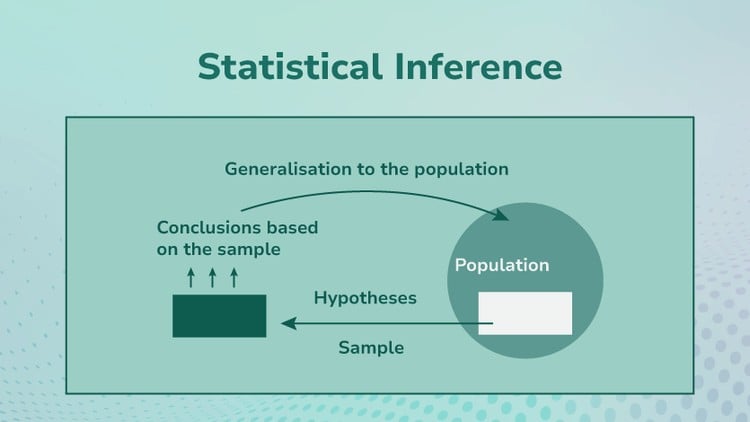
- Learn to draw valid conclusions about large populations from smaller, representative samples, a critical skill for generalizing findings from limited data.
- Implement hypothesis testing to formally validate assumptions, assess theories, and make informed choices with quantifiable statistical confidence.
- Interpret P-values accurately as evidence against a null hypothesis, ensuring precise understanding of statistical significance and avoiding common misinterpretations.
- Construct and interpret Confidence Intervals (CIs) to provide a robust range for population parameters, offering comprehensive and reliable estimations.
- Acquire expertise in designing, executing, and analyzing A/B Testing experiments, essential for optimizing products, services, and user experiences effectively.
- Understand various sampling techniques and their impact on inference validity, considering how sample selection (e.g., an illustrative “29 students”) affects generalizability.
-
Requirements / Prerequisites
- A solid grasp of descriptive statistics, including central tendency, dispersion, and basic data distributions.
- Familiarity with fundamental probability theory, including key distributions like the normal distribution and basic probability rules.
- Proficiency in a modern data science programming language, preferably Python (NumPy, Pandas) or R (dplyr), for data manipulation and analysis.
- A conceptual understanding of basic algebra and a strong analytical, problem-solving mindset are crucial for effective engagement.
-
Skills Covered / Tools Used
- Hypothesis Formulation & Testing: Translate business questions into testable hypotheses, selecting appropriate statistical tests (e.g., t-tests, chi-squared, ANOVA).
- Statistical Interpretation: Master nuanced interpretation of p-values, confidence intervals, and effect sizes to derive meaningful, actionable conclusions.
- Experimental Design: Learn principles for robust experiments, including randomization, control groups, and power analysis, for valid and reliable A/B tests.
- A/B Testing Analysis: Gain hands-on experience designing, analyzing results, and making data-driven recommendations from A/B experiments across various platforms.
- Programming for Statistical Analysis: Implement inferential tests and models using industry-standard Python (SciPy.stats, StatsModels) and/or R (`stats`, `infer`) libraries.
- Power Analysis & Sample Size: Determine optimal sample sizes required to detect significant effects, ensuring efficient and effective experimental resource allocation.
-
Benefits / Outcomes
- Become a Data-Driven Decision Maker: Guide strategic decisions, product development, and operational improvements with rigorous statistical evidence, moving beyond intuition.
- Enhance Analytical Rigor: Cultivate a meticulous mindset to critically evaluate data analyses, identify potential biases, and ensure the robustness of statistical claims.
- Design & Lead Experiments: Acquire the expertise to independently design, execute, and interpret sophisticated A/B tests, becoming invaluable in optimization roles.
- Communicate Insights Powerfully: Clearly and persuasively convey complex statistical findings and their implications to all stakeholders, technical and non-technical.
- Strong Foundation for Advanced DS: Build essential groundwork for machine learning, causal inference, and predictive modeling, understanding their inferential underpinnings.
- Boost Career Opportunities: Gain a significant competitive edge in data science, data analyst, and research roles where inferential expertise is highly valued.
-
PROS
- Deep Conceptual Mastery: Focuses on the ‘why’ behind the methods, fostering true understanding and adaptable problem-solving skills beyond mere procedures.
- Highly Practical Application: Emphasizes hands-on implementation with real-world data and industry-standard tools, directly preparing for professional data science challenges.
- Specialized A/B Testing Expertise: Provides comprehensive training in A/B testing, a critical skill for modern product, marketing, and user experience optimization.
- Enhanced Decision-Making Acumen: Equips learners to make evidence-based decisions, significantly reducing risk and improving outcomes by quantifying uncertainty.
- Foundational Skill for Advanced DS: Serves as an indispensable prerequisite for effectively understanding and applying more advanced machine learning and causal inference techniques.
- Engaging Learning Environment: Designed to facilitate personalized attention and in-depth discussion, leveraging a focused cohort size for maximum engagement and tailored feedback.
-
CONS
- Demanding Theoretical Aspects: Individuals with limited prior exposure to statistics or probability may find the theoretical concepts challenging, necessitating significant extra effort and self-study to keep pace.
Learning Tracks: English,IT & Software,Other IT & Software