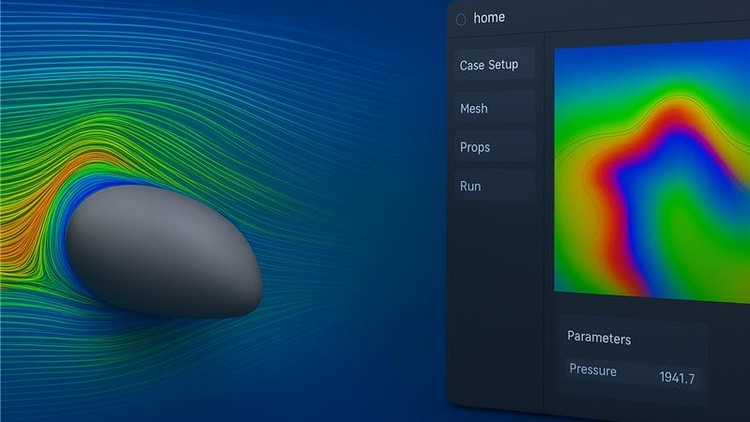
OpenFoam along with Python and use of Artificial Intelligence
What you will learn
Note➛ Make sure your 𝐔𝐝𝐞𝐦𝐲 cart has only this course you're going to enroll it now, Remove all other courses from the 𝐔𝐝𝐞𝐦𝐲 cart before Enrolling!
Very Basics of the CFD and the Open Foam Software
Real Examples of the use of Open Foam for CFD
Different Types of CFD Software and there use
Types of fields where CFD can be used
Add-On Information:
- OpenFoam Architecture Mastery: Understand OpenFoam’s directory structure, utilities, and solver framework to effectively navigate, comprehend, and customize this powerful open-source platform.
- Advanced Meshing Techniques: Master complex mesh generation using blockMesh and snappyHexMesh for creating high-quality computational grids across diverse, intricate geometries.
- Solver Customization & Development: Acquire skills to modify existing OpenFoam solvers or develop new ones, tailoring them for specific physical phenomena and unique research objectives.
- Python for Workflow Automation: Integrate Python scripting to streamline OpenFoam workflows, automate case setup, extract data, and generate insightful, publication-quality visualizations.
- Numerical Methods Fundamentals: Comprehend underlying numerical schemes, discretization methods, and stability criteria crucial for accurate, robust, and convergent OpenFoam simulations.
- Turbulence Modeling Deep Dive: Apply various turbulence models (RANS, LES, DNS concepts) within OpenFoam, critically assessing their strengths, limitations, and appropriate selection.
- High-Performance Computing (HPC): Optimize OpenFoam simulations for parallel processing on multi-core systems and clusters, mastering domain decomposition for large-scale CFD problems.
- AI-Driven CFD Introduction: Discover Artificial Intelligence’s role in enhancing CFD, including surrogate modeling, data-driven reduced-order models, and machine learning for accelerating simulations.
- Multi-Physics & Multi-Phase Flows: Tackle advanced scenarios like conjugate heat transfer, compressible flows, or fundamental multi-phase interactions, significantly expanding your OpenFoam capabilities.
- Validation, Verification & UQ: Develop a rigorous approach to assessing CFD result credibility, understanding best practices for validation, grid convergence, and quantifying simulation uncertainties.
- PROS:
- Marketable & Future-Proof: Acquire high-demand skills blending OpenFoam, advanced CFD, Python automation, and AI, positioning you at the forefront of computational engineering.
- Open-Source Power: Master OpenFoam, a powerful, free-to-use platform offering immense customization and eliminating licensing costs.
- CONS:
- Demanding Challenge: OpenFoam’s command-line interface and the inherent complexity of advanced CFD present a significant, though rewarding, learning curve.
English
language