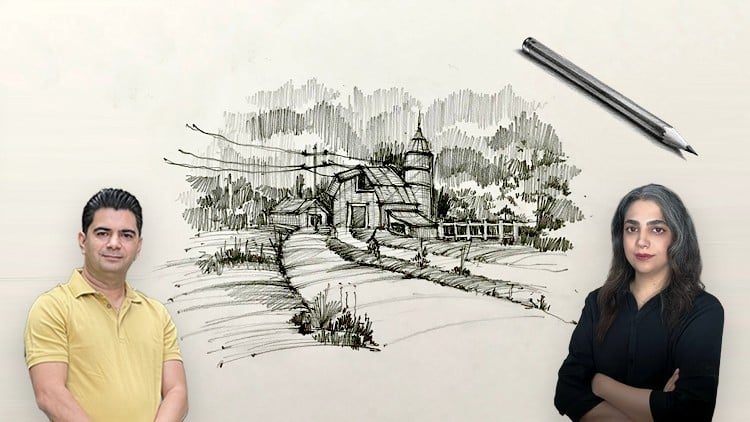
Get sketch lines, shading, hatching, and perspectives.Perfect for architecture, urban design and graphic design students
What you will learn
Note➛ Make sure your 𝐔𝐝𝐞𝐦𝐲 cart has only this course you're going to enroll it now, Remove all other courses from the 𝐔𝐝𝐞𝐦𝐲 cart before Enrolling!
Master the fundamentals of architectural sketching – understand the role of sketching in design and how to use it as a powerful visualization tool.
Draw confident sketch lines and croquis lines – learn the differences, applications, and techniques to improve line quality.
Improve hand sketching control through structured exercises with curves, parallels, and freehand drawing practices.
Apply shading and hatching techniques to represent light, shadow, textures, and depth in architectural drawings.
Build confidence as a designer by transforming from a simple observer into a creative professional who can communicate ideas clearly on paper.
Add-On Information:
- Master fundamental perspective: Grasp one-point and two-point perspective essentials to accurately depict architectural spaces, establishing vanishing points for compelling, realistic depth in your drawings.
- Sharpen your architectural observation: Train your eye to effectively perceive and interpret forms, textures, and spatial relationships, translating the 3D built environment onto paper with enhanced insight.
- Navigate essential sketching tools: Understand various pencils, pens, and papers, learning how different mediums create distinct line weights and effects to effectively express your design intentions.
- Create impactful compositions: Discover principles like the rule of thirds and focal points to arrange elements, crafting visually balanced and clear architectural sketches that guide the viewer’s eye.
- Integrate contextual elements: Learn simplified techniques to incorporate figures, trees, and vehicles, adding essential scale and life to your architectural sketches without overshadowing the main subject.
- Develop rapid ideation skills: Utilize freehand drawing for quick brainstorming and exploring multiple design concepts, fostering creativity and efficient iteration in your design process.
- Translate 3D forms to 2D: Understand the geometry of structures to represent architectural volumes and planes on a flat page, producing coherent and visually robust designs from concept to execution.
- Introduce basic material rendering: Go beyond simple shading to suggest various materials like brick, glass, or wood through texture and tonal variation, adding realism and informative detail to your work.
Pros of this course:
- Accessible entry into architectural visualization: Perfect for beginners, providing core sketching skills without requiring prior art experience.
- Enhances critical observation: Trains your eye to truly see and analyze the built environment, fostering a deeper connection to design.
- Powerful, low-tech communication: Quickly convey complex design ideas with just a pencil and paper, making you an agile and effective communicator.
- Boosts creative confidence: Empowers you to visualize and iterate on design challenges with greater assurance and a tangible output.
Cons of this course:
- Requires consistent practice: Developing proficiency demands dedicated effort and perseverance; mastery isn’t instantaneous but builds progressively over time.
English
language